Nearly six months after it was signed, the India-New Zealand Free Trade Agreement finally has a start date. Commerce and Industry Minister Piyush Goyal confirmed on Monday that the pact will come into force on October 20, 2026, timed to fall on Vijay Dashami, the day Dussehra is celebrated this year.
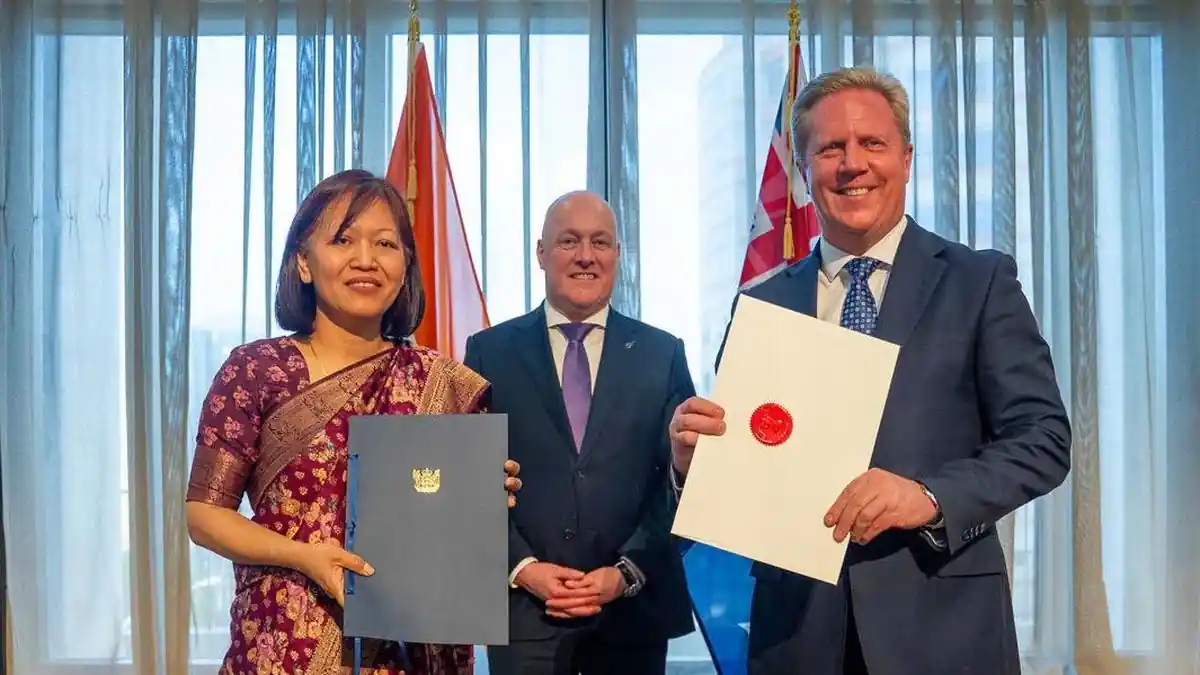
It's the kind of announcement that's been a while coming. The two countries signed the FTA back in April, but it needed New Zealand's parliament to ratify it before anything could actually take effect. That happened on September 17, when lawmakers in Wellington passed the implementing legislation by a comfortable 93-29 margin.
The headline number is simple enough. Every Indian export to New Zealand, all of it, gets duty-free access from day one. Goyal called it a deal that provides duty-free access for 100 percent of Indian exports, and that's more or less exactly what New Zealand's own trade ministry is saying too.
Going the other way is a bit more layered. India will eliminate or reduce tariffs on around 95 percent of imports from New Zealand by value, though only about 70 percent of actual tariff lines are covered. The remaining lines, roughly 30 percent, stay protected. Dairy is the clearest example. Most New Zealand dairy products will still face tariffs in India, with only re-exports and bulk infant formula getting duty-free treatment. It's a sector India has guarded closely in every trade deal it's negotiated in recent years, and this one is no exception.
Apples, kiwifruit and Manuka honey are treated a little differently again. They fall under tariff rate quotas rather than outright tariff elimination, meaning a certain volume can come in duty-free before regular tariffs kick back in. Wool, meat, coal and forestry products, on the other hand, get a cleaner path to becoming cheaper in the Indian market.
Alongside the tariff cuts sits a bigger promise: $20 billion in New Zealand investment into India over the next 15 years, expected to flow into areas like agriculture, food processing and infrastructure. Goyal described it as a way of bringing New Zealand's technology together with India's scale, and there's an Agriculture Productivity Partnership built into the agreement specifically for that purpose.
Trade between the two countries is still fairly modest in absolute terms. Total bilateral trade in goods and services came to about $2.4 billion in 2024, with merchandise trade alone closer to $1.3 billion. New Zealand puts the combined figure at NZ$3.95 billion. Both governments are talking about doubling that to $5 billion within five years, which is an ambitious jump for a trade relationship this size, though not an impossible one given how low the current base is.
For Indian exporters, the practical upside is fairly direct. Textiles, leather, footwear, gems, processed foods and engineering goods are the sectors expected to benefit most from tariff-free entry into New Zealand. Industrial clusters like Gurgaon-Manesar, home to a large chunk of India's auto and engineering manufacturing, are already being flagged as likely beneficiaries, though industry voices have pointed out that actual order flow will still depend on freight costs and New Zealand's product standards, not tariffs alone.
On the consumer side in India, the FTA also opens up cheaper wool and, eventually, cheaper kiwifruit, once the tariff rate quotas are factored in. New Zealand shoppers, meanwhile, get access to Indian pharmaceuticals, machinery, textiles and precious stones and metals at lower cost, goods that already make up a good share of what India currently exports there.
Beyond goods, the agreement also builds in around 5,000 visas and broader pathways for Indian professionals, students and businesses looking to work or study in New Zealand, along with talk of direct flights between the two countries within the next year. There's also a chapter, unusual for a trade agreement, dedicated to AYUSH, traditional knowledge, audio-visual industries, sports and tourism, meant to give the cultural relationship a formal place alongside the commercial one.
None of this is happening in a vacuum. India and New Zealand have had diplomatic relations since 1952, and the connection goes back further still, to Indian soldiers who fought alongside ANZAC forces at Gallipoli in 1915. New Zealand is currently home to around 300,000 people of Indian origin, close to 5 percent of the country's population, which both sides have pointed to as part of why this agreement moved as quickly as it did once negotiations started in March 2025.
New Zealand Trade Minister Todd McClay has called it one of the highest-quality FTAs his country has signed, and Prime Minister Christopher Luxon has framed it as a route to New Zealand jobs and incomes through access to a market of 1.4 billion consumers. From India's side, the message has stayed consistent throughout: full market access for Indian exporters, protection for domestic farmers, and dairy left untouched.
- India-New Zealand FTA comes into force October 20, 2026, coinciding with Vijay Dashami
- New Zealand's parliament ratified the deal on September 17 with a 93-29 vote
- 100 percent of Indian exports get duty-free access to New Zealand from day one
- India will cut tariffs on about 95 percent of New Zealand imports by value, dairy stays protected
- Apples, kiwifruit and Manuka honey get tariff rate quotas rather than full duty elimination
- The deal includes a pledge of $20 billion in New Zealand investment into India over 15 years
- Both countries are targeting a doubling of bilateral trade to $5 billion within five years
- Around 5,000 visas and expanded study, work and mobility pathways are part of the agreement
- Textiles, leather, footwear, gems, processed foods and engineering are seen as key beneficiary sectors for Indian exporters