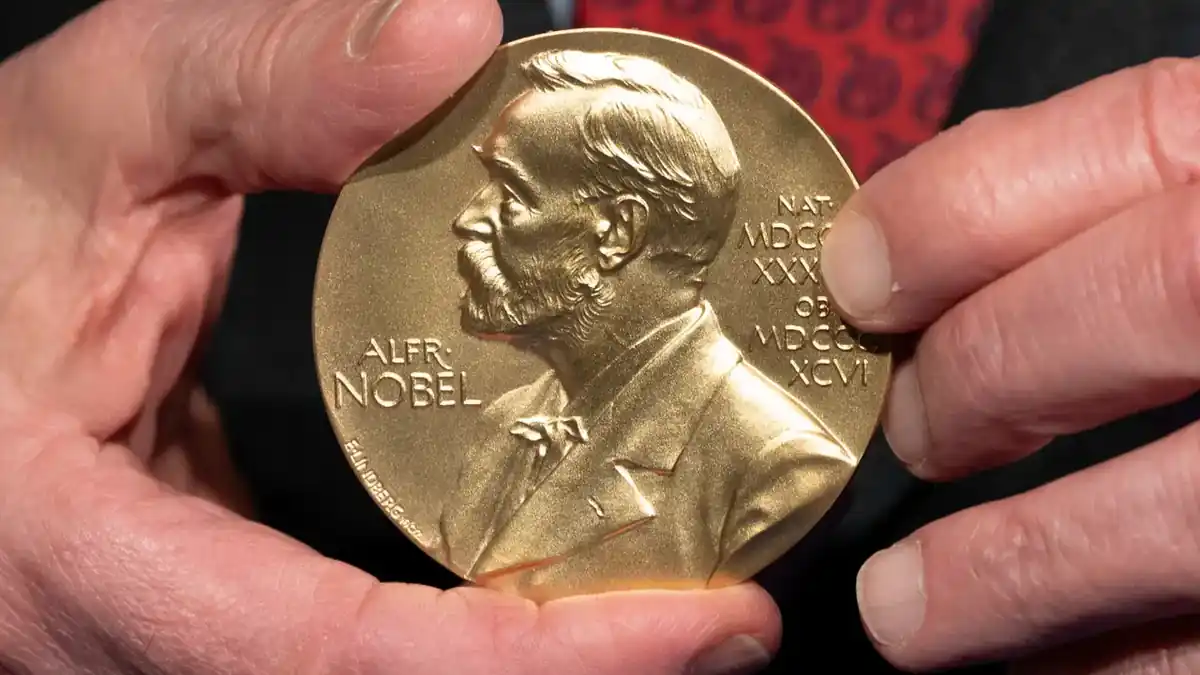
The 2026 Nobel Prize in Chemistry is given to the French chemist Henri B. Kagan and Japanese chemist Kenso Soai, who discovered how chemical reactions can be directed to favor one mirror image of a molecule.
The prize was awarded by the Royal Swedish Academy of Sciences on Wednesday, October 7, 2026, "for the discovery of non-linear effects and autocatalysis in asymmetric organic synthesis." Kagan, aged 95, is from Université Paris-Sud in Orsay, France. Soai is 76 years old and is from the Tokyo University of Science.
Chirality, in which two molecules are identical but mirror images of each other, similar to the difference between a left hand and a right hand, lies at the core of the Nobel Prize-winning discovery.
However, whereas conventional laboratory reactions produce equal proportions of the two mirror molecules, nature produces mainly one of them, a feature called homochirality. For over a century, scientists had no explanation for why nature always ended up with only one type of molecule, not the other.
"Henri Kagan and Kenso Soai have solved a chemical riddle of more than a century's standing – how homochirality can occur spontaneously. The chemical reactions discovered by them are truly amazing," Heiner Linke, chairman of the Nobel Committee for Chemistry, said.
Kagan’s contribution was concerned with what are called "non-linear effects" in the realm of asymmetric synthesis. This research demonstrated that even slight asymmetry, which can occur when two mirror images of a molecule are introduced to a chemical reaction, can be greatly exaggerated.
The concept of non-linear effects was thus born as a chemistry discipline in itself, serving not only as a way to study the mechanics of reactions but also as a hint at how the asymmetry of molecules could arise during the first chemistry of life.
Soai then went one step further and proved the theory experimentally in a way that had not been done before. He performed the now famous Soai reaction in 1995, where he used dialkylzinc alkylation of pyrimidyl aldehydes.
In this reaction, Soai proved that the products of the reaction could act as catalysts for the production of the other similar structure of the product. In 2003, Soai performed an improved version of the reaction, which resulted in the production of almost only one type of the two possible mirror image structures—something that had been observed before only in biological systems and not in a test tube.
Since then, Soai has demonstrated the reaction to be stimulated and controlled by the slightest chiral forces, including circularly polarized light, chiral inorganic material such as quartz, and even isotopically chiral initiators - something which shows that very little force is necessary to control the reaction.
These discoveries were vividly portrayed by the members of the Nobel Committee. "The Soai reaction is probably the coolest experiment in organic chemistry," said Peter Somfai, one of the committee members.
"In combination, the groundbreaking discoveries of Professor Henri Kagan and Kenso Soai have transformed our understanding of molecular chirality: its creation, amplification and transmission," Somfai said. Even more boldly, the committee hailed the feat as having been done by nobody else before but life itself."
The practical significance of this discovery is immense. There are many drugs that require just one version of molecules in order to function properly, whereas the other version might not work at all or might even be dangerous.
The work done by Kagan and Soai in relation to achieving control over the direction of reactions involving only one version of molecules has become the basis for developing reactions required for the synthesis of drugs, as well as flavors and fragrances.
Soai found out about the award while on his errands. "It's the most exciting day of my life; I am very happy to be sharing this award with professor Henri Kagan," said Soai during the Nobel Prize press conference over the telephone after the good news came to him when he was shopping.
For Kagan especially, Wednesday's accolade brings the long-standing tale to a close in the chemistry world. In 2001, the Nobel Prize in Chemistry was conferred upon William Knowles, Ryoji Noyori, and K. Barry Sharpless for their achievements concerning the research on chirally catalyzed reactions—this being an achievement that aroused controversy in the chemistry world, where it was believed that Kagan, who is one of the forefathers of asymmetric catalysis, deserved the accolade too.
Kagan was already well-decorated within the chemistry world, having won the Wolf Prize in Chemistry in 2001 and the first Ryoji Noyori Prize in 2002. Soai has since won the same Ryoji Noyori Prize.
While the award on Wednesday solves the problem of how a minor difference in chirality may lead to a major one, it fails to solve a more fundamental issue that has plagued the mystery for some time now: where did the very first minor asymmetry, on which this amplification could have worked, come from?
This is still a matter of debate among scientists. The contribution of Kagan and Soai, according to reports after the announcement, was transforming the issue from being essentially philosophical to experimental, which is, scientists say, the stage when chemistry makes true progress.
Both Kagan and Soai will receive an equal share of the monetary prize, which amounts to 12 million Swedish kronor.
In accordance with tradition, the prize in chemistry is usually the third Nobel Prize announced, after the prizes for medicine on Monday and physics on Tuesday.
The announcements for other Nobels will carry on during the rest of the week, including those for the literature and peace awards before concluding with the Economics Nobel next Monday.
It is expected that Kagan and Soai will officially accept their award during the ceremony in Stockholm on December 10.