India and Canada are rapidly advancing discussions on a free trade agreement in 2026. Indian Commerce Minister Piyush Goyal is currently in Canada and holding talks with the Canadian government regarding the deal.
In the coming months, positive developments are expected regarding the India–Canada free trade agreement.
Canadian Prime Minister Mark Carney said in a statement that discussions on a free trade agreement with India are ongoing.
He also believes that if this deal is finalized, it would open a major market for Canada and prove beneficial for businesses.
Canadian Prime Minister Mark Carney wrote on X...
“We’re negotiating a free trade deal with India. This will be a game changer for Canadian workers and businesses—unlocking a massive new market.
We’re working fast—I met Minister
Piyush Goyal
to review our progress so far and explore the opportunities ahead for both our countries in energy, agri-food, tech, and education.
”
India’s Commerce and Industry Minister Piyush Goyal is on a three-day visit to Canada.
India and Canada are planning to finalize the trade deal by 2026 and have set a target to triple their business by 2030.
India’s Commerce and Industry Minister Piyush Goyal said that this deal will be a “game-changer.”
Both countries aim to triple bilateral trade to $50 billion by 2030.
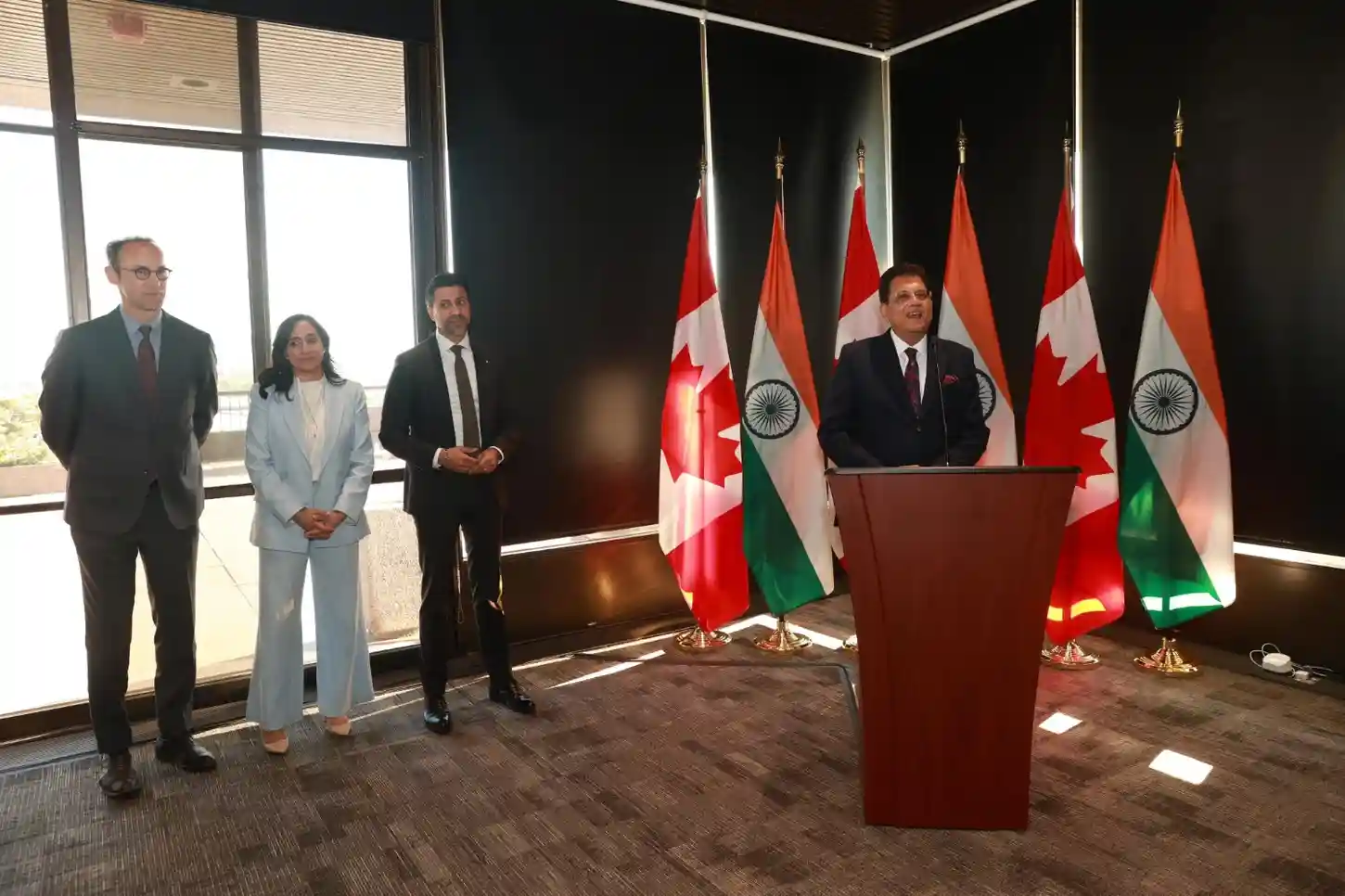
Photo: @PiyushGoyal
Improvement in diplomatic relations:
Before the arrival of Canada’s new prime minister, Mark Carney, India–Canada diplomatic relations were not very positive. However, after his government came to power, discussions with India gained momentum, and talks became more active.
In 2023, during the tenure of former Prime Minister Justin Trudeau, diplomatic talks with India had come to a pause.
After Canadian Prime Minister Mark Carney came to power, he held meetings with Indian Prime Minister Narendra Modi, and by late 2025, talks between the two countries resumed once again.
Trade agreement discussions between India and Canada began in 2010. Between 2010 and 2017, several meetings were held between the two countries, but no final decision or agreement was reached.
Then in 2022, discussions between India and Canada resumed once again. During this period, work progressed rapidly on an interim agreement called the Early Progress Trade Agreement (EPTA).
However, in 2023, during the tenure of former Canadian Prime Minister Justin Trudeau, a diplomatic dispute led to a complete pause in the trade deal talks in July 2023.
After the government of Justin Trudeau ended in Canada, and after new Prime Minister Mark Carney took office, relations with India began to improve.
Following this, in November 2025, Indian Prime Minister Narendra Modi and Prime Minister Mark Carney agreed to restart and move forward discussions on the free trade agreement once again.
India and Canada are working on cooperation in six key sectors:
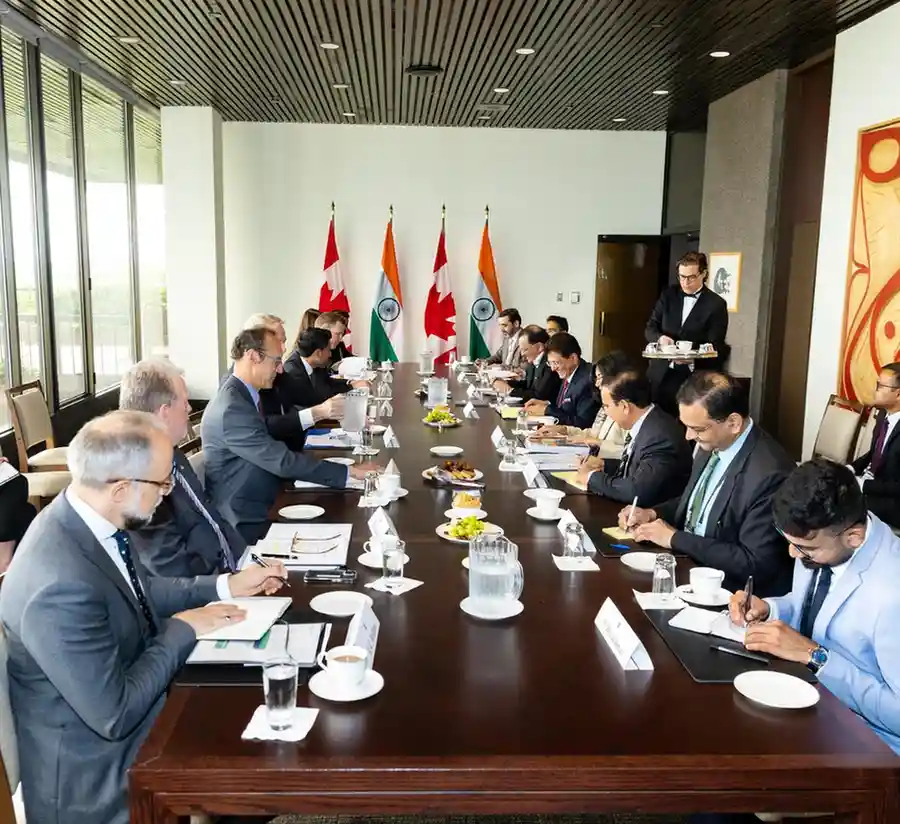
Photo: @PiyushGoyal
Considering India’s nuclear energy requirements, discussions are underway regarding uranium imports from Canada, with talks being held between India and the Canadian government.
As the world moves toward electric vehicles (EVs), there is a growing need for critical minerals such as lithium and cobalt used in EV batteries.
In this context, discussions are also taking place between the Indian and Canadian governments on cooperation in securing and supplying these essential minerals.
In agriculture, India imports a large quantity of pulses such as lentils and peas from Canada.
In this context, both countries are working to simplify and streamline regulations to make trade easier between them.
In the food processing sector, many Canadian companies are already operating in India. Several firms from Canada are investing in India’s cold storage and supply chain infrastructure.
Discussions are also underway between the two countries to further strengthen cooperation and investment in this sector.
Some Canadian companies are investing in India’s food processing sector, especially in cold storage and supply chain infrastructure.
McCain Foods, Brookfield Asset Management, CPPIB, and CDPQ,
In terms of total investment, Canada is investing over CAD $100 billion (approximately ₹6 lakh crore) in India.
This investment by Canadian companies is expected to take place in India, and its confirmation was reportedly made by Prime Minister Narendra Modi in 2026.
Both countries are working on new rules to promote the IT sector and the digital economy. India is globally known for its IT services industry.
Once new regulations are implemented, it will be important to see what impact they have on the IT sector. However, these changes are not expected to be seen in the next one or two years, and it may take up to five years for their full effects to become visible.
Today, AI is expanding rapidly across the world. In this context, discussions are also taking place between India and Canada to collaborate by combining Canada’s advanced AI infrastructure with India’s strong tech talent to work on new projects.
India exports large quantities of affordable and high-quality medicines to Canada.
Under this agreement, Indian pharmaceutical companies may get easier market access in Canada, allowing them to expand their presence more smoothly.
The governments of India and Canada are working on this matter together.
More than 4.25 lakh Indian students are studying in Canada.
Both countries are discussing making visa rules easier for students and also exploring the possibility of providing scholarships.
Indian engineers and IT professionals work across the world.
In this context, Canada is working on simplifying rules for Indian IT professionals and engineers to make it easier for them to work in Canada.
As per current estimates, around 150,000 to 200,000 Indians are working in Canada.
This number is expected to grow further in the coming years.
Some Canadian companies are investing in India across multiple sectors, including highways, renewable energy (such as solar power), and logistics.
These investments are in the range of billions of dollars.
Work is underway to reduce duties (taxes) on exports from India, including iron, steel, auto parts, and textiles.