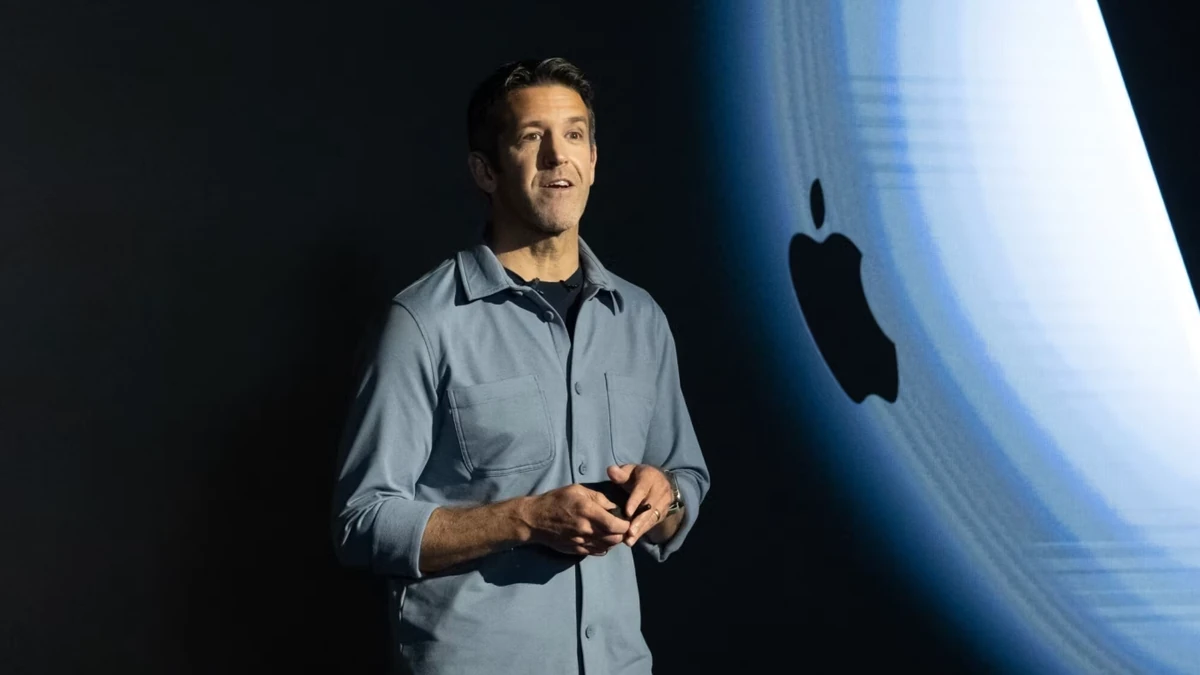
For the first time in fifteen years, someone other than Tim Cook will walk onto the Steve Jobs Theater stage as Apple's chief executive.
John Ternus, 50, took over as CEO on September 1, closing out a succession process the board approved unanimously and had been quietly running for months. He joined Apple's product design team in 2001, rose to senior vice president of hardware engineering in 2021, and had a hand in nearly everything the company has shipped since, including the Mac's recent sales resurgence, the iPhone Air, and the MacBook Neo. Cook, meanwhile, shifts to executive chairman, a role Apple says will focus on policymaker relations rather than product decisions. Under his fifteen years as CEO, Apple's market capitalization grew from roughly $350 billion to $4 trillion, and whatever Ternus unveils Wednesday will immediately be read as a signal of what kind of leader he intends to be.
It is, by most accounts, an inherited product line with unusually high stakes attached.
Apple has never shipped a folding phone. That changes, reportedly, on Wednesday.
Leaks point to a book-style device with an outer display around 5.5 inches and an inner screen closer to 7.6 or 7.8 inches when unfolded, roughly the footprint of a small tablet. Reports describe a titanium frame, a thinner-than-usual body, and a hinge engineers are said to have built specifically to survive years of daily folding rather than treating it as an afterthought. There are compromises too: a side-mounted Touch ID button in place of Face ID, and a dual-camera system that skips a dedicated telephoto lens entirely. The inner display is rumored to borrow iPad-style app layouts and can apparently double as a viewfinder.
Pricing rumors have settled somewhere between $1,999 and $2,500, positioning it well above even the Pro Max. That would make it Apple's first genuinely new iPhone form factor since the iPhone X in 2017, arriving conveniently close to the device's own 20th anniversary. Samsung already dominates the folding phone category and released its own passport-sized foldable earlier this year, so Apple is not so much creating a market as arriving late to one. Research firm IDC still expects Apple to ship more than 17 million foldable iPhones by 2027, part of a foldable segment growing 12.6 percent this year even as overall global smartphone shipments are projected to fall nearly 17 percent.
Next to the foldable, the iPhone 18 Pro and Pro Max look almost conservative, which may be the point.
Both are expected to run on Apple's new A20 Pro chip, built on a 2-nanometre process, alongside a smaller Dynamic Island and an upgraded LTPO+ display. The Pro Max reportedly gets a variable aperture camera, a feature Apple has again reserved for its largest model, plus a larger 5,567mAh battery. A new Dark Cherry finish is expected to replace last year's Cosmic Orange. Notably absent from Wednesday's stage, according to multiple reports, will be the standard iPhone 18, the iPhone Air 2, and a rumored budget iPhone 18e, all reportedly pushed to a separate launch in spring 2027, a departure from Apple's usual single-event rollout.
Apple Watch Series 12 and Apple Watch Ultra 4 are also expected to make appearances, alongside AirPods updates. A long-rumored pair of AirPods with a built-in camera, once thought to be imminent, now appears to have slipped to early 2027.
None of this arrives cheaply, and the reason has almost nothing to do with iPhones themselves.
A global shortage of memory and storage chips, driven largely by AI companies buying up DRAM and NAND capacity for data centers, has pushed component costs across the entire electronics industry. Cook told the Wall Street Journal in June that the situation had become "unsustainable" and that price increases were now unavoidable, adding he'd never seen anything comparable in more than 40 years in the industry. Apple already raised Mac mini pricing from $599 to $799 and quietly dropped its base 256GB configuration.
Estimates for the iPhone 18 Pro have swung wildly over the summer. TechInsights initially projected Apple would need roughly a $270 increase just to protect its margins, pushing the starting price near $1,371. TrendForce more recently narrowed that to a $1,249 to $1,299 range for the Pro and up to $1,399 for the Pro Max. JPMorgan's Max Weinbach, by contrast, argued Apple might hold increases to as little as $50, betting the company would rather absorb some of the hit than risk a consumer backlash. Analyst Tim Culpan has separately noted that roughly a billion dollars' worth of finished A20 Pro processors were reportedly sitting idle earlier this year, waiting on memory chips that hadn't arrived yet.
Whatever the final numbers turn out to be, Apple isn't alone. Research firm Omdia expects the average global smartphone selling price to climb around 20 percent this year, an industry-wide record most manufacturers are already passing on to buyers.
Pre-orders typically follow an Apple keynote within days; based on the company's usual cadence, that would put ordering around September 12 and devices in hand by September 19, with iOS 27 likely arriving the same week. By then, the only question left will be whether Ternus's first big bet, a fold nobody asked Apple to build, was worth the wait.
Apple holds its "Surprise and Shine" event on September 9 at 10 a.m. Pacific, unveiling the iPhone 18 Pro, iPhone 18 Pro Max and, if the rumor mill is right, the company's first foldable iPhone. It's also new CEO John Ternus's debut keynote after taking over from Tim Cook on September 1. Expect a book-style fold with a titanium frame, an A20 Pro chip across the Pro lineup, and prices that have crept upward for months thanks to a memory chip shortage even Tim Cook has called unlike anything he's seen in four decades at the company.