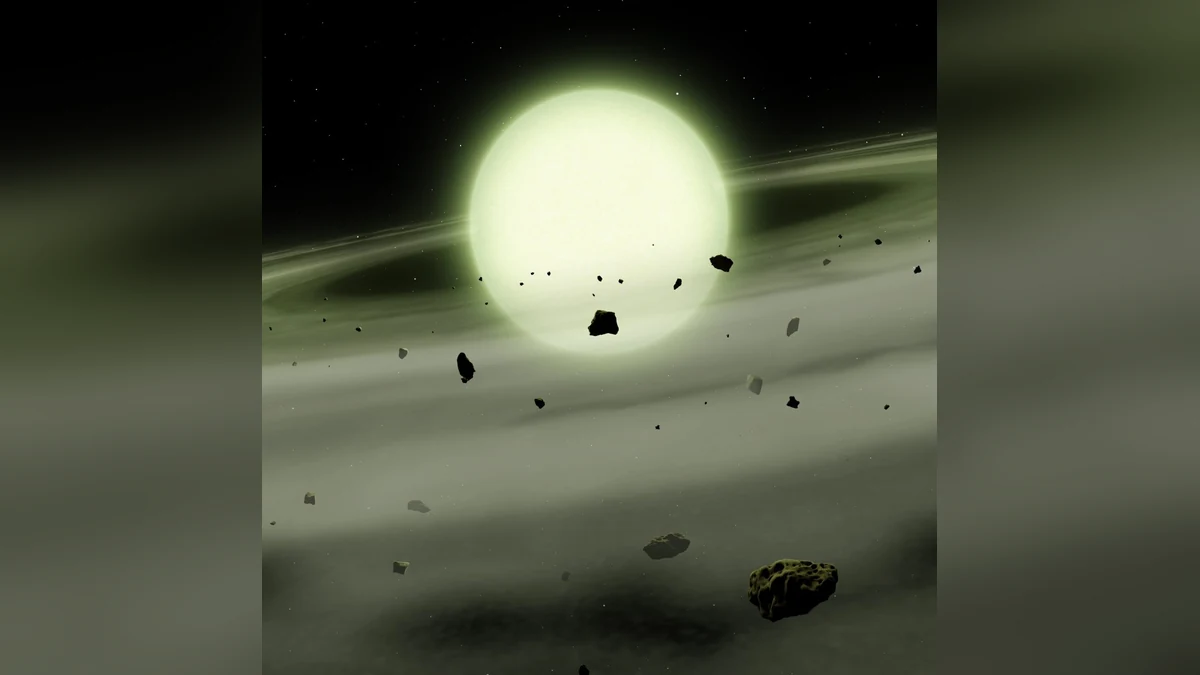
Green stars exist in comic books and video games. Real ones, as far as astronomers knew until this week, didn’t. That’s apparently changed.
The star at the center of this is WD J1330+6435, sitting roughly 280 light-years from Earth. It’s a white dwarf, which is what’s left after a star like our Sun runs out of fuel and blows off its outer layers, leaving behind a dense, slowly cooling core.
What caught researchers’ attention in the first place wasn’t the color. It was the chemistry. Bits of rocky material, debris from planets that used to orbit this star, had fallen onto its surface over time, enriching its outer layers with elements like calcium, lithium, and especially sodium. That’s not unusual on its own. Plenty of white dwarfs show signs of swallowed planetary debris. What’s unusual is what happened next.
Normally, sodium absorbs a very specific, narrow slice of orange light. It’s the same reaction behind the orange glow of old sodium streetlamps. If that were all that happened here, this star would look orange too, nothing special.
But white dwarfs are absurdly dense. WD J1330+6435 is roughly the size of Earth, but packs in about 165,000 times Earth’s mass. According to Warwick astrophysicist Boris Gänsicke, a co-author on the study, that density means even a tiny amount of sodium ends up blocking a huge portion of the star’s orange light output, far more than sodium normally would in a less extreme environment.
On top of that, lead researcher Mark Hollands explained that the atmosphere is so dense that sodium atoms are constantly getting bombarded by surrounding helium atoms, which actually shifts how those sodium atoms absorb light in the first place. Put it all together, and instead of a narrow orange absorption line, you get a much broader chunk of the yellow-orange-red spectrum getting swallowed up. What’s left over, the light that actually escapes, reads out as green.
WD J1330+6435 was the standout, but it wasn’t alone. The same research effort modeled how a range of white dwarfs would appear to human eyes based on their atmospheric chemistry, and found a surprising spread of colors well outside the usual white or blue-white most people associate with these stars.
Some turned up pink or salmon-toned, caused by carbon compounds twisting the star’s light so heavily that most of it gets pushed toward wavelengths beyond 600 nanometers. Others came out purple, yellow, or cyan, depending on exactly what elements had built up in their atmospheres. Two other white dwarfs, WD J0851+1543 and WD J1351+2645, turned up as paler green cousins of the main discovery, though with less certainty in the data behind them.
It’s easy to treat this as a fun, slightly trippy space fact, a dead star that happens to look green, and move on. But there’s real science underneath it. White dwarfs that have swallowed planetary debris are basically natural laboratories for studying worlds that no longer exist. The specific mix of elements in a white dwarf’s atmosphere can tell researchers what the rocky planets that once orbited it were actually made of, before they got pulled apart and consumed.
So a star’s weird color, in this case, is really just a visible signal of a much more detailed chemical story playing out in its atmosphere. The color is the headline. The composition behind it is the actual science.
The researchers say this work is really just a first pass. They modeled a relatively small sample of white dwarfs to get these results, and the next step is testing the approach against a much broader set of stars to see how common these unusual colors actually are once you look closely enough. For now, though, WD J1330+6435 holds a fairly unusual title: the first star anyone’s found, dead or alive, that would genuinely look green if you could see it up close.