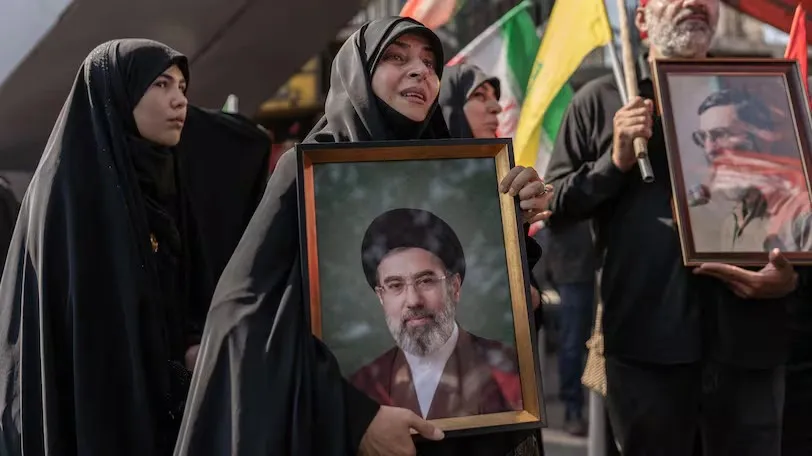
News stories have emerged in Israeli media suggesting that Iran’s Supreme Leader, Mojtaba Khamenei, is gravely ill and has perhaps already been hospitalized.
C14 has added weight to the rumor, reporting on sources from inside Iran, following a news story on the Jerusalem Post that referenced reports from IranWire and sources who reportedly work closely with President Masoud Pezeshkian’s government.
The rumors that are being reported describe Khamenei as being “gravely ill” and supposedly even spreading within the Iranian regime’s own top tiers and not just among observers of the situation.
One particular anonymous source quoted in the Jerusalem Post even went so far as to suggest that “martyrdom” of Khamenei wouldn’t be too much of a shock. It should be noted that none of the above has been confirmed, and the reports depend solely on anonymous reporting by Israeli- and Iran-specific media outlets, some of whom have a proven history of publishing unconfirmed intelligence stories about Iranian leadership during times of high tensions.
Mojtaba Khamenei, aged 56 years, was appointed the new Supreme Leader of Iran just few days after the demise of his father, Ayatollah Ali Khamenei who died from the joint military offensive by the United States and Israel on February 28, 2026.
Appointment of the new leader took place amid military confrontation and not according to the usual mode of appointment by the clerical leadership of Iran.
Since he assumed power, Mojtaba has been characterized by avoiding making any public statements and confines himself to issuing statements in written form.
It is indeed quite unusual for the Supreme Leader of Iran since the role of the Supreme Leadership requires him to make public statements, deliver sermons, and attend state ceremonies.
Even without considering the rumors of being hospitalized, the absence of a live figure for such a period of time becomes quite important.
It has been observed that the creation of the vacuum of leadership among the military and clerical leaders of Iran amid the ongoing war has serious implications for the security and relationship between Iran and the United States and Israel.
It must be noted that the specific details concerning the nature of the alleged injuries sustained by the body of Khamenei were vastly different based on the source of the report.
One of the sources says that in accordance with an interview with a witness in Tehran conducted by a British tabloid, the new Supreme Leader of Iran was reported to have been inflicted with serious injuries in his abdomen or liver, the loss of one of his legs, and is presently in a coma receiving intensive care.
However, another, more early diplomatic memorandum published by a British newspaper states that the Supreme Leader is in the holy city of Qom, which is 140 kilometers to the south of Tehran, where he is in critical condition, unable to participate in the decision-making processes in the country.
At any rate, all of the statements regarding the injuries sustained by the body of the Supreme Leader were constantly rejected by the officials of Iran, minimizing the nature of those injuries.
Besides media reporting, the comments by officials in Israel and America have further bolstered the speculation in absence of a concrete confirmation. According to an official of Israel, Khamenei is in “low condition to function,” a term that falls short of saying he has been hospitalized but supports the larger picture of incapacitation.
Saudi news channel al-Hadath reported in July that Khamenei “is not in Iran,” posing a different set of questions about his location and not about his health.
At around the same time, US President Donald Trump made claims on Fox News that the top leadership of the military of Iran had effectively been wiped out, and referred to Khamenei as “90% gone.”
Statements of these kinds from officials who are from the other side of the conflict will naturally be interested in depicting Iranian leadership in a weak position or chaos, something which should be kept in mind when judging the veracity of the claim against independently reported information.
However, no formal public rebuttal has been issued by the Iranian government concerning this claim in particular, although certain statements made by officials in the government have contributed to making this issue unclear rather than clear.
For instance, President Masoud Pezeshkian was quoted in a state television interview as stating that "direct communication with [the Supreme Leader] has become very difficult."
In return, this has been seen by the media in the area as a sort of tacit admission that some extraordinary things are happening when it comes to the availability of Khamenei despite the fact that there is no indication whatsoever of there being any medical issues on Khamenei’s end. Before now, whenever the issue of the injuries sustained by Khamenei during the February riots was mentioned by the officials in Iran, they always played down its significance but never denied the fact of the matter.
It is not the first time the allegations regarding the state of Khamenei’s health have been made.
A claim that Khamenei was lying in a coma having suffered serious injuries had already appeared in spring 2026, allegedly contained in a diplomatic memo and revealed by a British newspaper.
Recurrence of these kinds of rumors, in slightly modified versions, during the last months indicates that we face the situation where the information landscape is largely determined by anonymous sources, conflicting stories of intelligence agencies, and the interests of the conflicting parties.
On the one hand, Iran’s strict information regime concerning the leaders of the country and total disappearance of Khamenei from the public eye create the gap that Israeli, American, and other regional media are trying to fill with some sourced but unverifiable information. In such an important context of the issue—regional stability and the course of an actual military conflict—repeated appearance of similar but contradictory stories should be considered as evidence of lack of confirmation.