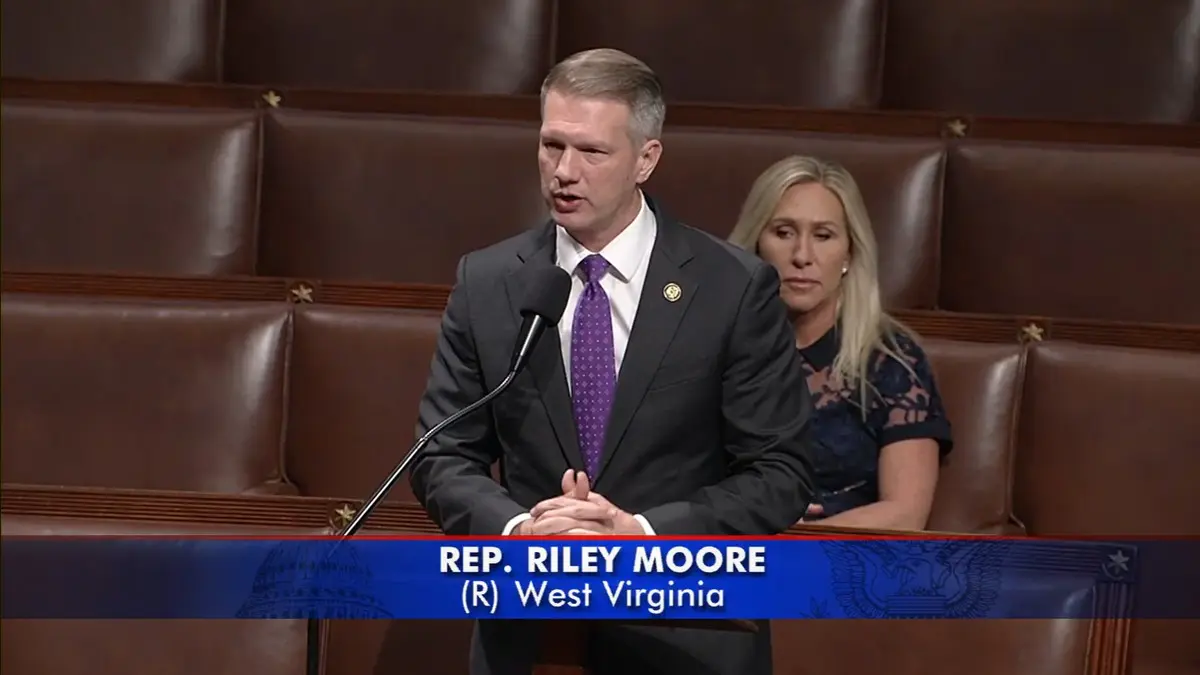
The Foreign Contribution (Regulation) Amendment Bill proposed for adoption in India has been heavily criticized by US Congressman Riley Moore, a Republican from West Virginia, and referred to by him as a blatant attack on the Christian community. In his post on social media site X, Riley Moore has pointed out that if the bill continues to progress in its present form, then it would certainly become a serious cause of concern in the relationship between the two countries.
His comments follow the current debates being held by the Parliament of India on the Foreign Contribution (Regulation) Amendment Bill, 2026, at the ongoing Monsoon Session.
This particular involvement of Riley Moore is significant in that it turns what could have been considered to be a normal case of legislation within India into a foreign policy issue.
The congressman’s comment makes it clear that legislators from the Capitol are ready to express their opinion on the internal affairs of India, especially when those affect religious minorities and their organizations.
In this regard, the core issue of concern in this debate is the content of the amendment proposal. According to Moore, the proposed amendments will enable the government of India to take over the control of churches and religious organizations once their FCRA registrations have been canceled, surrendered or allowed to expire.
The more general bill known as the Foreign Contribution (Regulation) Amendment Bill, 2026 is stated as an attempt to ensure that the foreign contributions made to the non-governmental organizations cannot in any way harm the country’s interests.
As part of the various provisions that are contained in this bill, the government is said to have powers to take over the properties belonging to organizations which have not complied with the registration requirements for the purposes of FCRA.
This, among others, is one provision that supporters of the bill are expected to cite as an important step towards ensuring better supervision of foreign funding to CSOs.
In his speech on FCRA, however, Moore did not base his arguments only on regulatory or even legal aspects of the issue; he put his comments into a longer historical context.More specifically, Moore has cited the example that Christians have been present in the area ever since St. Thomas, the Apostle, had arrived at the Malabar coast some decades after the resurrection of Jesus Christ.
This citation from history has been made to show that the Christians in India are not recent additions to the land but, instead, are one of the oldest ethnic minorities in India. According to him, the proposed amendments to the law would allow for the possibility of nationalization of churches and charities in what he called a direct assault against Christians.
Moore’s speech reflects once again the recurring issue of religious minorities in India which has been frequently addressed by US representatives over the last decade.
The comments made by Moore represent a larger, recurring theme of American focus on religious freedom situation in India.
American organizations like the Commission on International Religious Freedom have conducted hearings in the past regarding discriminatory policies against religious minorities, citing reasons from anti-conversion laws to restrictions on foreign aid to civil society organizations.
Past recommendations of the organization have included designation of India as a country of particular concern because of its systematic violation of religious freedom; these claims have always been denied by Indian officials as being politically motivated and lacking information on the ground realities of the Indian society.
Indian officials have previously disregarded such claims by international organizations as having political motivations without proper understanding of the country's multi-faith society.
The past history of discussions makes it clear that the comments made by Moore will not be considered as an isolated instance but as a part of a continuing discussion between the transatlantic world regarding minority rights.
The Indian government has already made an attempt to preempt or respond to the criticism that the bill has faced before this present crisis arose.
Speaking during his tour of Kerala, Union Minister Kiren Rijiju assured that all the misunderstandings arising from the FCRA Amendment Bill would be sorted out, adding that those who violate the laws would face stern punishment and that no organisation working for the good of the nation would be harassed.
He assured that the concerns raised by the Christian missionaries would be considered but also accused the opposition parties of creating misconceptions about the bill for political reasons.
In this way, the Indian government appears to be using a two-pronged approach in their messaging.
On the one hand, they are trying to reassure the religious community that the intent behind the bill is not discriminatory, whereas on the other, they are attempting to justify the need for stricter rules regarding foreign money.