Orbiters have mapped its valleys. Rovers have crawled across its deserts. Landers have bored into its dirt. Yet despite all that investigation, scientists still confront one frustrating limitation: every experiment has had to be performed millions of kilometers distant, using devices that are necessarily small, lightweight, and engineered to endure space.
Its impending Tianwen-3 mission isn't simply another excursion to the Red Planet. It is an attempt to achieve something humanity has never accomplished before collect Martian rocks and dirt, launch them off the planet, and bring them safely back to Earth for study. If all continues on track, the mission could launch in 2028 and return samples by 2031, potentially beating every other nation to one of the most sought-after prizes in contemporary space exploration.
That alone would make history. But the details make the task even more compelling.
Unlike a traditional Mars rover, Tianwen-3 is constructed around one objective: bringing parts of Mars home. Chinese engineers intend to drill as deep as two meters beneath the Martian surface , where rocks and soil have been sheltered from harsh cosmic radiation and powerful ultraviolet light for millions possibly billions of years. Scientists believe these subsurface layers are significantly more likely to maintain ancient chemical traces than the open surface.
The project seeks to return at least 500 grams of Martian material, a surprisingly significant amount by planetary scientific standards. Those samples would contain soil, rocks, and perhaps volatile substances that could indicate how Mars developed from a planet with flowing water into the freezing desert we observe today.
Mars' surface has spent billions of years being bombarded by radiation, progressively degrading fragile chemical compounds that could hint at ancient microbial life. Digging two meters below the surface substantially enhances the possibilities of finding items that have been largely undisturbed by those damaging conditions.
In other words, scientists are not merely hunting for intriguing rocks—they are searching for a better-preserved record of Mars' distant history.
Unlike the Moon, Mars has a far stronger gravitational pull and a thin yet problematic atmosphere. Tianwen-3 must land safely, drill into the ground, collect samples, seal them against contamination, launch them back into Martian orbit aboard a small ascent vehicle, dock with an orbiting spacecraft, and then survive the lengthy journey back to Earth.
Every one of those steps has to operate precisely.
A single failure anywhere in the chain might end the mission.
China's strategy involves launching two Long March 5 rockets. One spacecraft will carry the lander and ascent vehicle to Mars, while another will function as the orbiter and Earth-return spacecraft. After gathering the samples, the ascent vehicle will blast off from the Martian surface, rendezvous with the waiting orbiter, transfer its valuable cargo, and begin the return voyage to Earth.
It sounds nearly routine when described in a few sentences.
In actuality, no nation has ever completed this sequence on Mars.
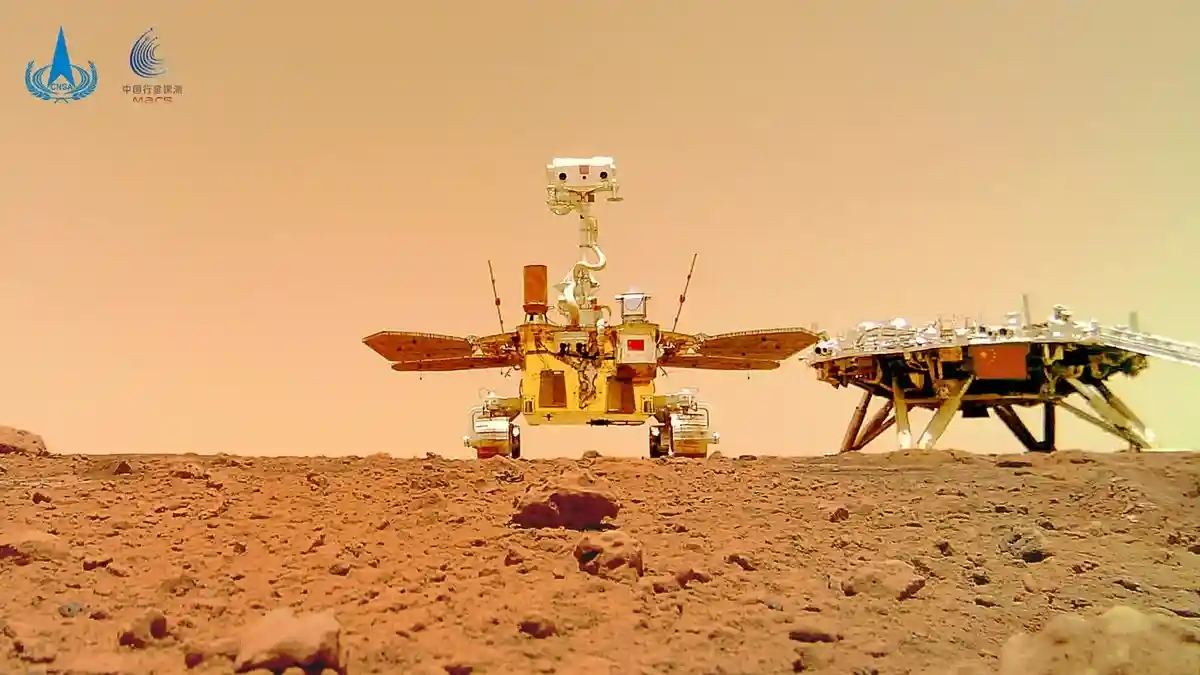
The mission also adds on China's steadily developing experience in deep-space exploration. In 2021, the Tianwen-1 mission successfully placed an orbiter orbiting Mars while delivering the Zhurong rover onto the surface a milestone that made China only the second country to successfully operate a rover on Mars after the United States. Earlier lunar missions also proven China's capacity to acquire samples from another globe and return them safely to Earth.
Tianwen-3 is the logical next step—but on a far more difficult planet
NASA and the European Space Agency have spent years creating their own Mars Sample Return program around the Perseverance rover's carefully picked rock cores. But that project has encountered technological complexity, increased prices, and recurrent schedule adjustments. As a result, China's simplified mission design now appears capable of delivering Martian samples years earlier provided it continues on track.
That prospect has changed Tianwen-3 from an ambitious research mission into something considerably broader.
It has become part of a bigger contest for leadership in planetary exploration. Still, this isn't merely about national prestige.
The true winners, if the expedition succeeds, would be scientists around the world.
Laboratories on Earth include devices that are simply too huge, too sensitive, and too power-hungry to launch into space. Electron microscopes, powerful isotope analyzers, synchrotron facilities, and high-resolution chemical laboratories might explore Martian material in ways no rover ever could. Researchers would be able to repeat tests, test rival theories, and continue studying the same samples for decades as analytical technology advance.
Some of the Apollo Moon rocks recovered in the 1960s are still yielding fresh discoveries today because current technologies can detect subtleties inconceivable when those samples originally arrived.
The same could someday happen with Martian rocks.
Scientists are particularly interested in knowing whether Mars formerly housed circumstances appropriate for microbial life. Even if Tianwen-3 doesn't detect clear evidence of ancient creatures, the chemistry trapped inside its samples could show how water, minerals, volcanic activity, and the planet's atmosphere interacted billions of years ago.
Those answers might change our knowledge of how rocky planets evolve—including Earth.
For now, Tianwen-3 remains a mission on paper, with launch preparations progressing until the targeted 2028 window.
But if everything develops as planned, the first carefully collected chunks of Mars might land on Earth in 2031. That moment would represent more than another successful space trip.
It would give us something we've never had before: the possibility to hold another planet in our hands and study it with the full strength of Earth's laboratories.
And that might be the beginning of an altogether new chapter in our search for life beyond our own earth.