A period of 10 days is quite an extended period to survive under the ground. In Nepal, Saturday was the day when one group of rescuers demonstrated that survival for such a period of time is still possible.
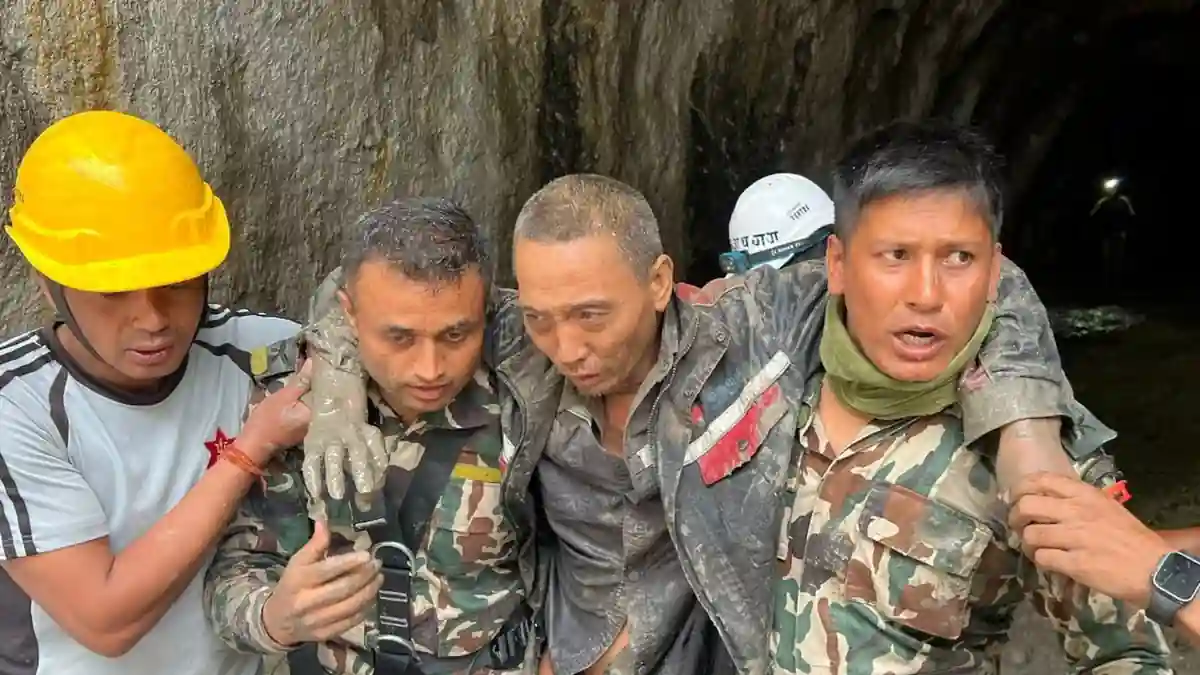
According to the report issued by the Nepal Army, there is one Chinese national who has been saved from the hydropower tunnel in Nepal after ten days of the deadly floods. The name of the person who was rescued alive from being stuck in the 225 meter long tunnel at Upper Trishuli-1 Hydropower project, Rasuwa district is Luhaitao.
The footage that came out from the Nepali Army was very telling, showing the effect that ten days underground had left him with.
The person can be seen on the video tape released by the Nepalese army since he is taken to the military hospital by helicopter with emergency medical aid being provided to him. He appears tired and confused, covered with mud and dust.
Luhaitao was not the only unexpected survivor extracted from the tunnels in such an incident during the week, because there was another case of miraculous survival just a day before this one at another location.
In the meantime, two other individuals were saved from a tunnel of the Trishuli 3A Hydropower Project. They were found to be Kabir Maharjan, 45 years old, who was the mechanical supervisor of this project, and Sanjay Sah, 30 years old, who was the foreman of this place. This information has been provided by the Public Relations Directorate of the Nepal Army.
According to CNN, the rescuers had to use satellite images to locate the tunnel, which had been covered completely by the mud.
The rescue efforts in tunnels were not the only efforts on that Saturday, as a lady was also rescued alive from the ruins of the collapsed building, the same day as Luhaitao.
A 64-year-old Nepali lady was rescued alive from her house, which was buried in thick layers of mud and rubble, and she was found on the top floor of a four-floor building. As reported by CNN, the rescue took place from that very building's top floor.
The process that led to the disaster has been better understood as more investigators and disaster management groups have analyzed the series of events that occurred.
According to the Health Emergency Operation Center of Nepal, the event is considered to be an ice and rock avalanche which formed a temporary natural dam on the Lhende Khola river close to the northern boundary. The failure of this natural barrier resulted in floodwaters rushing down the Bhote Koshi and Trishuli Rivers, inundating everything on their path, including the construction tunnels housing many workers.
While individual stories of rescue still give hope in the midst of all of this, the sheer scale of everything is still overwhelming, even two weeks on since the initial devastation was inflicted.
The deaths from the flash floods stand now above 1,350 individuals based on the CNN count of figures provided by Nepalese and Chinese governments, with an estimated 5,500 individuals missing from the devastation, as noted separately by The South China Morning Post.
However, the hydropower industry itself makes up an extraordinary amount of the damage. Figures of 147 individuals working on the Trishuli 3A project site who have been out of contact since the floods occurred were reported by Nepal's state-owned energy company.
Beneath the rescue figures lie the stories of families that have been waiting for more than a week for any news without coming to a conclusion.
Krishna Poudel put up a poster of his younger brother Ishwor, aged 26 years, who is a hydropower laborer, along with a few hundred other such posters eight days after the flood, and till now, he has not received any news about his brother.
In his own words, the description of his last conversation with his brother is given below: "When the floods struck on August 26, I called my brother on phone at 7:30 in the morning and he said..." His sentence goes in vain after that.
It looks like the international help Nepal had sought for last week is already starting to bear fruit with respect to the practical task of gaining access to these underground sites.
Specialists from India and China have been helping their Nepalese counterparts in carrying out the tunnel mission. A tunnel rescue team from India, which has been working alongside the Nepalese Army, created a temporary track within the Chilime tunnel in Rasuwa district, Nepal, which was hit by floods on Saturday.
In addition to tunnel rescue efforts, another silent but related operation has helped bring back Nepali citizens trapped on the Chinese side of the border.
In these rescue operations, it is reported by one senior official from the region that as many as 269 Nepali nationals stranded in China were successfully repatriated in just two days. Among those who were rescued were pilgrims, businessmen, and other travelers who had come to China prior to the disaster.
Victims include the people who have died and the trapped miners. In addition to the victims of the incident, there is also a campaign going on to support the displaced persons.
The number of people living in Nepal requiring assistance because of the disasters according to a report by the UN World Food Program is 43,000 or 10,000 families respectively. These people have become displaced because of the disasters and have lost their means of livelihood along with their basic necessities being deprived from them.
A period of ten days without food, water, or even oxygen far exceeds anything considered possible by any survival manual – which is exactly why the rescues of both Luhaitao and Friday's rescue of both Maharjan and Sah are seen as truly exceptional rather than as mere updates from an unfolding rescue effort.
Where search crews have to use satellite images just to find entry points into mud-blocked tunnels, these instances of survival give a concrete reason to continue at places where there are still hundreds of missing workers despite increasingly slim chances of finding more survivors.
With several large-scale rescue efforts ongoing at different tunnels at hydropower projects, where many workers are feared trapped inside, teams from Nepal, India, and China will likely be continuing their efforts to search the newly opened access points in the days to come.
With Friday and Saturday both turning out survivors in the ninth and tenth day, the rescue effort seems to be on-going as opposed to recovery, an important difference for the families of the hundreds of people still missing.