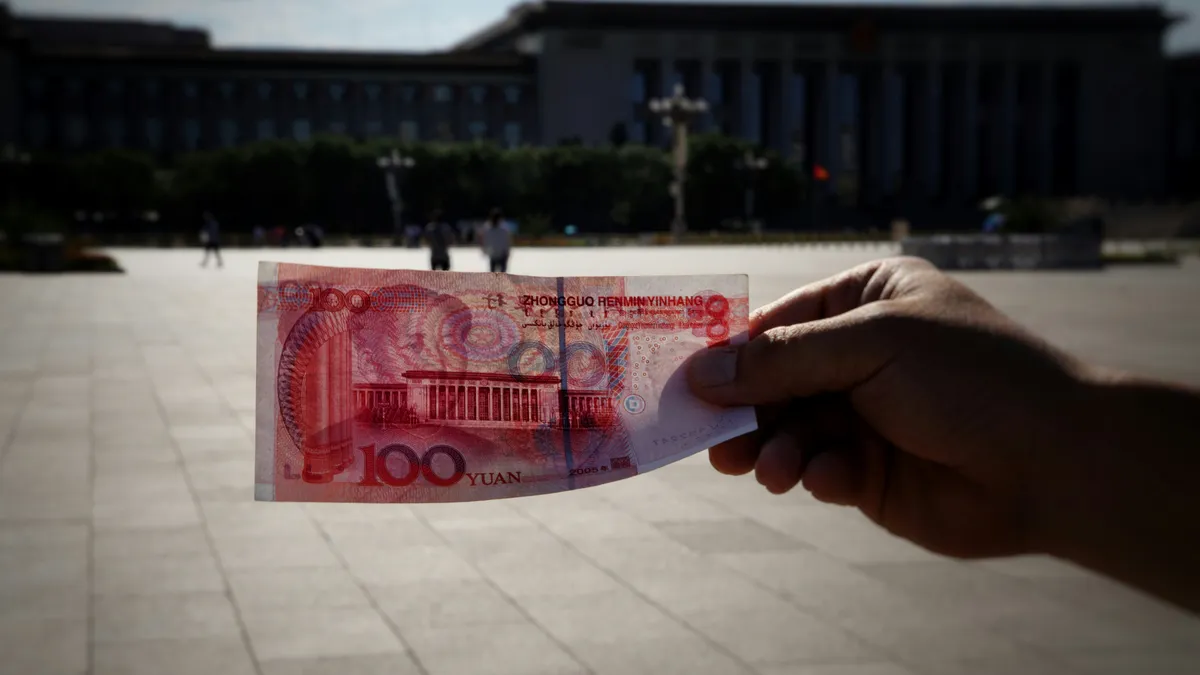
The yuan, relative to the US dollar, is now at its highest value in almost three and a half years, with the currency achieving its high of 6.7455 yuan for each dollar before falling back close to the 6.74 to 6.75 range.
This was the best level since February 2023, an important level which has been watched closely by analysts and traders throughout 2023.
The yuan's strengthening is part of a sustained period where it has gained about 3.7% since the start of the year in comparison to the dollar, making it one of the stronger-performing currencies in Asia, second only to the Australian dollar, which has performed even better.
Both onshore and offshore forms of the currency have been tracking each other well throughout the entire rally process.
A great deal of the appreciation of the yuan in recent weeks seems to have been accompanied by, and even caused by, a general pullback in the US dollar. Indeed, the value of the US Dollar Index – the gauge that tracks the performance of the greenback relative to a basket of world currencies – has softened considerably from its previous high points, reducing the appeal of dollar-based investments. Issues ranging from uncertainties over policy directions in Washington, independence of the Federal Reserve and concerns over the fiscal future of the United States have all been suggested as reasons behind this trend.
This environment has made things easy for the yuan and other Asian currencies to rise without any forceful action being taken by the Chinese authorities. According to financial experts, the value of the yuan depends on two factors – the fluctuations of the dollar in the world market and the managed exchange-rate system of China.
The central bank of China has been an active participant in determining the pace and path of yuan appreciation through the daily fixing of its midpoint. The People's Bank of China has been setting higher reference levels in recent sessions despite the fact that actual fix was lower than the estimates made by some analysts. The onshore yuan may fluctuate up to two percent above and below the daily midpoint level, which indicates the importance of fixing decisions of the central bank for the final level of yuan.
Besides fixing, the PBOC also took measures to improve the liquidity situation, implementing large-scale reverse repo operation that would ensure adequate money supply to the banking system.
Officials reiterated their pledge to develop Shanghai as a major financial center for cross-border finance and to promote Hong Kong as a major center for offshore yuan transactions.
Meanwhile, geopolitical external changes have provided additional impetus to the increase of the Chinese yuan.
Improved geopolitical situation in the Middle East, involving increased diplomatic activities to mediate between the United States and Iran, along with improved expectations regarding security in the Strait of Hormuz, has created the risk-on environment in financial markets around the world. In such a risk-on environment, Asian currencies usually tend to benefit, because investors become more confident in the ability to transfer their capital into emerging market currencies rather than into safer assets, such as the US dollar.
Meanwhile, China is dealing with its own set of economic and trade problems; rising trade tensions in previous months contributed to the need to strengthen the Chinese yuan.
Instead of pushing its currency down, the Chinese government prefers to appreciate it gradually and steadily, without affecting negatively its industries' exports.
As the value of the yuan increases, however, some of the fundamental data about the state of the economy in China reveals a different story.
A private survey revealed that the country's composite PMI index declined to a one-year low in July, on account of slower pace of growth in both the manufacturing and service sectors.
The manufacturing component of the PMI fell to a four-month low while the service component fell to its lowest level in close to two years, casting doubts on the health of domestic demand amid a strong currency.
This contrast between an appreciating currency on the one hand and weak growth data on the other highlights the delicate situation faced by the policymakers in China, who have to carefully balance the advantages of a strong currency such as cheap imports and higher international confidence with the disadvantages associated with its appreciation.
Any extended period of strength in the yuan has its implications for China’s large export-oriented economy that has been heavily dependent on the competitiveness of its currency to stay ahead in international markets.
According to analysts, companies operating in this sphere have sped up their efforts to convert their forex gains into the yuan currency in recent months, recording some of the biggest settlement surpluses seen in recent years, which adds to the pressure on the yuan, thus creating a vicious cycle.
On one hand, a stronger currency would put pressure on the bottom lines of Chinese manufacturers, including producers of electronics and automobiles, although it will reduce the cost of imported materials and energy.
However, estimates indicate that the yuan may appreciate even further, reaching around 6.65 per dollar level at the year end.
Looking forward, the market players are concentrating on several important factors that might decide if the strong yuan will continue or fade away.
The US labor market data coming soon is very crucial because strong labor market data will revive hopes of delay of US interest rates cuts by Federal Reserve and will result in some recovery in dollar and relief for the yuan. On the contrary, weak US data will extend the downward trend of dollar and will provide more scope for appreciation of Asian currencies.
In addition, the trade data coming soon from China will provide some insights on whether the strength of exports and settlements is able to sustain the positive trend in yuan.
According to some experts, global policymakers have started converging towards discouragement of competitive currency devaluation and thus, it seems that the rising yuan will not face any opposition from policymakers.