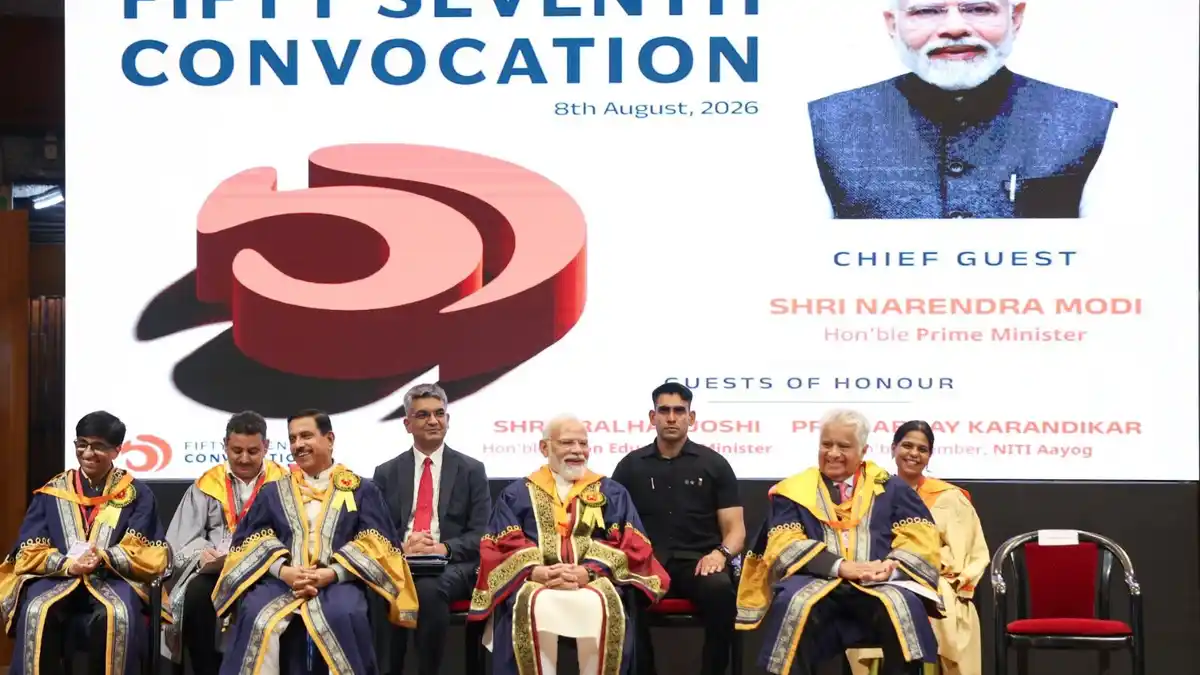
Indian Prime Minister Narendra Modi attended the 57th Convocation of the Indian Institute of Technology (IIT) Delhi on Saturday, 8 August, in his role as the chief guest, and conferred the highest academic awards to IIT's brightest graduates.
The ceremony started at 11 in the morning and involved 3,000 participants, of whom 587 were doctoral degree scholars who graduated at the ceremony.
For the Prime Minister, the visit had a personal significance because he had last participated in the IIT Delhi convocation in 2020, during the COVID-19 pandemic years, when the convocation took place in the hybrid format and the Prime Minister attended the ceremony virtually, not in person.
According to the Prime Minister's remarks at the ceremony, there was much of a difference for him to join the ceremony in person and virtually, and the direct participation added much to the importance of the event for him.
The convocation address was also delivered by the Union Education Minister Prahlad Joshi, who called the event his first official participation alongside the Prime Minister at an educational institution and thanked Modi for his vision regarding the transformation of India's education system into the one where learning and research are prioritized.
Besides the convocation ceremony per se, the prime minister launched the Param Pragya artificial intelligence supercomputer system at the IIT Delhi Sonipat campus. The system was designed to significantly increase the computing resources of the institute for conducting research on AI, and its launch was seen as a part of building the indigenous supercomputers to conduct research.
The launch at the time of the convocation took particular significance as technical Indian institutions become increasingly involved in advancing the AI agenda of the country. In particular, IIT Delhi announced global partnerships and scholarship programs for students during the ceremony.
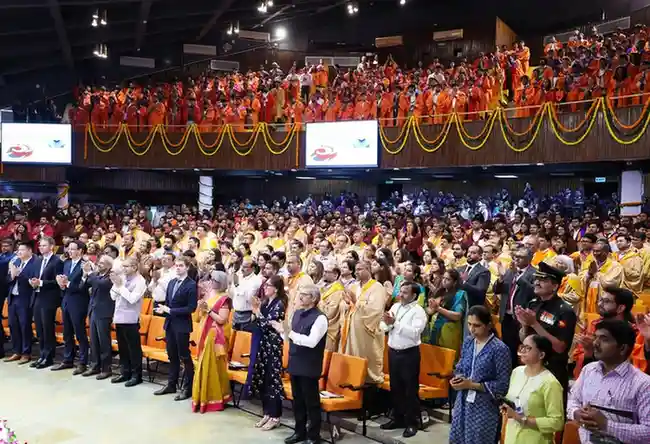
Photo: @narendramodi/X
Speaking to the graduating class of scholars, Modi advised them to focus beyond the systematic world of assignments and exams and be ready for the future filled with technological advancement and changing global equations.
The key idea delivered in his speech was the fact that finishing education should be considered as a starting point of their life that is going to become a lot harder to predict and requires staying curious and ready to learn.
As usual, the prime minister started his speech by saying he felt honored seeing the most successful students getting the awards from the podium, as well as mentioning the importance of that event for the graduate students themselves and their parents.
Besides, he encouraged new engineers and scientists to look at their success from the standpoint of contribution into India's development and self-reliance, especially in the field of artificial intelligence.
While addressing the crowd of graduates and parents in congratulatory words during the ceremony, Narendra Modi mentioned the lack of female students among the medal holders. Indeed, while announcing the results of awarding the President's Gold Medal, Director's Gold Medal, Shankar Dayal Sharma Gold Medal, and the Perfect Ten Gold Medals, he congratulated all the awardees, saying that even better results would have been achieved if there were more girls in this group.
The light tone of this part of his speech was directed right at the "Generation Z," encouraging all the students in India to make their technical institutions do their job in order to close the gender gap in the most successful students while the number of enrolled women continues increasing in IITs.
Considering the combined context of the convocation address and the Param Pragya ceremony, we can see that the Indian government has been creating a larger story about the Indian system of technical education and how premier universities such as IIT Delhi should be seen as something more than educational establishments granting students degrees—as infrastructures for the development of AI and research in the country.
The fact of awarding 587 PhD scholar graduates highlights the ever-growing volume of research outputs produced by the most prestigious technical universities in India—the aspect that is often mentioned in discussions about the competitiveness of Indian research.
The day itself included the usual rituals of wearing gowns and receiving diplomas from their professors while also reminding them about the fact that, from the official standpoint of the head of the state, the students' training in the realm of technology is just the first step on their way.