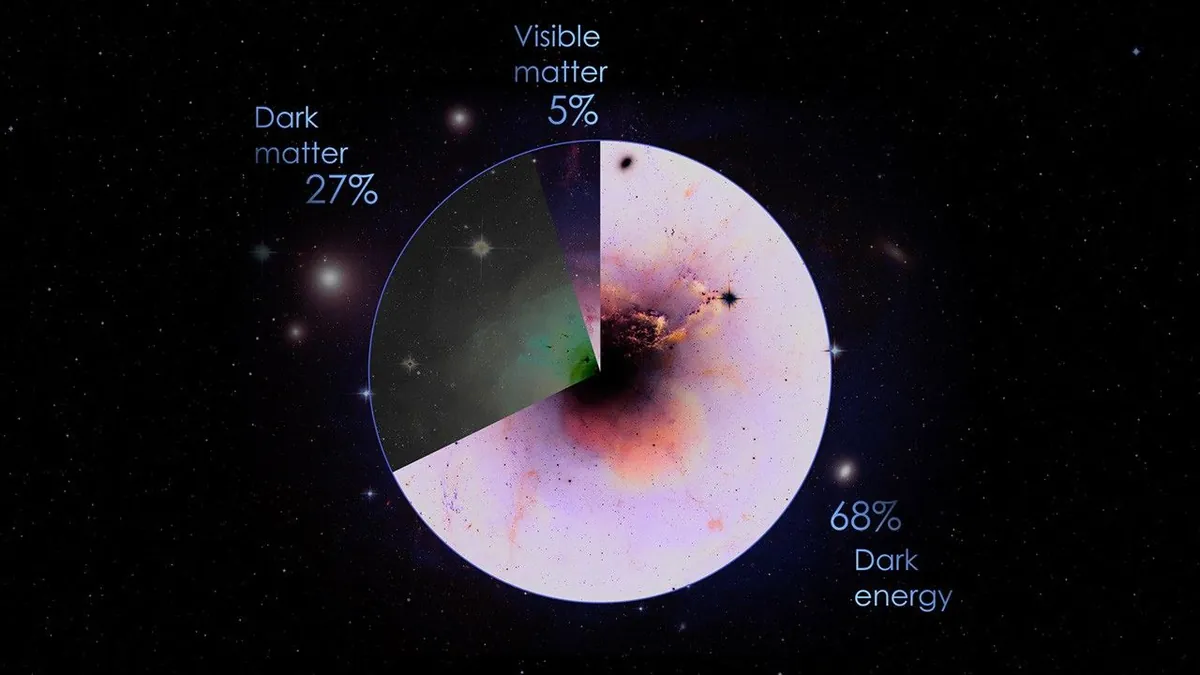
The only thing that is truly weird about dark matter is this fact: no scientist has ever physically seen it, or even detected it, directly.
However, even still, about 27% of everything within the universe consists of it -- no doubt. The common matter we have, which makes up each thing the universe that we know, which is to say your coffee mug, the earth, stars, you, and so on, is only about 5%.
The other percentage of the total matter in the universe is dark energy, yet it's actually a unique quandary for another day.
So then what in the dickens IS this mysterious thing?
The short answer: most scientists have NO idea what dark matter is.
It is believed that the history of dark matter began in the 1930s, with the work of a Swiss astronomer by the name of Fritz Zwicky, when he was searching a huge cluster of galaxies known as the Coma Cluster.
What he noticed was that the planets inside the Coma Cluster were going around WAY too rapidly to be kept within its gravitational grasp if only the matter he could account for was playing a role in holding it all together.
Using math, Zwicky figured that there had to be something else within the Coma Cluster playing a sort of "gravitational role," which he named: "dunkle Materie" or German for dark matter.
Most of Zwicky’s idea went ignored for several decades. But in the 1970s, astronomer Vera Rubin was studying the way stars rotate in spiral galaxies.
She calculated that outer stars in a galaxy should rotate more slowly than central stars, as our outermost planets revolve around the sun more slowly than our inner planets do.
Instead, the stars out toward the edge of those galaxies rotated no slower than stars closer to the center.
That can’t be possible unless something in the galaxy is pulling on those stars with extraordinary strength - a gigantic amount of mass that we simply cannot see.
Now other evidence supports Zwicky’s premise. For instance, gravitational lensing occurs when light from one object is bent in passage close to massive objects- and astronomers have found there is often far more gravitational bending of starlight passing over great distances than there is visible matter.
Even further is the now-famous Bullet Cluster; a collision of two galaxy clusters.
Researchers found that the normal matter of one cluster had been slowed down by the other as a result of the crash, but the gravitational mass of the clusters had not- it shot right through what looked like a smoking gun of dark matter.
Here's where things get truly confusing, even for the specialists.
We have one or two main candidates for dark matter - particles known as WIMPs, or "weakly interacting massive particles" and axions – and a couple of others from speculative theories but all the detectors that have been constructed to capture one of these particles have yet to yield any evidence.
Major experiments like LUEX (Large Underground Xenon) and others have been taking measurements for years.
One or two physicists has begun to reconsider the initial assumptions that led us to dark matter in the first place, suggesting there could instead be a need to modify our equations that dictate gravity itself.
A theory called the Modified Newtonian Dynamics, or MOND theory, suggests gravity works differently at large distances and it predicts a universe that would not require dark matter.
It is still relatively fringe, and has been tested against observations such as galactic rotation curves and appears to require finer tunings and to provide incorrect predictions in other situations.
However, a few physicists still take it sufficiently seriously to carry out tests against astronomical observations.
Regardless of what dark matter turns out to be it isn't just of interest in abstract academic terms.
It influences how galaxies form, how clusters interact and the overall structure of the universe around us - essentially you couldn't have built it the way it currently is with only ordinary matter! The search is carrying on.
using more highly sensitised underground detectors, larger and more powerful particle colliders and by looking to the night sky using ground based and satellite astronomy in the hope that new data is recorded that can point towards more candidate particles, or finally that you don't need any dark matter if you just alter gravity differently!