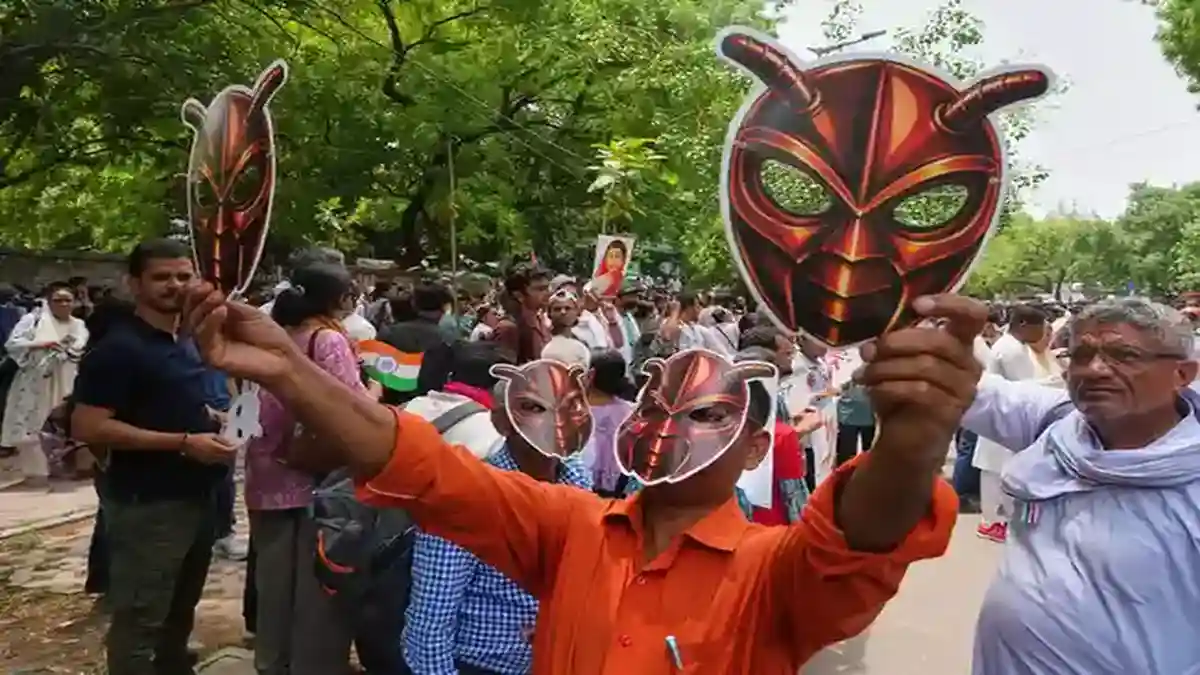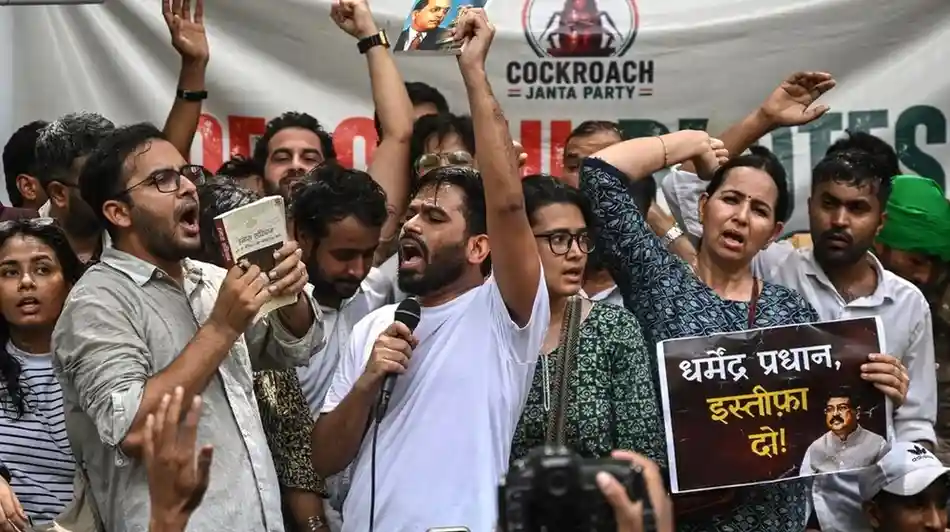
Jantar Mantar smells like wet concrete and last night's tear gas on Tuesday morning. A couple hundred protesters are already back, phone flashlights doing the job umbrellas can't in the drizzle. Nobody's talking about going home.
That's the strange part about this movement. It keeps not ending. Six weeks ago it barely existed at all.
Abhijeet Dipke flew in from the United States on June 6 to launch something called the Cockroach Janta Party not a real party, more a punchline aimed at India's political class, the kind of gag that usually dies in a group chat within a week.
This one didn't. Student groups piled on: the Students Federation of India, All India Students Association, others. And the joke found a real target fast the botched 2026 NEET-UG medical entrance exam and a mess in CBSE's on-screen marking process, the kind of bureaucratic failure that ruins actual lives, and one that reportedly touched more than two million students.
Then Sonam Wangchuk showed up.
The Ladakhi engineer, the man widely credited with inspiring the inventor character in 3 Idiots, joined the sit-in on June 28 and went on an indefinite hunger strike alongside six students.
That's roughly when this stopped being a campus story. National news crews arrived. So did national anger, especially after police pulled Wangchuk out of Jantar Mantar last Saturday and admitted him to a hospital, a move organizers describe, flatly, as a detention with better paperwork.
The plan for Monday was simple enough on paper: march to Parliament on the opening day of the monsoon session. They called it Sansad Chalo. Authorities weren't gambling on it staying calm roughly 9,000 security personnel deployed, five metro stations shuttered, internet access cut near Parliament House.
It didn't hold anyway.
Thousands poured in from Delhi and the towns around it, pushed past barricades near Constitution Club and Patel Chowk, and things got messy fast lathi charges, tear gas, stones flying back the other way.
Two police buses got wrecked. So did fifteen or twenty government vehicles. By 7 p.m., Ram Manohar Lohia Hospital alone had logged 65 medico-legal cases, several of them hunger strikers too weak to stand on their own. Officially: 118 police and paramilitary personnel hurt, about 60 protesters, 70 detained, FIRs stacking up for rioting and damage to public property.
Independent tallies put the real injury count closer to 180.
Not everything that circulated Monday night checked out, to be fair. Police spent part of Tuesday knocking down a viral claim that a 12-year-old girl had been assaulted and dozens left with head wounds false, they insisted, and asked people to stop sharing it. Dipke, for his part, posteddetained, andg closer to an apology than a rallying cry, telling supporters he could have done more to protect the women in the crowd, some of whom he said were struck by male officers.
Something did shift Monday, though. The government actually agreed to talk. Union Health Minister J.P. Nadda spent hours at his residence with two CJP spokespeople, Saurav Das and Ashutosh Ranka, hearing out three demands: free Wangchuk, sack Education Minister Dharmendra Pradhan, and pay roughly ₹1 crore to the family of every NEET aspirant CJP says died by suicide over the leak more than twenty, by their count. Home Minister Amit Shah, who's personally overseeing the security response, sat separately with Pradhan for over three hours.
None of it amounted to an actual promise.
Das said afterward that Nadda agreed only to raise things "at the appropriate level" the sort of phrase that means nothing has been decided. One protester, Sahil Singh, put it more bluntly to Reuters: "They beat us black and blue, and they damaged our protest site."
He wasn't interested in half-measures. Only Pradhan's exit would do.
Dipke says the march is back on. Small clusters were already regathering at Jantar Mantar Tuesday morning, rain and all, ringed by paramilitary who show no sign of packing up either. Pradhan, for what it's worth, has weathered exam scandals before and kept his job commentators keep pointing that out, as if precedent settles anything here. It probably doesn't. A few million angry, underemployed young people don't organize themselves around one minister's chair. They organize around everything that chair has come to represent.