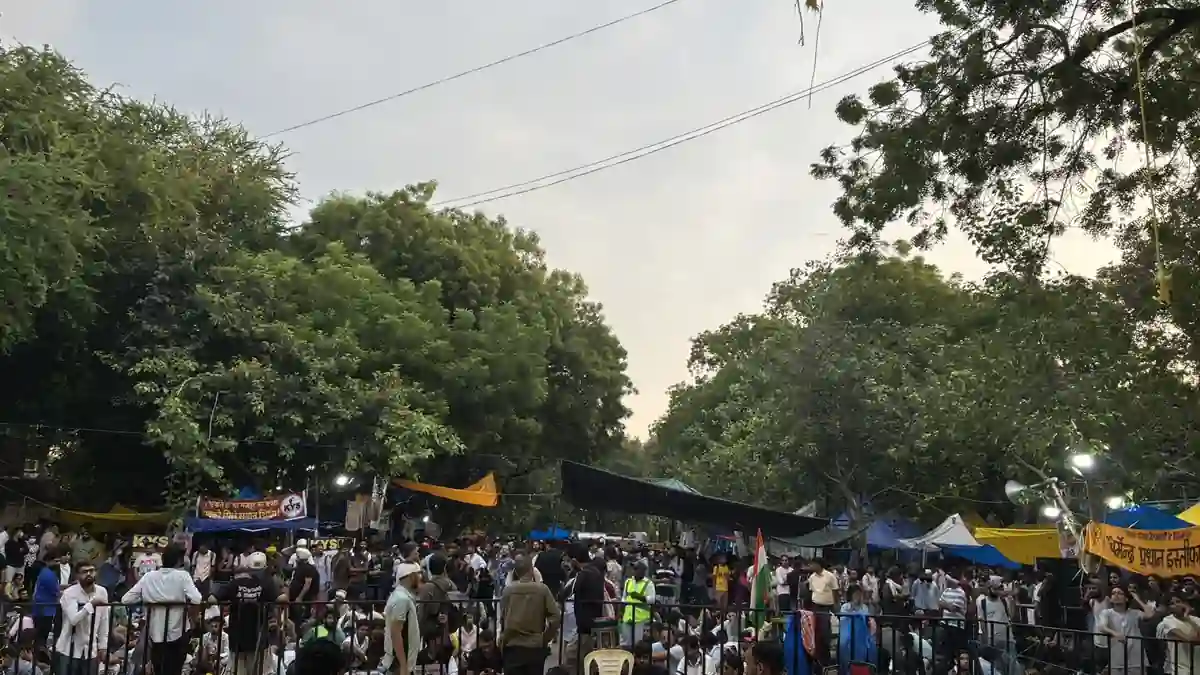
The FRS of Delhi Police has flagged over 2,500 people with criminal records at Jantar Mantar during the course of three days, starting July 21 and continuing until July 23. This was done following violent incidents that occurred on July 20 when a youth political party named Cockroach Janta Party marched towards the Parliament demanding the resignation of Education Minister Dharmendra Pradhan.
According to the police authorities, this particular technology has been upgraded especially to ensure that those who are known for repeated offenses do not take advantage of the ongoing protest movement at Jantar Mantar, which has been going on for over a month now. Four camera units using FRS have been installed at all the entry and exit points of the protest site, and these units have been connected directly to the criminal records of the Delhi Police.
According to the briefings by police officers on how the whole system works, it is based on the use of high-quality cameras that can capture good images of faces despite the distances involved. All images captured will then be compared to the police records within a matter of seconds. In the case of a match to any of the wanted criminals, fugitives, repeat offenders, or any individual listed as "Bad Character," the police on the spot will be immediately alerted.
However, it should be noted that those in authority are taking care to emphasize that the purpose of the system is not to monitor the activities of the people exercising their right to peaceful assembly under the Constitution. On the contrary, they insist that the purpose of the system is strictly precautionary in nature – to help identify people with past criminal records who might use their presence within a big crowd to perpetrate additional crimes on either police personnel or fellow protestors and others present there. In this context, it must be mentioned that some officials referred to the presence of agitators wielding knives and other sharp-edged weapons in the midst of the crowd after the July 20 crackdown as the reason for using the cameras.
The use of the technology by the Delhi Police is nothing new. It was earlier employed by the force to provide security during Republic Day and Independence Day celebrations, as well as important festivals like Holi, Diwali, Eid and Ramlila.
The size of the database of the system has become much bigger in recent years. According to early estimates, the number of criminal files used for matching was approximately 20,000. During the Independence Day security arrangements in a later year, the number of such files has increased up to 300,000, and according to trade publications, today the number of files exceeds 350,000 criminal files, which can be processed in nearly a million records within 200 milliseconds.
There is other information that Delhi Police uses its facial recognition system across several databases, namely one with over 150,000 history-sheeters and another with about 2,000 terror suspects.
The implementation of the facial recognition system occurred in the context of weeks-long unrest in the center of Delhi. The Cockroach Janta Party, a satirical political youth movement created in mid-May 2026 by digital strategist Abhijeet Dipke, gained momentum due to discontent with the scandals related to the exams, in particular, the leakage of the NEET-UG medical entrance exam and unfair examination process in the CBSE leaving thousands of candidates uncertain about their results. The name of the party is chosen as a satirical reference to the party takes its name as a pointed parody of the ruling Bharatiya Janata Party.
The protesters, who were made up mostly of students, professionals, and families, had been camping at Jantar Mantar for weeks demanding Pradhan’s resignation. The situation got really bad on July 20 when over 10,000 protesters tried to march towards the Parliament only to be fired at with tear gas and batons, in addition to an aggressive police crackdown. According to the Delhi Police, almost 180 people were injured in the confrontation, 60 of whom were protesters while the rest were security forces, but according to CJP leaders, almost 150 people were injured. About 70 protesters have been arrested and legal actions will take place against them.
A lot of video footage was recorded of the police beating up the protesters, however, no footage of the protesters initiating any form of violence has come out. The reaction of the police has also received criticism from Amnesty International India, as the chairman of the organization said that the crackdown brought up doubts of legality, necessity, and proportion of the actions. Following the event, CJP leaders have decided to stop marching through central Delhi for the safety of their supporters and continue their sit-in demanding Pradhan’s resignation.
There have also been legal challenges made to the increased surveillance by the camera. There is Public Interest Litigation made in the Delhi High Court, where Aishe Ghosh, former president of JNU Students' Union, has pointed out that there is a bigger surveillance mechanism in place at Jantar Mantar that includes an erected tower, which she argues has been filming the protests since June, and even recording the protesters in their regular activities like eating, resting and visiting the hospital.
In India, there is no specific law regulating the use of facial recognition technology. Previous leaks of information through the Right to Information process have revealed that in Delhi Police, facial recognition results of any match over 80 percent accuracy rate is considered valid enough to take legal action, which has been criticized by digital rights organizations as too low because of its potential to lead to instances of mistaken identity for communities whose names are frequently found in police files.