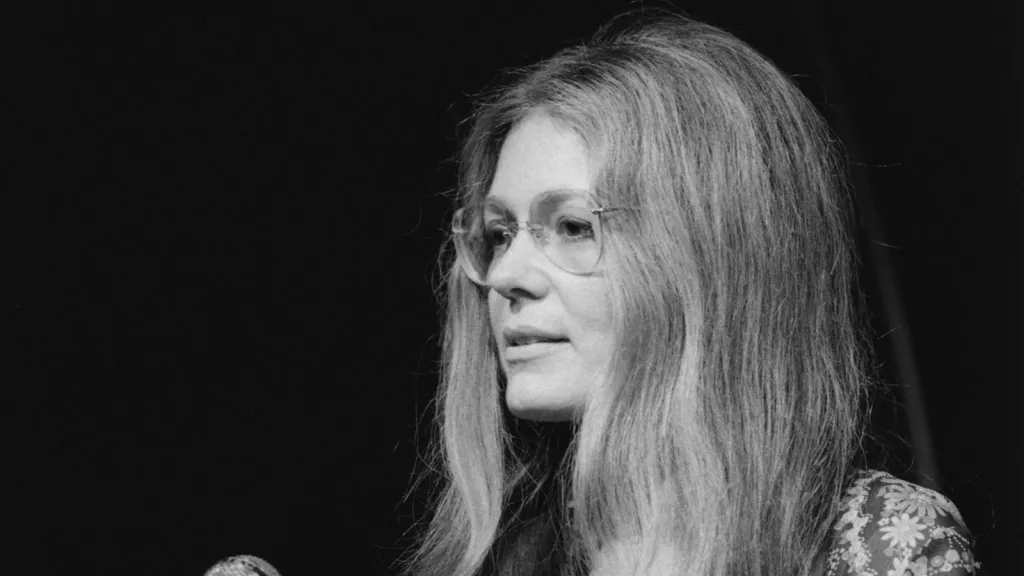
For almost sixty years, there was one face and one voice that came to be synonymous with American feminism more than perhaps any other.
Author and activist Gloria Steinem, whose face and voice came to be synonymous with America’s women’s rights movement, passed away on Wednesday at her residence in New York City. She was 92.
According to her social media pages and those of the foundation she founded, she passed away on Wednesday at her residence in New York City amid the many people who loved her.
Steinem's public persona was unique to her activism of many years.
Steinem was a highly recognizable figure, with her signature hair style, which had been streaked and parted in the center, along with the large pilot sunglasses.She spent her entire activist career traveling and delivering speeches at universities, public meetings, rallies, and marches.
She explained in 2015 in an interview why the importance of such activism is so clear to her by saying that true empathy can only happen face-to-face and not through the Internet.
The most significant institutionally created legacy of Steinem was her role in launching a magazine which everyone believed would quickly perish in 1972.
Ms. Magazine was seen as an absurdity and laughed at by many writers, particularly men, from its inception in 1972. It is still going strong today under the banner of the Feminist Majority Foundation, surviving longer than any of its early critics ever did.
Among the critics of Steinem was President Richard Nixon, whose derogatory remarks about her and the "Ms" designation were taped in his office. She too had a biting comment for him in 1972, when she referred to him as the world's most sexually insecure leader since Napoleon.
While Ms. Magazine was a venue, the advocacy efforts by Steinem spread into virtually all significant areas of struggle within the women's rights movement for decades.
During more than half a century, Steinem actively supported the struggle for women’s rights in the workforce, the right to abortion and sexual education, and became virtually synonymous with the struggle for women's rights.
The reason why she advocated for the right to reproduction was based on her personal experience. She had gone through an illegal abortion when she was 22 years old, which she concealed for almost ten years. While looking back in 2011, Steinem rejected the notion that the decision was shameful since, in fact, she was never guilty about it, even though she tried for many years to feel so.
Both her advocacy work and her humor were evident in her public persona, and the combination of the two often served to disarm her critics as much as it served to challenge them.
Her basic philosophy was captured in a succinct phrase that she is often quoted as having said: defining feminism as “the ability to view the world in its totality, not half of it.”
Not even fame and many years of campaigning could protect Steinem from outright attacks, some of which came from surprising quarters.
In one episode on Larry King’s CNN talk show in 1990, for instance, Steinem was clearly shocked by a female caller who wished her well before saying she should “rot in hell” for destroying the family in America. “But at least,” she would later remark, “it was a sign of the times because it showed that people were taking feminism seriously, something which was not the case when Ms. Magazine launched in 1972.”
Another early experience of Steinem, the negative portrait she once got in Esquire magazine, had even greater impact, reportedly bringing her to tears.
The results of Steinem’s life’s work were finally acknowledged by the same establishments that she had been fighting for so long.
In 2013, Steinem received a Presidential Medal of Freedom for her decades-long struggle for civil rights, as well as an award from the United Nations’ Society of Writers and the National Gay Rights Advocates Award.
There was one specific moment shortly after she turned 85 years old that illustrated just how personally her advocacy had been felt by others from all different generations.
As she was hosting a women's “talking circle” about her life while watching a play that honored her off-Broadway, individuals from the audience stood up one at a time with some even fighting back tears as they thanked her and recounted their own stories of discrimination.
There was one specific moment shortly after she turned 85 years old that illustrated just how personally her advocacy had been felt by others from all different generations.
As she was hosting a women's “talking circle” about her life while watching a play that honored her off-Broadway, individuals from the audience stood up one at a time with some even fighting back tears as they thanked her and recounted their own stories of discrimination.
By the time the industry decided to make a film on her life story, Steinem had been, for more than half a century, one of the most recognizable faces in America.
Steinem’s story was turned into a film in 2020 by the name of “The Glorias: A Life on the Road.” The movie was based on her autobiography written in 2015 and starred Julianne Moore.
Her statement released by her foundation and family highlighted not only her public work, but also a more personal trait that her friends and followers said characterized her private life as well as her public talks.
"Gloria's gift was her listening to other people and making them feel heard and seen. Her words, actions, and example granted everyone freedom to be themselves," the statement released on her Instagram page and Gloria Steinem Foundation stated. "Gloria always lived up to her independent nature, with curiosity and a great sense of humor."
Apart from the continued publication of Ms. Magazine, Steinem's nonprofit organisation is set to carry on with her legacy in the coming years.
"Gloria's Foundation" nonprofit organization wishes to preserve the feminist legacy of the building, along with the activist's very own archives, which will ensure her decades worth of writings, speeches and organizational work is preserved for generations to come.