In the morning of August 12th, shortly after midday UTC, users who searched for “Sam Altman” on Google started seeing a rather alarming fact appear next to the photo and bio on their search results page. This time, however, the data came from one of the most authoritative sources around—Google’s Knowledge Panel (which normally shows basic biographical info). Here, instead, was an ominous little line indicating Altman had died… today, at just 41 years old. No one had even broken the story yet, let alone confirmed it. The tech sites were still listing him as OpenAI’s CEO, having released material written by him as recently as June. But Google knew better—it must have known everything about Altman! Or had something catastrophic happened to the Internet?
A few minutes later, frantic users began sharing these alarming images on Twitter/X and Reddit asking if anyone could tell them whether what they were seeing was real—or perhaps if the entire Internet infrastructure was malfunctioning. One particular shot made its way around online and quickly became the most shared response to the altman-die event: a screenshot of the Google Knowledge Panel showing that Altman died today at 41.
But I know from experience that this has been the case for years now. It was, of course, the latter.
The investigation determined that the content had originated from edits made to Altman’s Wikipedia bio where someone added a death date of August 12, 2026, along with a death location in Seattle and an unsupported claim that he would be assassinated. Additionally, the opening paragraph of this story was modified and placed in past-tense.
The edit was automatically flagged by Wikipedia’s own automated safeguards as “potentially unreferenced addition to biography of a living person”.
The changes were ultimately retracted after another user reverted the vandalism. But not before it had lived under a temporary account and appeared on Wikipedia’s site for roughly 41 minutes (the time between when the initial vandalism happened and when a human decided to step in).
During those few short minutes, however, it seems that Wikipedia wasn’t alone in being fooled by this bit of misinformation. Minutes after the first attempt at introducing the false death date was pulled back down, another user attempted to inject the same date using yet another temporary account.
This one failed too—albeit quickly—and triggered Wikipedia to put some additional protective measures up on the page to block out new and unregistered accounts.
For what it’s worth, Google doesn’t go around manually writing each of its Knowledge Panels based upon all people currently living on Earth, which makes sense considering how many there are. Instead, the company has variously automated mechanisms that continually scrape public knowledge resources (like Wikipedia) to populate these panels.
It looks like the most recent scrape just grabbed the vandalized version of Altman’s Wikipedia page and used the fabricated date of death info to flesh out his summary entry.
Thanks to the widespread sharing of these images, Google acted swiftly to rectify their mistake and minimize potential fallout. “We appreciate you flagging us on this,” he said at the time in a public post. “This [error] will no longer be showing up. This is not a manually changed item by Google. When people vandalize public info sources this may impact what’s shown within search.”
What makes this incident all the more striking is that the incorrect information wasn’t generated via some sort of experimental artificial intelligence functionality. Instead, the Knowledge Panel containing the inaccurate data appears when clicking on the All tab (as opposed to AI Mode) on Google’s search page.
Moreover, there isn’t even any sign that the content was provided using AI Overview—i.e., AI-generated summaries of webpages that are designed to give you a general sense of what’s discussed without having to wade through pages upon pages of links and descriptions.
In fact, this seems like yet another example where the problem originated with one of Google’s established systems, namely the Knowledge Graph. This longstanding technology enables users who perform searches about certain subjects to view concise bits of information about those topics based on structured data sourced from a variety of places, including Wikipedia. But here, instead of displaying just a brief snippet explaining that someone died recently, this version of the Knowledge Panel also featured an extremely large box marked “Died” right alongside an article’s current information stating that Altman remains the current CEO of his organization.
OpenAI—that contradiction alone probably tipped off savvy readers to something being very, very wrong before anyone over at Google got around to fixing things.
This incident highlights one key structural problem of the modern web—large amounts of seemingly verified, editorially reviewed factual content are generated by automated processes where there’s nobody in the room for every step along the way. Anyone can edit Wikipedia—even those without accounts. But Google’s summarization engines have been trained to consider it a reasonable, reliable source for exactly these sorts of claims (usually) because community moderation is good at spotting and rolling back acts of vandalism.
In this case, the reverting editor caught up with the edit in question within under an hour—very fast by Wikipedia’s standards—but still didn’t happen to be around when Google’s scrappy bot picked it up and served it out to its hungry readership.
Commentators covering the episode have also pointed to an uncomfortable asymmetry. of searchers. It’s interesting how fast Google recognized its own mistake thanks to Altman’s huge public presence. If this attack had been made against someone without as high a profile — say a local official, an academic, or just an ordinary member of the public who didn’t get their picture in the paper (or Twitter) — would it have taken longer for them to recognize and correct it? Would people even notice?
The incident reminded us of other conversations we’ve seen swirling around on the internet lately regarding what they call the “Dead Internet Theory”—that there are large swathes of online activity that aren’t really real anymore because it’s all either synthetic or automated. I’m sure many will remember how Altman has commented on these types of theories before.
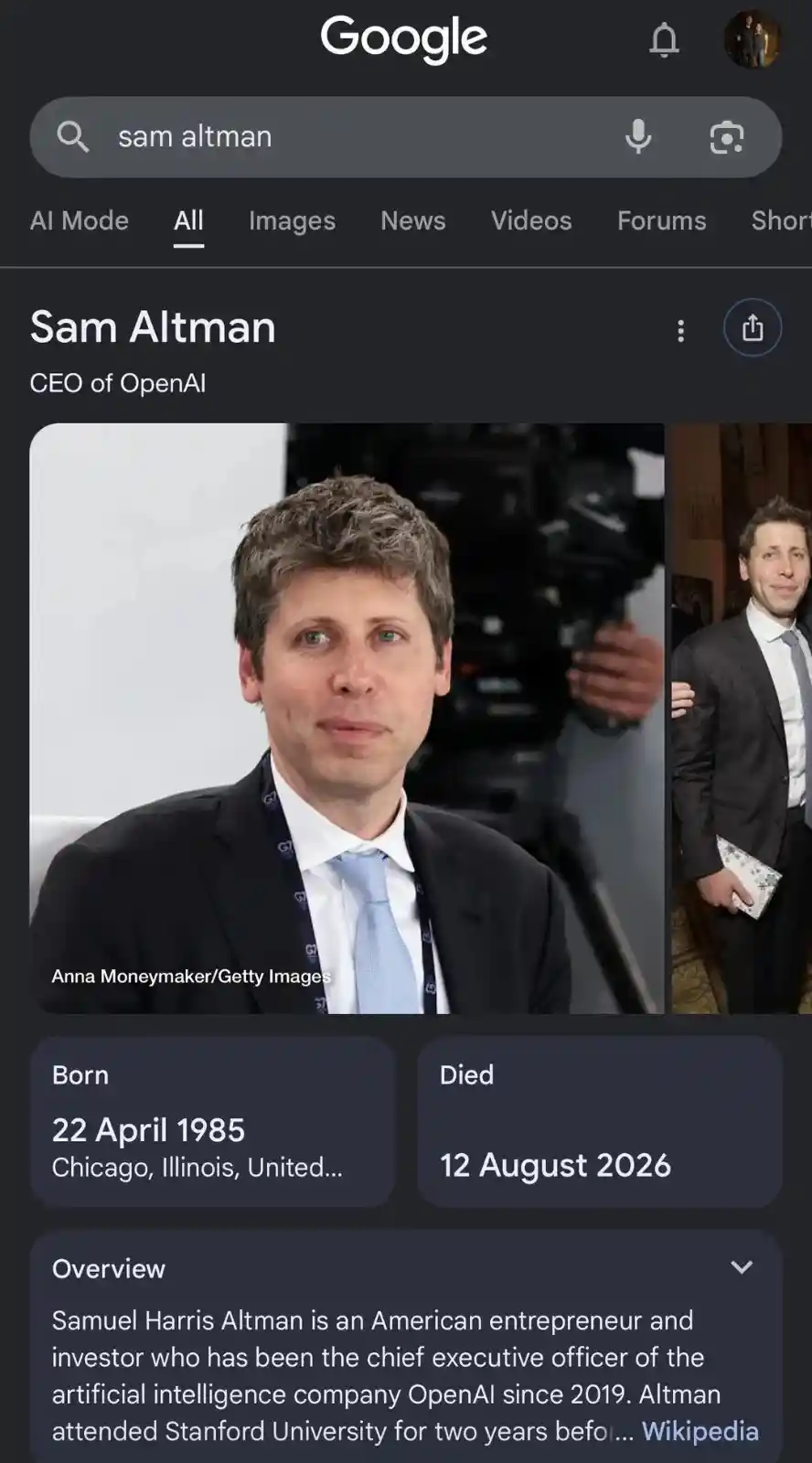
Photo: @Screenshot of Google Search
That aside, however, this incident makes for a great case study about the precarious state of automated fact-finding pipelines that fuel everything we read and hear online today. With search engines, your voice assistant, and more recently AI-based chatbots all pulling information off structured datasets derived from crowd-edited sites like Wikipedia, corruption at any point along that chain will eventually work its way out to end-users.
In this particular instance, an anonymous vandalism act polluted underlying datasets used by Google’s various services. It then percolated through several layers before being recognized and corrected. Given the speed at which this happened, I assume Google does have some level of monitoring tools looking over the shoulder of people like me, but how many steps do these companies plan to add to their safety nets?
It would be good to see them expand current protections that already exist around highly visible individuals (e.g., celebrities) to protect those who are less prominent – while ensuring that such mechanisms are available across their entire ecosystem. However, the only thing I’ve seen to date is the company taking reactive actions (i.e. keeping a watchful eye on social media activity).