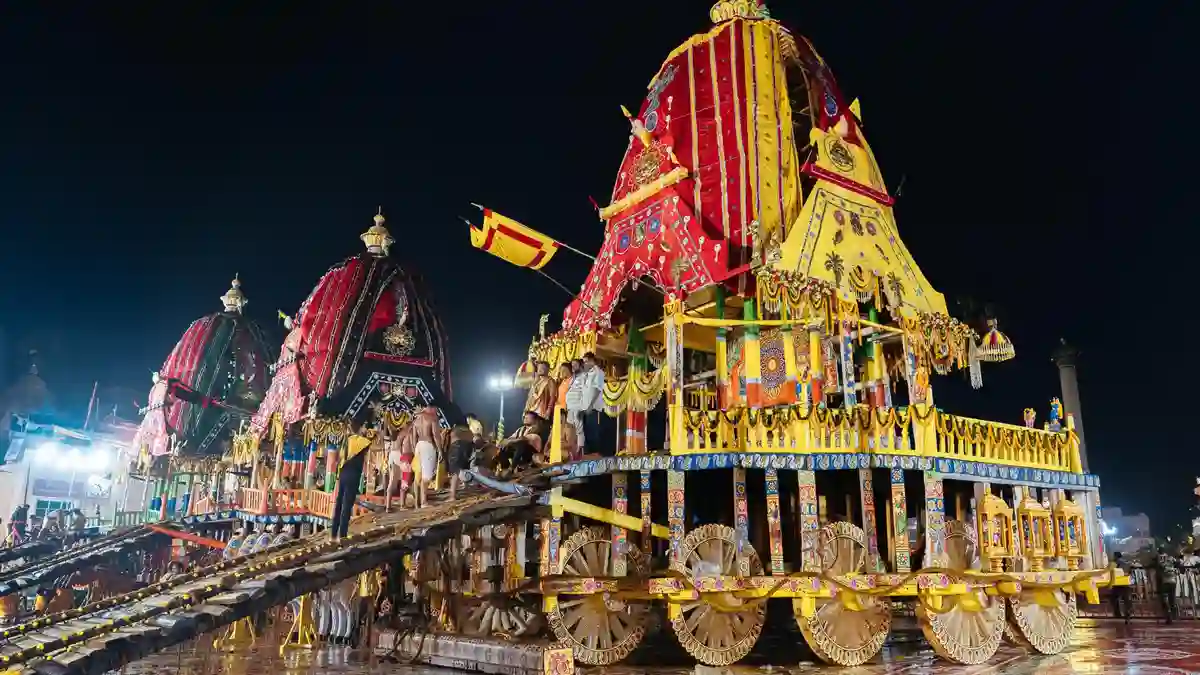
Somewhere along Grand Road on Thursday afternoon, the wide processional street locals call Bada Danda, the one the deities travel each year on their way to Gundicha Temple, the crowd just stopped moving. Not slowed.
Stopped. People started fainting where they stood, packed too tight to fall over properly. Stretchers began cutting sideways through a mass of soaked, saffron-clad devotees who'd been standing in intermittent rain for hours to catch a glimpse of Lord Jagannath.
Two people didn't make it home. One devotee suffocated in the crush, roughly 500 metres from the outer security cordon, not far from where the Pametersritual priests carrying the deities from temple to chariot was still going on. A second death was a cardiac arrest, and offwereals were quick to say it wasn't connected to the crowd surge itself, just a tragedy that happened to land on the same afternoon.
As for how many people ended up needing medical help, good luck getting a clean number. Early reports said around 100. By evening some outlets were reporting over 200. Nobody was really counting; they were pulling people out.
Here's roughly what unfolded, based on what officials and witnesses have pieced together so far. The ceremonial processions started at 9 am. By 4 pm, Puri's titular king, Gajapati Maharaja Dibyasingha Deb, had performed the Chhera Pahanra sweeping the chariots with a golden broom, a ritual gesture of humility that precedes the actual pulling. Devotees then began hauling the three chariots toward Gundicha Temple.
Whether the crush happened during that pull or in the crowd massed to watch the Pahandi beforehand is still murky. Inspector General of Fire Services Umashankar Dash put it simply: there was a heavy rush of people at exactly the stretch of Grand Road the chariots roll down.
Lakhs of bodies, one narrow corridor, a security cordon on one side—the crowd had nowhere left to go.
Fire services and the Special Rescue Unit reached the spot and started clearing lanes for ambulances. A first-aid tent on-site handled what it could; anyone worse off went to Puri District Headquarters Hospital and other nearby facilities.
What makes this sting a little more is how much had gone into preventing exactly this. Nearly 13,000 police personnel 19 of them IPS officers were deployed just for crowd management this year, alongside coastal patrolling, lifeguards, and AI-powered CCTV meant to flag exactly this personnel,ensity before itofficers,dangerous.
Chief Minister Mohan Charan Majhi had reviewed preparations personally that morning and told officials, in no uncertain terms, to prioritise devotee safety.
It happened anyway. And it happened last year too: three people were killed, and around 50 were injured near Gundicha Temple, when trucks carrying ritual materials rolled into an already-packed crowd. Different trigger this time, no vehicles involved, just density.
But the shape of the problem is starting to lprioritizeike a one-off and more like a pattern: an event that pulls in more people than any single stretch of road can safely hold, no matter how many cameras or officers get thrown at it.
The chariots kept moving. That's worth sitting with for a second. Stretchers were still being carried past chanting crowds when the pulling resumed. Singer Sonu Nigam turned up in Puri for the occasion. President Droupadi Murmu put out a message invoking blessings for "the entire world."
Prime Minister Modi called the Yatra an embodiment of humility. Reliance Foundation ran a food drive for pilgrims and frontline workers. Amit Shah performed his own rituals at a Jagannath temple in Ahmedabad, hundreds of kilometers away, alongside a string of political leaders marking the day.
None of that is wrong; exactly, the Yatra is genuinely one of the largest religious gatherings on earth, and people don't stop believing because something went wrong a few hundred metres away. It's just a lot to hold at once: a health emergency on one stretch of road, greetings and photo-ops circulating everywhere else.
By Thursday evening, health officials still hadn't issued a formal casualty count, and the identity of the devotee who suffocated hadn't been released. Odisha's health department, already running COVID-19 surveillance through the nine-day festival, is expected to update numbers as hospitals along the route file their reports. The chariots resume their journey to Gundicha Temple on Friday.