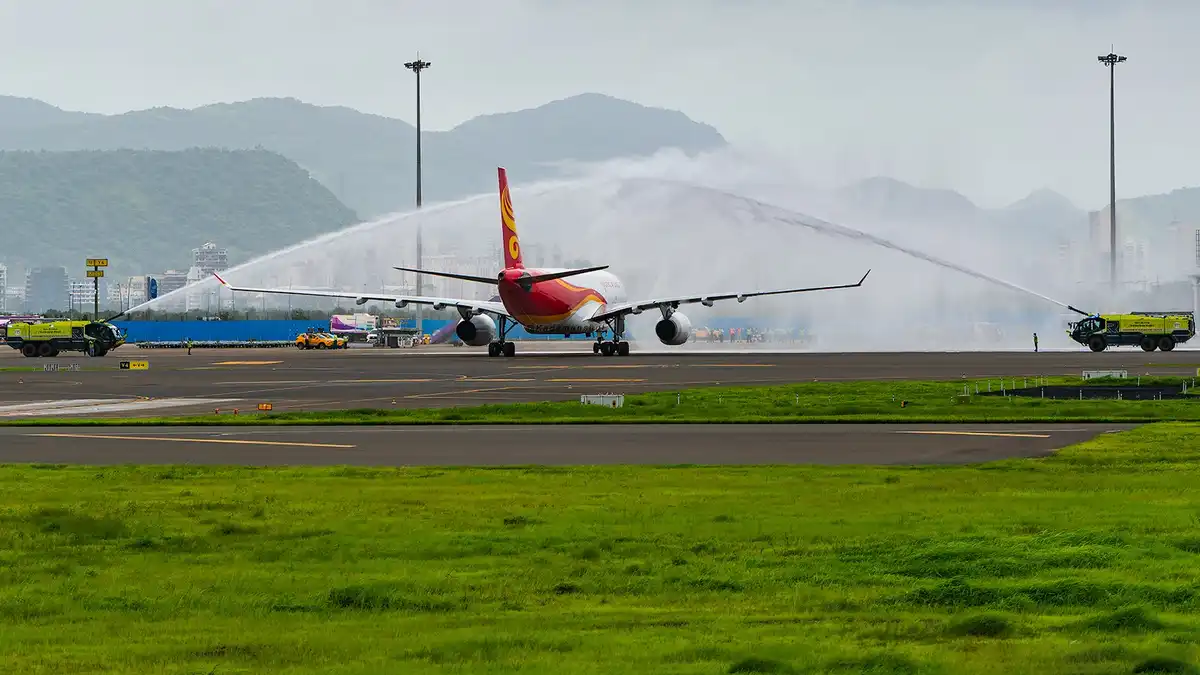
Sunday was not just another ordinary day for Navi Mumbai International Airport.
For NMIA, the first dedicated international freighter flight arriving at the airport, run by Hong Kong Air Cargo from Hong Kong, signified an important milestone as a trading and logistics hub across the world.
Eight months after beginning commercial operations, this can be considered a huge step forward for NMIA.
This type of plane is an Airbus A330-200F freigter which transported 60tons of cargo.
This is not a single occurrence of such events.
There will be three cargo flights per week from Hong Kong to Navi Mumbai via Hong Kong Air Cargo.
It is indeed a regular connection between one of the world's busiest cargo centers and the newly established international airport in India.
This one-off flight is merely the start of a much bigger plan.
The operation is one of 13 new freighter operations that will be initiated by NMIA as part of its international freight ramping up effort.
To put it simply, this HKG flight on Sunday is the first domino that is likely to fall rapidly within the coming weeks.
NMIA is having quite the run recently, with one first after another coming up fast.
The airport hosted the first-ever international passenger flight of Air India Express to Abu Dhabi on July 15.
This was soon followed by the first-ever dedicated freight flight of IndiGo Cargo to Sharjah with cargo of 20 tonnes in weight on August 1.
The latest flight from Hong Kong, carrying three times the previous load, is NMIA’s largest cargo first yet.
However, the expansion of the airport will not be limited to Hong Kong and Sharjah alone.
NMIA has been expanding rapidly in terms of destinations, with several international operators filing for and obtaining clearance to operate at several major destinations in Asia, Europe, and West Asia.
These include Chengdu, Bangkok, Taipei, Kuala Lumpur, Singapore, Abu Dhabi, Doha, Frankfurt, Istanbul, Dubai, Amsterdam, Bahrain, Paris, and Riyadh.
This is truly an ambitious reach – covering three continents and linking Navi Mumbai to several of the largest centres of commerce and manufacture in the world.
The NMIA official described the expansion as critical for the airport’s future identity.
“With an anticipated rise in freighter movements at the end of August, we are quickly expanding our international cargo network with better connectivity to key markets in Asia, Europe and West Asia,” the official explained.
He further noted that the network development will bring more business opportunities for exporters, importers and companies, while at the same time confirming NMIA’s position as a strategic logistics and trade center for Maharashtra and Western India.
That is quite an ambitious statement for an airport that is less than a year old – but judging by the freighter figures, it is being backed by international cargo carriers.
The NMIA is owned by Navi Mumbai International Airport Ltd (NMIAL), which is a joint entity comprising of Adani Group, having 74% shareholding, and CIDCO, an agency for planning under the government of Maharashtra, owning 26% of shares.
This is important as it makes the cargo plans of the airport a part of one of the biggest infrastructures of India owned privately, with Adani Group already having several airports in operation.
To get a sense of how fast this development has happened, it is worthwhile to take one step back in time.
It was not until the first commercial aircraft arrived at NMIA on December 25, 2025 – an IndiGo flight from Bengaluru – that the airport began its operations on the air side. The inauguration of the airport took place on October 8, 2025, by Indian Prime Minister Narendra Modi, and on the very first day of commercial flights, NMIA was serviced by airlines like IndiGo, Akasa Air, Air India Express, and Star Air.
Just in a matter of eight months, from that initial landing of a domestic flight in December to the first landing of a freighter with 60 tonnes of cargo from Hong Kong in August, NMIA has been able to grow from being non-existent to being a fully operational airport for international freight traffic.
Passenger planes capture attention, but it is usually the freighters that ultimately decide whether an airport will be financially sound in the long run.
Freight business generates constant income from landing charges, warehouse services, custom clearance and ground handling, and is more dependable than passenger traffic since companies plan their logistics around cargo flights and not airports.
In case of NMIA, the arrival of cargo airlines such as Hong Kong Air Cargo is a clear sign that international logistics firms view the airport as a serious, sustainable player and not simply an alternative to the already crowded Mumbai airport.
Everything associated with NMIA’s fast construction is not necessarily going to go without a hitch.
Observers who are following the development of the airport observe that the financial viability of the project will be directly dependent on the rapidity of its operation, and that consistent growth in traffic is vital, because low traffic would negatively affect revenues.
To put it simply: declaring 13 cargo flights at one’s disposal is one thing, while consistently loading those airplanes is another matter.
NMIA is next scheduled to be tested in late August when it is expected to experience an increase in cargo flights as a result of the completion of most of the planned 13 routes.
In the event that Hong Kong, Sharjah and the rest of the ever-growing list of ports provide a regular flow of cargo flights, NMIA will easily be able to position itself as the alternative gateway for the Western Indian economy's imports and exports.