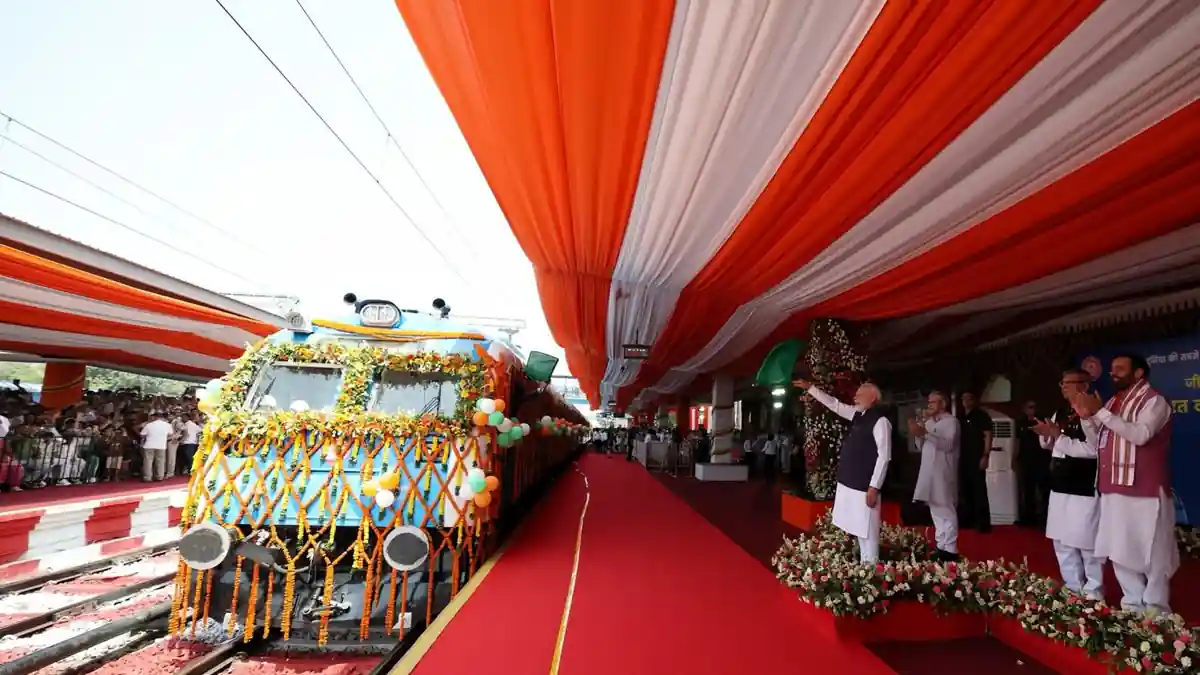
There's a particular kind of quiet that comes with a train running on water vapor instead of diesel smoke.
You don't smell it coming. On Friday, that quiet arrived in Haryana, of all places not Mumbai, not Delhi, but a modest junction town most Indians would struggle to place on a map until this week.
Prime Minister Narendra Modi flagged off the country's first indigenously built hydrogen-powered train at Jind railway station, sending it out on its debut run along the Jind–Sonipat corridor of Northern Railway. With that, India stepped into a club that, until now, counted only Germany, Japan, China and the United States as members and by most accounts, it didn't just join quietly. It joined loudly, with a train bigger than anything the others have managed to put on rails.
The name it's been given wears its politics on its sleeve: NaMo Green Rail, borrowing the Prime Minister's own initials. Cynics will roll their eyes at that, and fair enough. But underneath the branding sits engineering that's genuinely hard to shrug off.
This is no token prototype rattling along for a photo-op. It's a full 10-coach formation, built to carry something in the region of 2,600 passengers reportedly making it the most powerful and longest hydrogen train running anywhere on Earth right now, dwarfing the two- and three-car sets Germany and Japan have been quietly trialling for years.
Strip away the fanfare and here's what's actually powering it: a 1,200 kW hydrogen fuel cell system, cleared for 75 kmph in service with a design ceiling of 110 kmph.
At the heart of it is a Proton Exchange Membrane Fuel Cell hydrogen and oxygen meet across a polymer membrane, electricity comes out the other side, and the only exhaust is water vapour. No sproton exchange membrane fuel cell:o diesel haze hanging over the platform.
It was designed and built entirely at home, coach by coach, at the Integrated Coach Factory in Chennai, to specifications signed off by the Research, Design & Standards Organisation. That matters if the government wants to make a point about self-reliance, and it clearly does.
Jind itself now hosts the country's largest railway hydrogen storage and refuelling facility, purpose-built to keep this one train fed twice a day, every day.
None of this happened overnight, whatever the headlines this week might suggest. Indian Railways first floated the idea back in 2023, under a scheme with the almost poetic name "Hydrogen for Heritage" the original plan was to convert scenic, heritage lines like Darjeeling and Kalka-Shimla away from their diesel and steam engines.
Thirty-five hydrogen trains were envisaged, at roughly ₹80 crore apiece, with another ₹70 crore per route for infrastructure.
Jind-Sonipat took a slightly different route to get here. Rather than a from-scratch build, an existing DEMU rake was retrofitted, at a sanctioned cost of about ₹111.83 crore, including infrastructure.
Then came the unglamorous crore, a full year of trials through 2025, checking emergency braking, oscillation, and running stability—the kind of testing nobody writes headlines about, but that decides whether a train is safe to fill with 2,600 people.
The Railway Board cleared it for commercial service oscillation, and 2026. Bastability—the later, it's carrying passengers.
The pitch for hydrogen rail is fairly simple once you strip away the jargon: it's a way to clean up routes that will probably never justify the cost of stringing overhead electric wires hill sections, remote branches, heritage lines.
Hydrogen carries about 120 megajoules of energy per kilogram, against diesel's 43, and burns clean at the point of use.
It also slots neatly into two much bigger promises India has made to itself: net-zero emissions by 2070 and energy independence by 2047.
Sitting behind all of it is the National Green Hydrogen Mission, backed by close to ₹19,744 crore, funding everything from electrolyser factories to pilot projects exactly like the one now trundling through Haryana twice a day.
Here's the part that tends to get skipped in the celebratory coverage: nobody involved is pretending this is cheap or simple.
Railway Minister Ashwini Vaishnaw told the Rajya Sabha back in 2023 that running costs for hydrogen trains hadn't even been worked out yet in the Indian context — the working assumption is that they'll start high and only come down as the fleet grows.
Hydrogen also needs to becontext—the serious pressure or extreme cold, which drives up both cost and the safety systems wrapped around it. And every time you convert electricity into hydrogen and back into electricity again, you lose energy along the way a real disadvantage next to simply running wires overhead wherever that's actually possible.
None of that seems to be slowing anyone down, at least not yet. If the Jind-Sonipat pilot holds up over the coming months and that's still an if, however confident the flag-off looked, it becomes the working template for the other 34 trains still on paper under "Hydrogen for Heritage."
What started this week as a single train on a single stretch of Haryana track is meant to be the opening move in a much longer bet on how India's diesel-dependent lines eventually get their power.
Whether that bet pays off is a question the next few years of running data, not this week's ceremony, will actually answer.