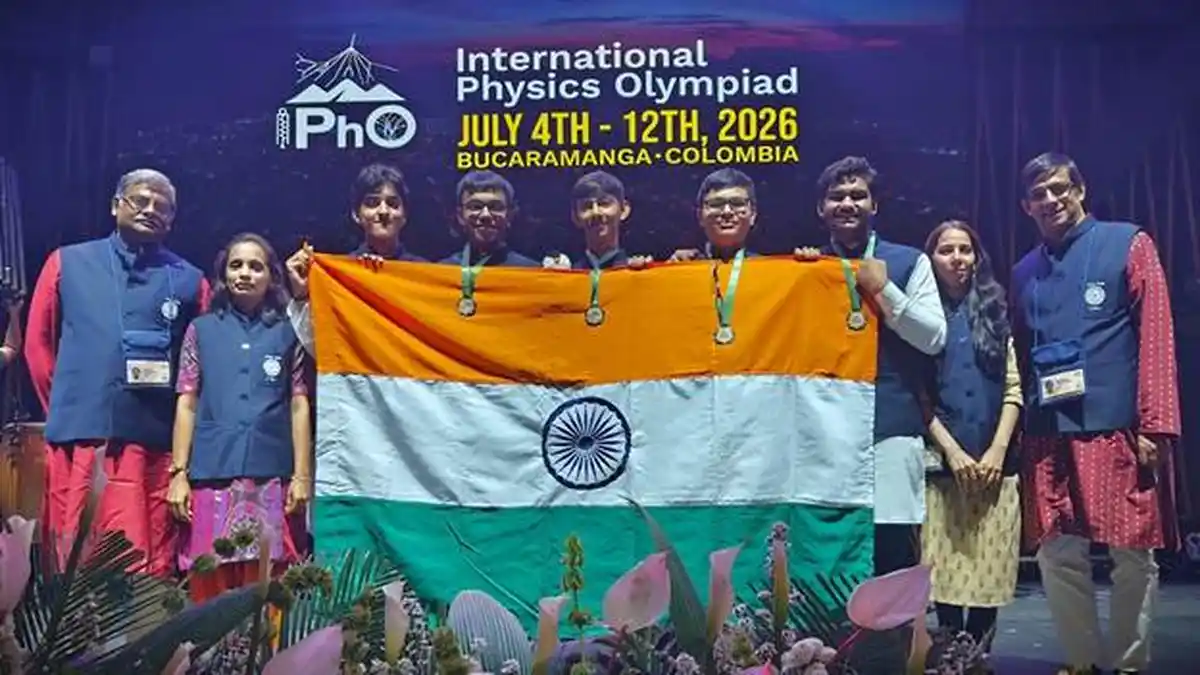
It was one of the best performances ever by India in the field of international science. It should be noted that the 56th International Physics Olympiad (IPhO) 2026 turned out to be quite successful for India. The international contest was held in Bucaramanga, Colombia, from July 4 till July 12, and the whole team of India, comprising five students, won the gold medals, meaning that all medals went to India.
At present, India occupies the leading position among six countries ranking in the world rankings, such as Russia, China, Kazakhstan, South Korea, and Taiwan. Given that IPhO is one of the most difficult international competitions, it can be considered a considerable achievement.
IPhO is a yearly competition that brings together top physicists around the world who are mostly school students preparing to enter the university. The teams consist of 5 participants chosen by each country. The competition itself is very difficult and includes both theoretical problem-solving and practical experimental physics.
The theoretical test includes multi-step problems that are quite challenging and sometimes require the application of physics ideas far beyond the ordinary school program. The experimental test assesses totally different skills—such as conducting experiments, using equipment properly, measuring accurately, and coming up with correct conclusions in a limited period of time. To succeed in IPhO, students need not only theoretical knowledge but also practical experience of real scientists.
This year the contest gathered 381 participants from 87 countries.
The five gold medal winners of India were from different cities of India, showing how far and wide-reaching the pipeline of talent for science in India has become:
- Kanishk Jain – Pune, Maharashtra
- Riddhesh Anant Bendale – Indore, Madhya Pradesh
- Rishit Garg – Dwarka, New Delhi
- Shresth Suraiya – Mumbai, Maharashtra
- Svarit Joshi – Ahmedabad, Gujarat
These students needed to qualify through two rigorous tests of theoretical and practical physics; both of these form the basis of the IPhO competitions. The five contestants of India were competing with 381 students from 87 different nations, and each was amongst the brightest physicists in their age group.
It's particularly remarkable because these winners have diverse backgrounds. Coming from five different cities, spread across five different states of Maharashtra, Madhya Pradesh, New Delhi, and Gujarat, the science talent in India does not seem to be restricted to one place or kind of school.
A complete gold medal streak is uncommon even in the most successful Olympiad programs from around the globe. In most cases, a country with a highly successful science educational system ends up having gold, silver, and bronze medals in its delegation due to the high competitiveness of the competition and the small gap between the best participants. The fact that all five Indians managed to win this prestigious award in one Olympiad indicates more than individual achievements—it shows that the training program produces consistent winners.
This success is an addition to the already successful record of the participation of India in Olympiads. It was stated that all Indian participants have been winning podium positions in IPhO for the last ten years, which shows a consistent success trend over a decade. Such consistency can rarely be produced by coincidence—this shows a very effective selection and training system.
Besides this, the first position in the world with respect to Russia, China, Kazakhstan, South Korea, and Taiwan also needs to be accounted for. These countries are ones whose science education system is known to have a lot of rigor and specialization in it. One of them is India currently, an indication of how advanced the Indian system of science education has become.
In India, science Olympiads are conducted by the Homi Bhabha Centre for Science Education (HBCSE), which acts as the national centre of the Tata Institute of Fundamental Research (TIFR), working under the Department of Atomic Energy (DAE). The HBCSE acts as the nodal centre in conducting the science Olympiads in India.
The team from India was headed by Prof. Anwesh Mazumdar of HBCSE-TIFR along with Dr. Leena Joshi from St. Xavier's College, Mumbai and scientific observation from Prof. Ananda Dasguptu of IISER Kolkata and Nisha Kelkar of Gogate-Joglekar College, Ratnagiri.
Making it to IPhO is not an easy task. Students who eventually qualify for the Indian team have to go through rigorous selection process comprising school exams, olympiads at state and national levels followed by orientation and training programs at HBCSE. Mentors play an important role in helping students progress from learning physics through textbooks to applying their skills in practical problem-solving required at international level. This year's success also owes a lot to the training program as well as the five participants.
Prime Minister Narendra Modi congratulated the team on winning the medals and congratulated them for bringing glory to the nation through their performance. The Department of Atomic Energy also acknowledged the contribution of mentors and team leaders in making this happen. Medals like these do not come overnight; they are the result of consistent efforts and backing of institutions involved.
While it may be easy to dismiss all this as celebration, this kind of achievement also has implications on the larger Indian science education infrastructure, whether it be domestic or foreign. For one thing, such a feat usually has its consequences – it may inspire more educational institutions to give more credence to the concept of preparing for an Olympiad, may motivate more individuals to pursue a career in physics or research, and ultimately may strengthen the position of educational institutions such as the HBCSE, which have been quietly nurturing such talent over several years.
This comes at a time when there is much international debate about science education, talent pipelines, and how different countries prepare their youth for careers in science and technology. A feat such as this clean sweep by India does provide a data point proving that at the level of gifted pre-university students, India's education system can hold its own against the best in the world.