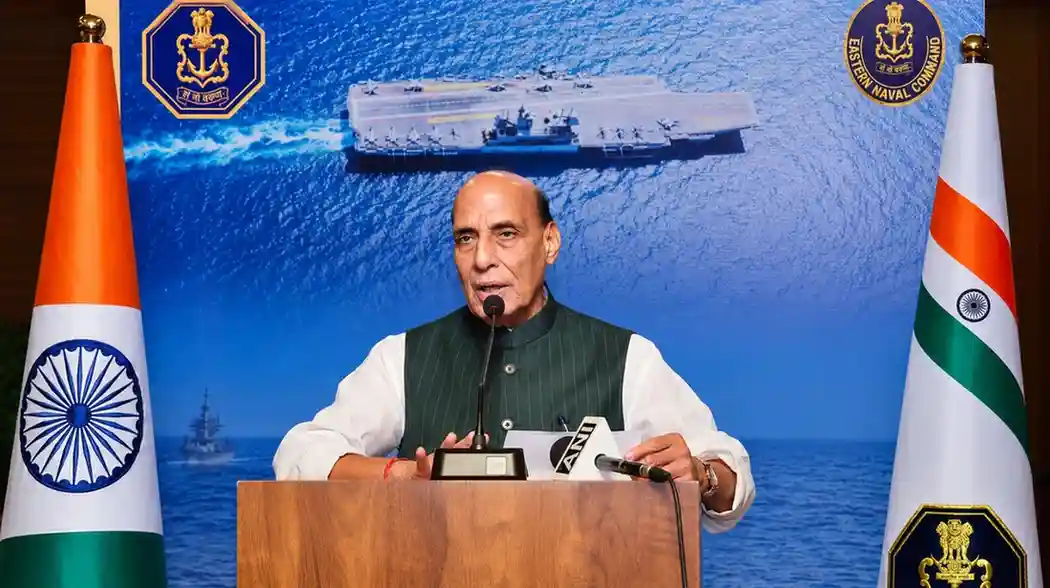
Defence Minister, Rajnath Singh, has once again stated his vision of how India should move forward in its defence manufacturing sector with a manufacturing target of ₹3 lakh crore and defence export target of ₹50,000 crore every year by 2029.
Speaking at an event in New Delhi on 18th July 2026, Mr. Singh mentioned "Operation Sindoor" as a case study for India's self-reliance in defence technology and manufacturing.
The target of producing ₹3 lakh crore is not a fresh statement, rather it’s something which has been repeated time and again by Singh along with updating it whenever he repeats the target with new statistics on production numbers and stating that there are good signs that the milestone is achieved successfully.
In his latest speech on Operation Sindoor, Singh has stated that the annual production of defense items has been at an all-time high level of nearly ₹1.78 lakh crore in the fiscal year 2025-26 against the ₹40,000 crore which were recorded in 2014.
The defense export has witnessed an extraordinary growth and increased from ₹686 crore in 2013-14 to more than ₹38,000 crore at present. There is a target of producing more than ₹2 lakh crore of defense items in the present financial year, which ultimately takes the target of ₹3 lakh crore in 2029.
The numbers are quite a climb up as compared to what the discussion was one year ago. Singh in the year 2025 has announced that the production number reached to ₹1.30 lakh crore with the same-year target being of ₹1.75 lakh crore.
Singh has focused much of his recent narrative on Operation Sindoor as an example of India's efforts at manufacturing and production for defence being realized in the real world.
The fact that the weapons and platforms utilized in the mission were manufactured in India has been cited by Singh as a way of reinforcing the point that India's push towards becoming "Aatmanirbhar Bharat" (self-reliant India) in defence is not just a policy statement but also an operational one.
This was done with the aim of emphasizing the bravery and professionalism of the Indian soldiers and the reliability of indigenous military technology.
The use of this event in Singh's narrative is two-pronged in its aim since it not only ensures the armed forces' readiness to defend the country, but also doubles up as a marketing exercise aimed at foreign customers who would be buying the Indian defence systems almost one-and-a-half times the present amount by 2029.
Apart from the manufacturing and export goals, Singh has also emphasized the importance of making structural investments, which would help create India's own defence manufacturing infrastructure.
According to Singh, establishing of the Defence Industrial Corridors in Uttar Pradesh and Tamil Nadu can be seen as one of the most transformative government efforts towards developing the country's indigenous defence manufacturing industry, as investments estimated to amount to around ₹70,000 crore have been made within the two corridors, out of which almost ₹10,000 crore has already been invested.
The export side of the equation can be said to have undergone an even more dramatic change.
According to Singh, the number of exports has increased nearly 34 times over the last 11 years, while defence items made in India are now exported to nearly 100 countries. Such a shift from a traditionally import-dependent country in terms of military equipment to an exporter of fully assembled military systems constitutes a major component of the government’s approach towards shaping India’s strategic profile.
As Singh has pointed out numerous times, India’s growing capabilities on the defence front should not be viewed as anything other than deterrence, as peace is only achievable through strength, and the country’s defence capabilities are merely a deterrent force aimed at ensuring peace and stability in the region.
Increasing to ₹3 lakh crore by 2029 when starting from an initial level of ₹1.78 lakh crore means nearly doubling output each year for the next three years, which may seem to be a very steep growth trajectory, but this growth is not something unheard-of considering the performance of the industry over the last decade.
Production, according to the government's figures itself, rose four times between 2014 and 2026, thereby giving some credence to the belief that similar or even better growth is possible in the future.
It all hinges on how much growth in production takes place because of investments made in the Defence Industrial Corridors and how consistent growth in exports is maintained in line with the government’s ₹50,000 crore export target.