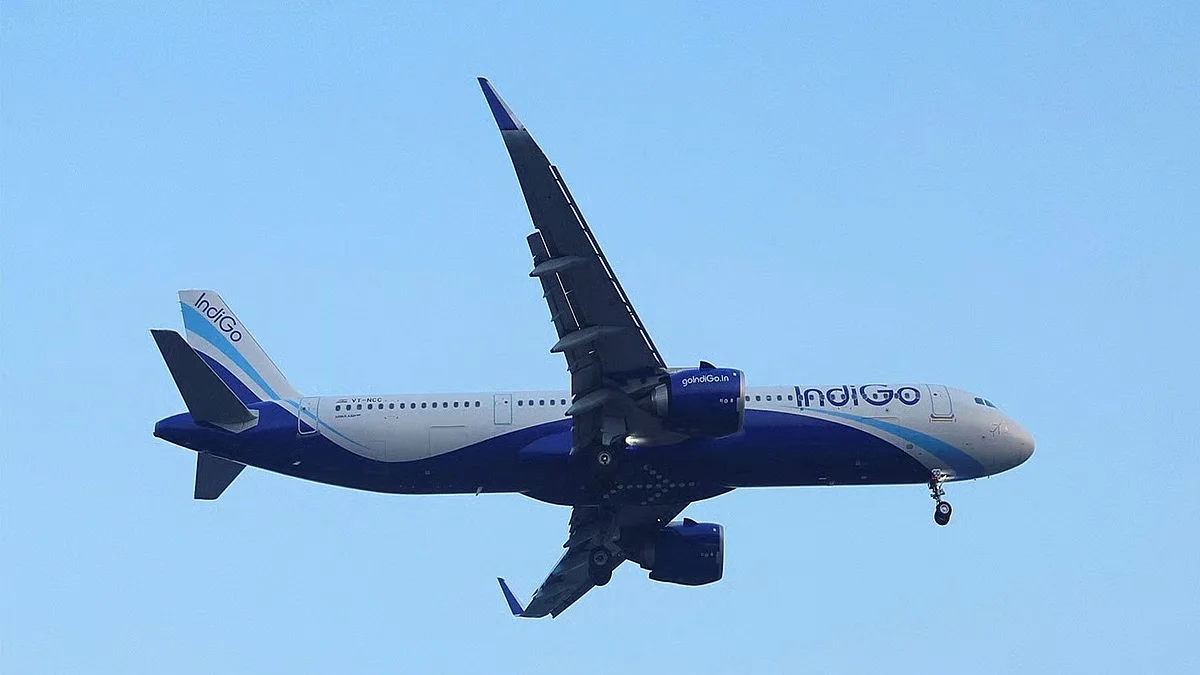
Our Tuesday journey that was expected to cover the route from Goa to Delhi in 2.5 hours, turned out to last only for 40 minutes. This happened because of the trouble faced by the aircraft’s engine at the time of take off; and eventually the flight made a safe landing at Manohar International Airport of Goa in just 30 minutes while carrying 229 passengers. IndiGo airlines’ flight 6E 2102 was to take off from Goa Airport at 9:16 AM, with New Delhi as its final destination.
After reporting the situation, the reaction of the air traffic control was prompt and handled in the right way.
The Air Traffic Control (ATC) called for a full emergency at about 9:30 am and the aircraft safely landed at the runway 28 at 9:51 am. The aircraft was completely parked at Stand 6 and the Air Traffic Control declared the end of the full emergency at 10:03 am.
The whole process took about 35 minutes and it can be seen that the aircraft was close to the departure airport when the problem occurred.
However, the airline was definitely more reserved in its description of the technical fault in comparison with some early descriptions.
As reported by IndiGo Airlines in a press release, "A technical fault was discovered soon after the aircraft took off from North Goa." As is our usual protocol, the authorities concerned were informed, and the flight was brought back to the Manohar International Airport."
According to a spokesperson for IndiGo Airlines, "We regret the trouble this has caused our passengers."
There has been varied language used by various sources and even the various statements issued by IndiGo about what went wrong, and it is important to note this difference.
While airport authorities and various news sources have used the term "engine failure" to describe the problem, the IndiGo statement was more conservative in that it only mentioned a "technical problem," but without mentioning that it was an engine failure. What really happened is not officially confirmed since it will be the responsibility of the engineering team on board to find out the exact cause.
It makes a great deal of difference whether we use the terms "engine failure" or "engine snag," since these terms are not the same at all.
The first and foremost thing about the day is that it is the easiest fact possible—everybody made it out of the plane without a scratch.
There have been no injuries reported during the whole event. All passengers left the aircraft safely and were provided with a place to stay until the airline sorts out some other options.
Inconvenient the whole situation may be, but it was true. The plane, which had to land in Delhi by 11:45 am, was rescheduled for departure at 3:30 pm, all depending on the clearing of the aircraft and other operational issues.
The plane won’t get into service till it passes through a safety inspection test.
The aircraft has gone for inspection and will be back into service only when it gets the required clearance, according to the statement from IndiGo. It also assured the concerned people that other means have been arranged for the passengers to reach their destination, Delhi.
The emergency landing of Tuesday is not an unusual occurrence but rather one in a string of technical problems in the air which have led to the diversion of IndiGo planes recently.
A different occurrence saw an IndiGo Delhi-Goa flight having to make an emergency landing in Mumbai due to a technical problem mid-air, where all passengers were safely disembarked and handled by terminal officials, while another aircraft from IndiGo was arranged to take the passengers to their destination in Goa.
The above occurrences of technical problems leading to diversion or the need for a return-to-departure are just a few that have been experienced by India’s biggest airline till 2026, a year that has seen IndiGo face a huge technical problem with its reservation platform in December and consecutive technical problems on its website in August.
But for India's largest airline, one that carries 67% of all domestic air travel in the country, this trend of technical problems has now reached a point where the scrutiny it is receiving is not limited to one particular occurrence.
The individual incidents such as the one that occurred on Tuesday have been successful in not causing any harm to anyone and in adhering to the appropriate protocols, with the pilots identifying the issue, declaring the appropriate emergency, and landing successfully. The combination of repeated engine problems in one single year added to the other operational and booking problems that IndiGo has had is fair cause to ask if there is something more behind these events.
One thing to point out is that initial reports on such events tend to be inconsistent, and that was the case this time around, with some sources terming it as "engine failure," some as "snag" and others just a "technical problem" without any one source providing an accurate account of what transpired.
As things stand now, before the technical team at IndiGo and possibly other aviation safety bodies conduct a full evaluation, the details of the problem on Tuesday need to remain under scrutiny.
Given that the aircraft is grounded to conduct maintenance and another flight has been organized to accommodate the stranded passengers, the current issue is sorted out, assuming there are no more delays on their part.
The real issue would be whether India's aviation watchdog, DGCA, scrutinizes IndiGo's history of technical problems in the current year, which would hold more weight for the airline than this one single flight being safely returned to its point of origin.