For a few days last week, it looked like the Strait of Hormuz might actually reopen. Then Iran released a list of demands that reads less like a negotiating position and more like a wish list.
On Thursday, Iranian and Omani negotiators reportedly agreed on coordinates for new shipping routes through the strait, the kind of technical breakthrough that usually precedes an announcement. Oman, playing mediator in a war it did not start, called the talks "positive and constructive." Optimism spread quickly through markets and diplomatic circles alike.
It didn't last. By Saturday, Mohammad Bagher Zolghadr, secretary of Iran's Supreme National Security Council and a Revolutionary Guard commander, issued a statement carried by state media: the strait will not open until America "corrects its behavior". His list of preconditions was long. Lift the naval blockade. End sanctions. Release frozen Iranian assets. End the war outright. Pay restitution for war damages.
Iran's foreign minister, Abbas Araghchi, added another wrinkle on Sunday, insisting there are no direct negotiations with Washington at all, only with Oman, and that agreeing on shipping coordinates is a technical and legal matter that has nothing to do with actually reopening the waterway.
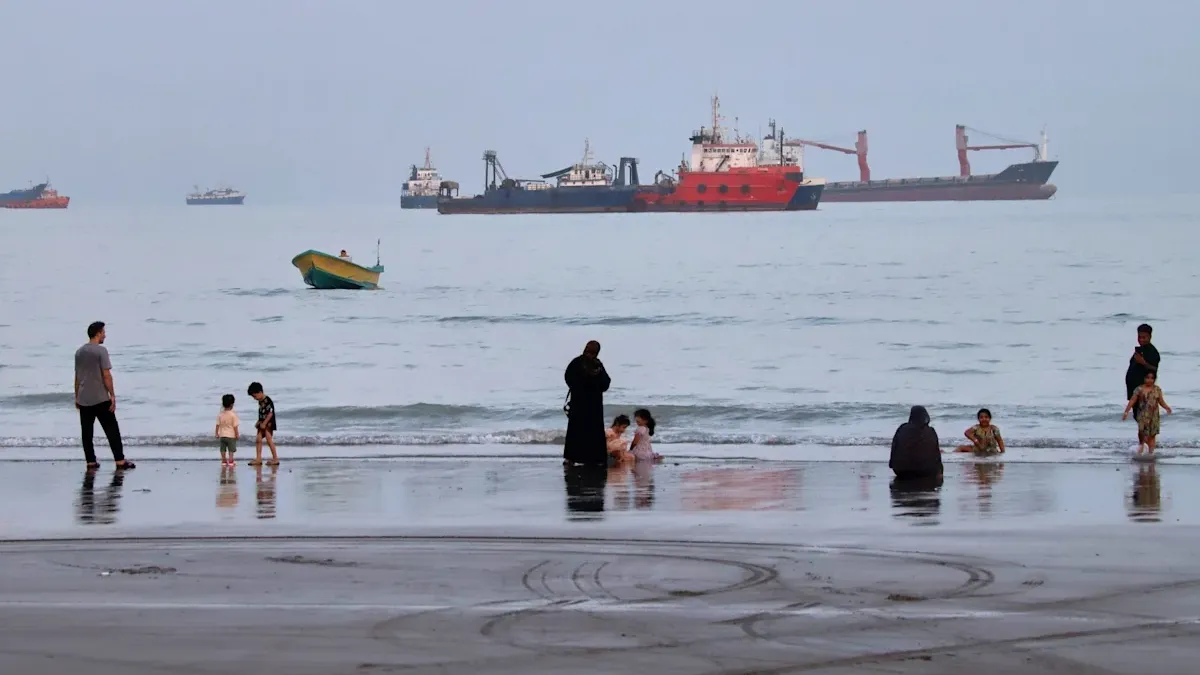
The route question itself has a messy history. After an earlier ceasefire, Iran had ordered commercial vessels to use a northern lane hugging its own coast near Larak Island. Washington pushed instead for a southern route along Oman's shore, arguing it was safer and more neutral. Iran rejected that idea, calling it a violation of the June memorandum, and reportedly began targeting ships that used the Oman route anyway. The coordinates agreed on Thursday were supposed to settle exactly this argument. Zolghadr's statement two days later suggests it settled far less than anyone hoped.
On Thursday, Iranian and Omani negotiators reportedly agreed on coordinates for new shipping routes through the strait, the kind of technical breakthrough that usually precedes an announcement. Oman, playing mediator in a war it did not start, called the talks "positive and constructive." Optimism spread quickly through markets and diplomatic circles alike.
It didn't last. By Saturday, Mohammad Bagher Zolghadr, secretary of Iran's Supreme National Security Council and a Revolutionary Guard commander, issued a statement carried by state media: the strait will not open until America "corrects its behavior". His list of preconditions was long. Lift the naval blockade. End sanctions. Release frozen Iranian assets. End the war outright. Pay restitution for war damages.
Iran's foreign minister, Abbas Araghchi, added another wrinkle on Sunday, insisting there are no direct negotiations with Washington at all, only with Oman, and that agreeing on shipping coordinates is a technical and legal matter that has nothing to do with actually reopening the waterway.
The route question itself has a messy history. After an earlier ceasefire, Iran had ordered commercial vessels to use a northern lane hugging its own coast near Larak Island. Washington pushed instead for a southern route along Oman's shore, arguing it was safer and more neutral. Iran rejected that idea, calling it a violation of the June memorandum, and reportedly began targeting ships that used the Oman route anyway. The coordinates agreed on Thursday were supposed to settle exactly this argument. Zolghadr's statement two days later suggests it settled far less than anyone hoped.
Oil traders, for their part, are pricing in more uncertainty, not less. Brent crude climbed above $84 a barrel on Monday, its third straight session of gains, up more than a quarter compared with a year ago. WTI sat just under $79. Both benchmarks have been swinging on every headline out of Tehran, Muscat and Washington since the war began in late February, when US and Israeli strikes triggered a closure of the strait that briefly sent Brent above $140 a barrel, a level not seen since 2008.
Prices have come down considerably from that wartime peak. They haven't settled.
A ceasefire in April and a memorandum of understanding in June briefly eased the pressure. Then the US reimposed its naval blockade on July 14 after the MOU appeared to collapse, and the tit for tat resumed. Attacks on tankers. Competing claims about who targeted whom. A fresh round of diplomatic shuttle talks that keep almost, but not quite, producing an outcome.
The uncertainty isn't just an Iran-US problem anymore. The United Arab Emirates said one of its ships, owned by the state oil company ADNOC, was struck while transiting the strait over the weekend. Yemen's Houthi rebels, who are backed by Iran, claimed a separate large-scale attack on Saudi-aligned forces. Britain's foreign secretary, Yvette Cooper, has gone as far as convening roughly 40 countries to demand what she called an immediate and unconditional reopening of Hormuz, a sign that patience outside the region is wearing thin too.
President Trump has kept up his usual public optimism, saying repeatedly that a resolution could come "pretty soon". Iran's public statements suggest otherwise, or at least suggest that Tehran's version of soon comes with a long list of conditions attached. Until that gap closes, the strait stays a bargaining chip, and every barrel of oil moving through it stays priced for risk.