In the past few days, several statements from both Iran and the United States have fueled speculation that a deal between the two countries could be reached soon. Recently, President Trump canceled a planned U.S. attack on Iran and said that the two sides were "very close" to reaching an agreement.
However, President Trump has made similar statements several times in the past, so his latest remarks did not receive much attention in the media. But when Iran's Foreign Minister, Abbas Araghchi, said on Friday evening during a television program that an agreement with the United States was on the horizon and that reopening the Strait of Hormuz would be part of it, it sparked fresh hope around the world that a deal between Iran and the US could finally be reached.
He said, "We are closer to an agreement than ever before. It could happen in the next day or two, or within the next few days."
Araghchi said that people should avoid speculating about the deal in the media, as such rumors and speculation could "damage the atmosphere" surrounding the negotiations.
According to the Iranian Foreign Minister, the proposed deal is only one and a half to two pages long and covers the key points that both countries have been discussing over the past two months.
Araghchi said, "Reports have been presented in a timely manner to the Supreme National Security Council and security institutions, and the military has also monitored key issues, including the Strait of Hormuz and the end of the war."
The Iranian Foreign Minister also spoke about the future of the Strait of Hormuz. He said that until now, services in the Strait of Hormuz had been free, but "Iran's final decision is that the management of the Strait of Hormuz in the future will be different from the way it was managed in the past."
Abbas Araghchi has previously made similar statements about the possibility of a deal on at least three occasions.
Abbas Araghchi's first statement came under the Islamabad Memorandum of Understanding (MoU), when he said that Iran and the United States were "closer than ever" to reaching an agreement.
Then came his second statement during an interview with Iran's state broadcaster IRIB on June 12, where he said, "The agreement could be signed in the coming days."
His third statement was that the deal could be signed remotely, without the need for an in-person meeting or direct talks between the two sides.
It is not just Trump who has made repeated statements about a possible deal; similar remarks have also come from the Iranian side.
On Friday, Iranian Foreign Minister Abbas Araghchi said during a television program that a deal could be reached. Following his remarks, Brent crude oil prices fell to their lowest level since early March.
Brent crude oil prices fell to $87.33 per barrel, down by $3.05, or 3.4%, compared to the previous day.
U.S. West Texas Intermediate (WTI) crude oil prices also fell to $84.88 per barrel, down by $2.83, or 3.2%. This is the lowest level for WTI since April.
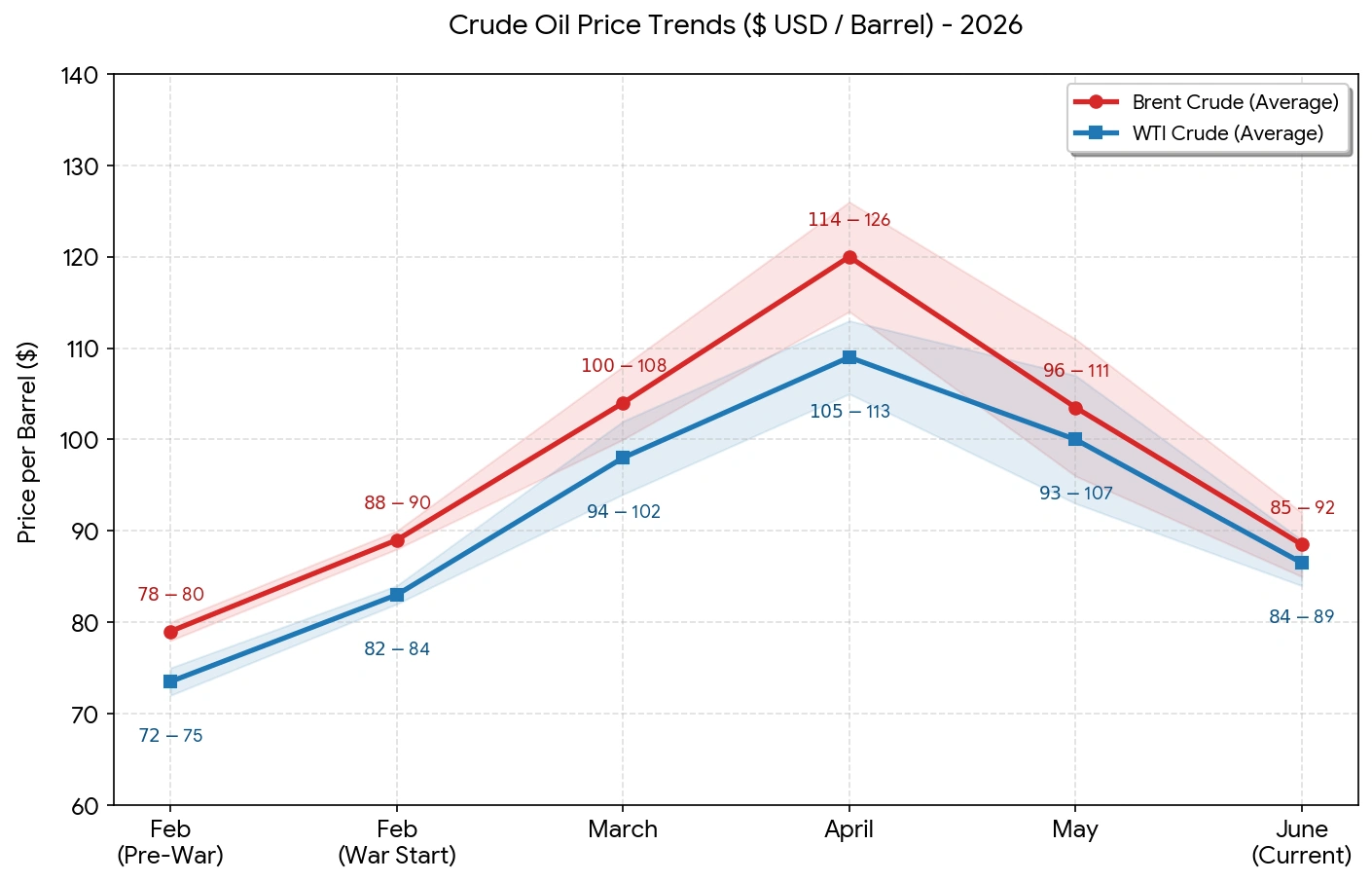
Photo: @The Indian Post Live
- February (before the war) Brent Crude: $78–$80, WTI Crude: $72 – $75
- February (start of the war) Brent Crude: $88–$90, WTI Crude: $82 – $84
- March Brent Crude: $100–$108, WTI Crude: $94 – $102
- April Brent Crude: $114 – $126, WTI Crude: $105 – $113
- May Brent Crude: $96 – $111, WTI Crude: $93 – $107
- June (current) Brent Crude: $85–$92, WTI Crude: $84 – $89