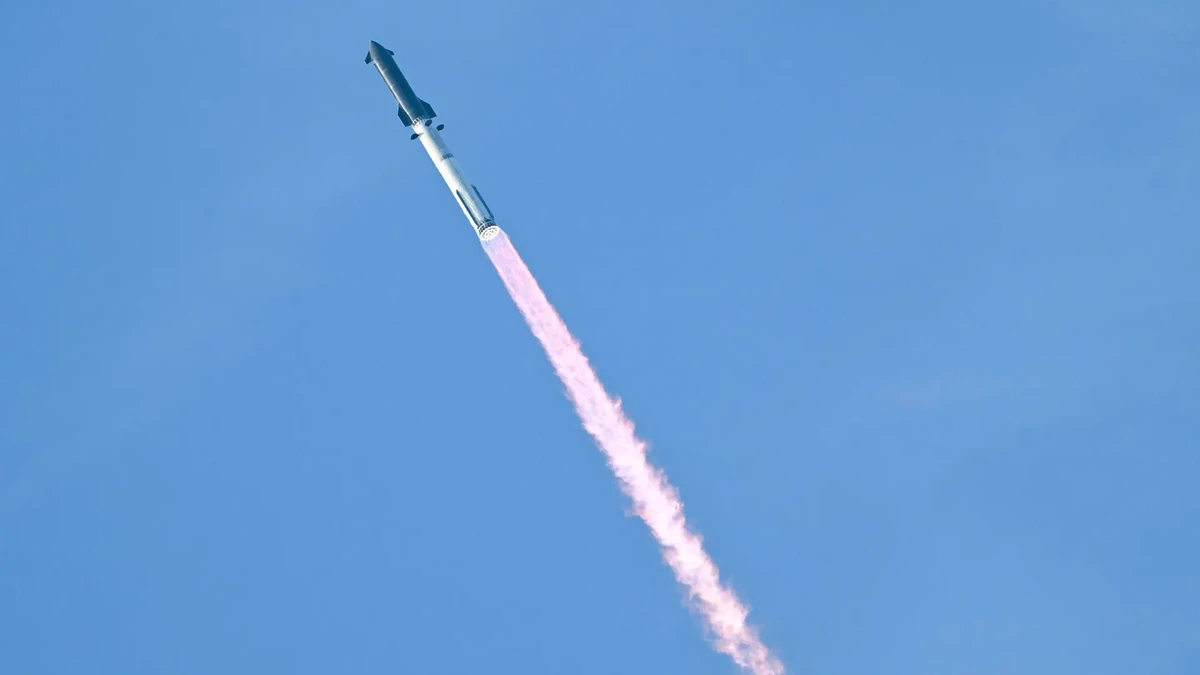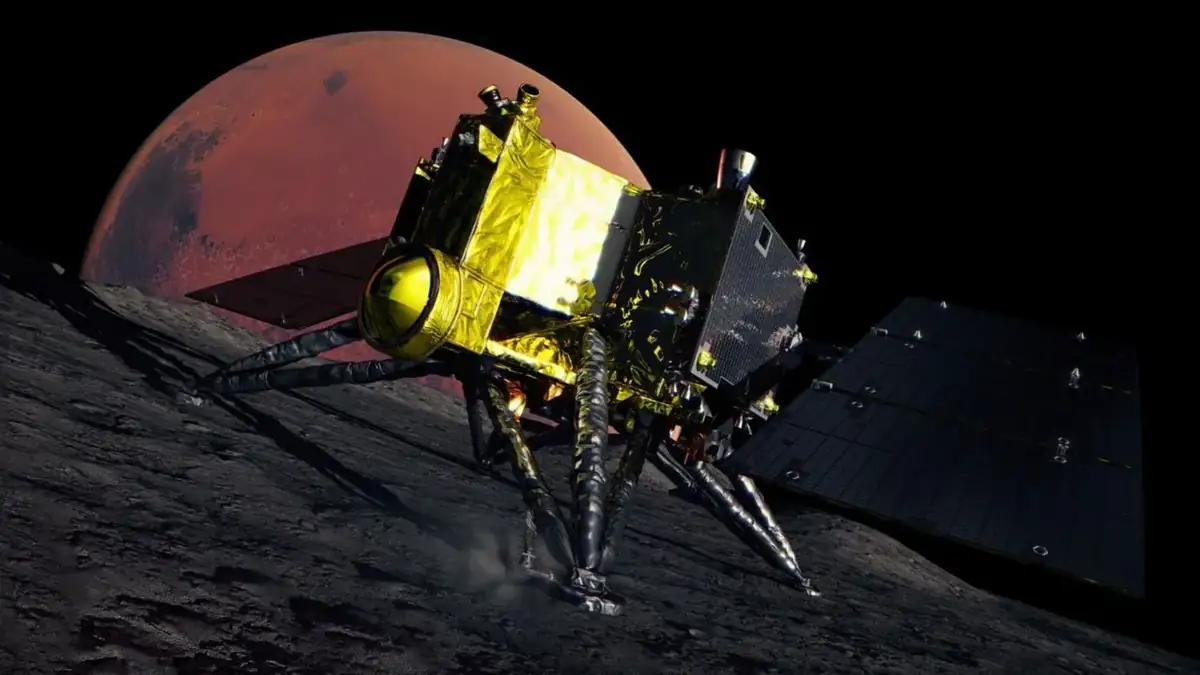
An H3 rocket left the pad at Japan's Tanegashima Space Center at 4:41 am on Tuesday, October 20, carrying the Martian Moons eXploration probe, or MMX. In GMT terms that was 1941 on Monday. The BBC, The Guardian and The Hindu all reported a successful launch within hours.
So Japan is on its way to Mars. The destination, though, isn't Mars itself.
It's Phobos.
MMX should arrive around 2027. JAXA's project manager, Kawakatsu Yasuhiro, has called Phobos an "unexplored frontier for humankind," which is a fair description of a moon nobody has ever touched.
Phobos is tiny and its gravity barely counts, so MMX can't orbit it the normal way. The plan is a quasi-satellite orbit: the spacecraft really circles Mars, but keeps pace with Phobos closely enough to look like it's circling the moon. Mapping comes first. Then the team picks a spot, and then the lander tries to set down in gravity so weak that a bad bounce is a real concern. ESA's own mission summary points out that landing and maneuvering in those conditions is a big part of the difficulty.
Two samplers are on board, because JAXA wants at least 10 grams (about 0.35 ounces) and would rather not rely on one device.
After roughly three years around Mars the spacecraft heads home in 2030. The return capsule is about 60 centimeters wide. It's due to land in Woomera, South Australia, in 2031.
Deimos, Mars's other moon, gets several flybys but no landing. The probe has 13 instruments, with contributions from NASA and France's CNES, and two 8K cameras made with the broadcaster NHK.
IDEFIX is a 25 kilogram rover built by CNES and Germany's DLR. Under Phobos gravity it would weigh around 15 grams. It will go out onto the surface before the main lander tries to collect anything, and the data it sends back is supposed to make that landing safer.
Nobody knows how Phobos and Deimos got there. Two explanations compete. In one, they're asteroids that strayed near Mars and got caught. In the other, something huge hit Mars, threw debris into orbit, and the moons formed from the wreckage.
You'd think decades of observation would have answered it. It hasn't. JAXA researcher Yada Toru says data from a distance can disagree with actual samples because of space weathering, the slow damage a surface takes from radiation and tiny impacts. He has also mentioned that Phobos might contain cometary material. If it does, MMX would return only the second comet sample in human history.
JAXA has bigger ambitions attached. It describes MMX as a way to build the technology for a round trip to Mars, and it has talked about Phobos as a natural space station for crewed missions. Those are the agency's words. There's no schedule behind them yet.
The original launch date was 2024. The H3 rocket ran into trouble, and Mars launch windows open only once every 26 months, so the wait was two years.
December 2025 made it worse. The H3 failed for the second time in seven flights, and for a while it wasn't clear that MMX would make this window at all. Investigators found a fairing separation problem, isolated it, and the launch plan went ahead.
Japan comes to this with experience. Hayabusa and Hayabusa2 both brought back asteroid samples, and the SLIM lander put down on the Moon within a tight target zone. Russia tried a Phobos sample return in 2011 with Phobos-Grunt. It never left Earth orbit.
Not much for a while. MMX cruises, controllers check it over, and course corrections are made as needed. The next real event is the Mars arrival in 2027.