
Micron’s had a year most chipmakers would kill for. The stock’s more than tripled since January, and depending on which week you check, it’s either riding high on fresh analyst upgrades or getting knocked around by competitive worries out of China. This week, it was a bit of both.
The headline number is the one that’s getting attention: a $3,000 price target, up from $2,100, a 43% increase in the firm’s own estimate. D.A. Davidson’s framing was blunt, essentially arguing that the market still hasn’t fully priced in how tight AI memory supply is likely to stay through 2027 and 2028. Analyst Thomas Luria pointed to Micron’s push to tie half its revenue to long-term, hard-to-cancel customer contracts as a key reason the business looks more predictable than it used to, not just a company riding a temporary AI wave.
That view isn’t an outlier, either. Of the 50 analysts tracked by LSEG covering Micron right now, 46 rate it a buy or strong buy. That’s about as close to consensus as Wall Street gets.
Micron’s most recent earnings report gave bulls plenty to point to. The company beat expectations for both its fiscal fourth quarter and full year 2026, and issued guidance for early 2027 that came in ahead of what analysts were modeling. Buried a bit deeper in the filing was arguably the more interesting detail: Micron reported $134 billion in remaining performance obligations under existing customer contracts as of early September, with roughly a quarter of that, about $33.5 billion, expected to show up as actual revenue within the next year.
That kind of locked-in demand is exactly what analysts like Luria have been pointing to. It’s a lot harder for a stock to feel speculative when a huge chunk of its near-term revenue is already under contract.
Micron also closed out a long-running legal headache this month, settling with Netlist through a five-year patent license agreement covering server DIMM and high-bandwidth memory technology. The deal comes with a real cost attached, $600 million paid out over five years, working out to roughly $30 million a quarter through 2031. That’s a meaningful fixed obligation, but relative to Micron’s current scale and cash flow, it’s not seen as a major drag. More importantly, it removes legal uncertainty that had been hanging over parts of Micron’s product lineup.
On top of that, Micron’s board expanded the company’s share buyback ceiling, a move that’s typically read as a signal that management is confident about future cash generation, even with a big capital expenditure plan still underway.
Not everything about this week was bullish, though. Micron shares dropped as much as 4.2% during a broader memory-sector selloff, triggered largely by news that China’s ChangXin Memory Technologies, or CXMT, is making faster-than-expected progress on denser DRAM designs and is now targeting the server memory market directly. That’s a space Micron and South Korea’s SK Hynix have largely had to themselves at the high end, so any credible competitor entering it is worth watching closely.
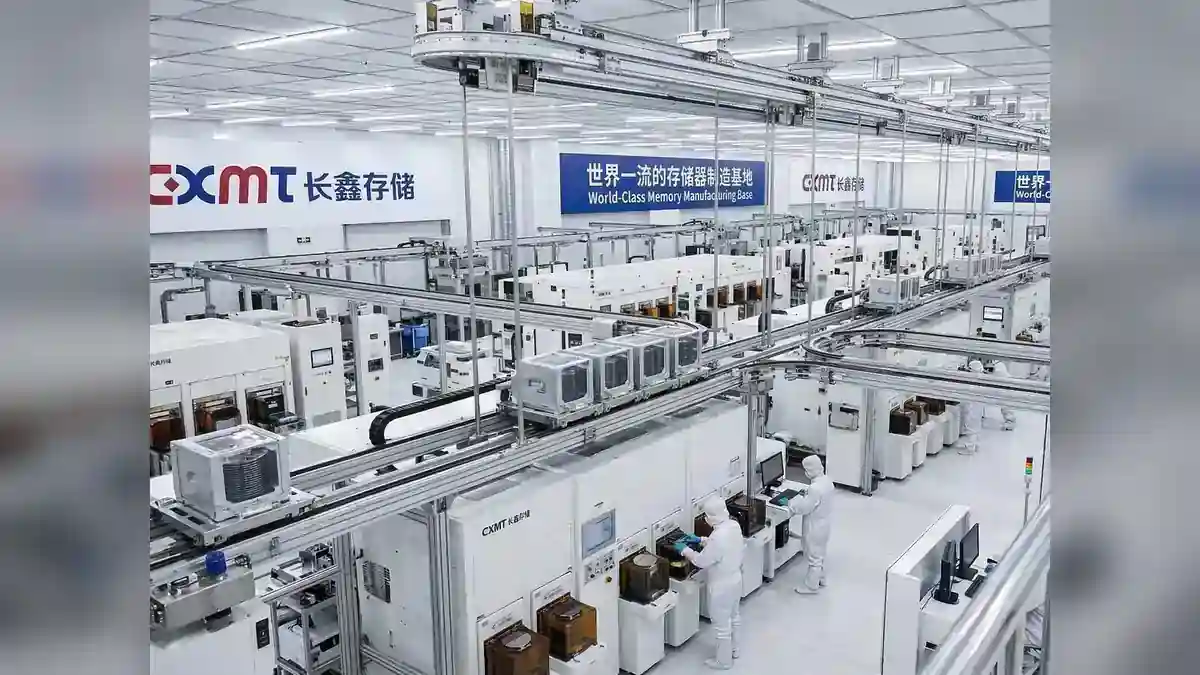
Photo: Getty Images
It’s not an immediate threat to Micron’s current contracts or guidance, but it’s the kind of development that tends to weigh on sentiment even when the underlying fundamentals haven’t changed. Memory is a notoriously cyclical, commodity-driven business, and any sign of new supply hitting the market tends to make investors nervous about pricing power down the line.
Beyond the stock price swings, Micron’s been making real physical investments to back up the AI memory narrative. The company broke ground on a new leading-edge memory manufacturing facility in Clay, New York back in January, part of a broader expansion tied to as much as $6.4 billion in direct CHIPS Act funding for U.S. production. It also completed an $1.8 billion acquisition of a wafer manufacturing facility in Taiwan earlier this year, adding capacity outside the U.S. as well.
The company’s also been simplifying its business in other ways, exiting the retail portion of its consumer-facing Crucial brand late last year, a move that lines up with Micron’s broader shift away from general computer markets and toward high-growth AI and data center demand specifically.
The core question hanging over Micron right now isn’t really about this quarter or even this year. It’s whether the AI memory boom driving all of this is a multi-year structural shift, as bulls like D.A. Davidson are betting, or a cycle that eventually cools off the way memory markets historically have. Competition from CXMT adds a new variable to that equation, one that wasn’t really part of the conversation a year ago.
For now, the numbers, those long-term contracts, the raised guidance, the expanded buybacks, are giving Wall Street enough confidence to keep piling into the stock, even after a 266% run this year already. Whether that confidence holds through the next earnings cycle, especially if Chinese competition keeps advancing, is probably the thing worth watching most closely from here.