Prime Minister Narendra Modi received Indonesia’s highest civilian honor in Jakarta on Tuesday as India and Indonesia made use of the PM's visit to sign an extensive number of deals that covered areas like defense, missiles, minerals, technology, and education, among others—marking the biggest expansion in bilateral relations since 2018 when relations were upgraded.
This trip is part of the PM's tour of the Indo-Pacific region, where he is expected to travel to Australia and New Zealand.
President Prabowo Subianto of Indonesia personally honored Modi with the 'Bintang Adipurna of the Republic of Indonesia,' which is the highest civil and military honor of the country, established in 1959 to recognize exceptional service. The award was presented during a ceremony at Istana Merdeka, which is the presidential palace of Jakarta.
The award comes with a rich history; it has been conferred upon only one Indian leader before, and that too way back in 1961 when the Republic of Indonesia honored India's first Prime Minister, Jawaharlal Nehru, with this award. Modi thus becomes the second Indian leader to have received this prestigious award after six decades.
On receiving the award, Modi showed humility, saying, "I receive the Bintang Adipurna of the Republic of Indonesia with great humility. This honor belongs to the people of India and the love of the people of Indonesia." He further said that the award was "an appreciation of the rich bonds between India and Indonesia."
On his side, Subianto described the visit as “a historic milestone,” pointing out that it highlighted the dedication of both countries in strengthening their relationship through “concrete and mutually beneficial cooperation.”
The award is just one of many high-ranking state honors that Modi has been conferred throughout his life in different countries, reflecting the importance of personal diplomacy on his foreign visits.
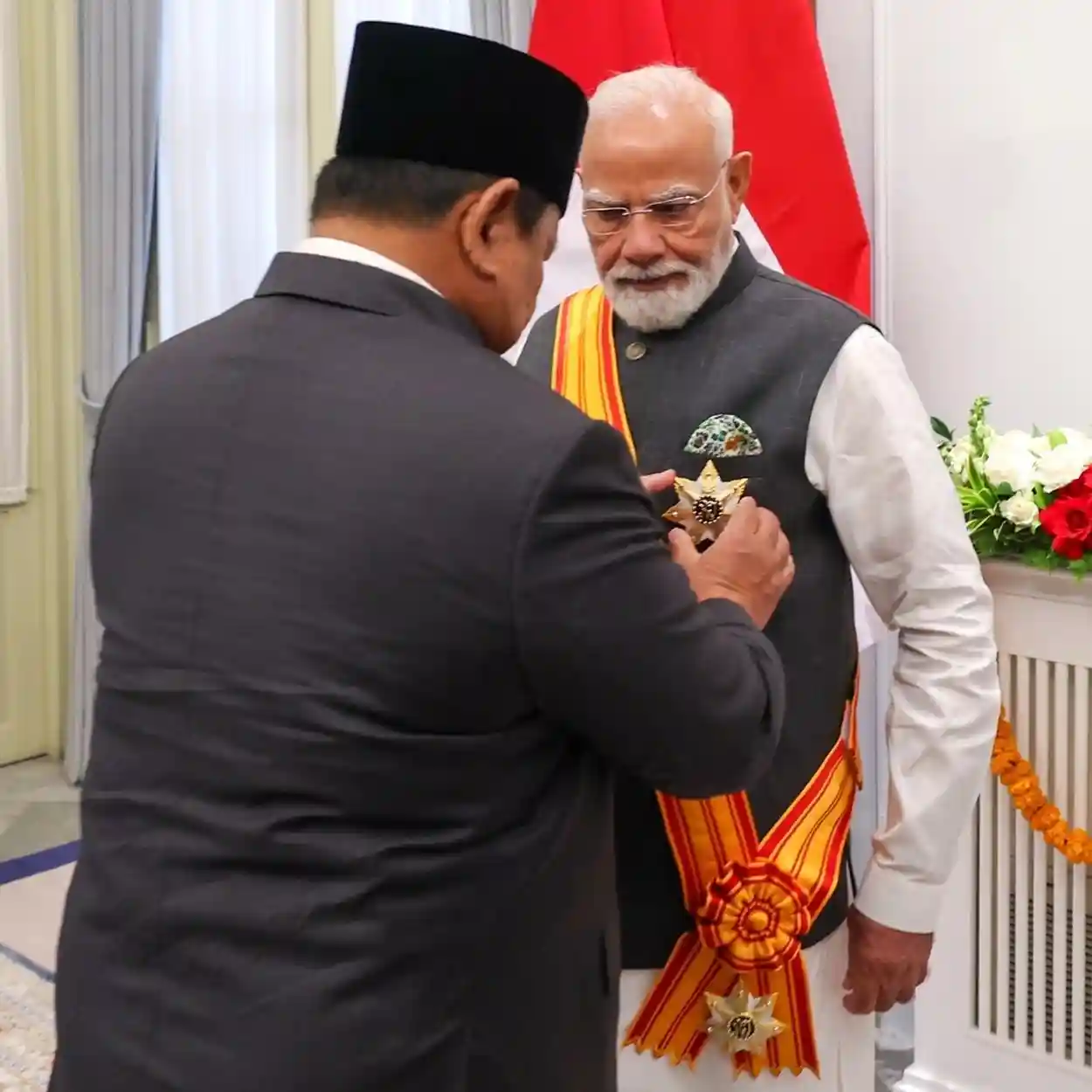
Photo: @narendramodi/X
The reception that was accorded to Modi in Jakarta was well prepared even before any deal could be done. He landed in the Indonesian capital city on Monday afternoon and was received at the airport by the Indonesian president together with four other ministers, which is a rare honor only accorded to the closest allies. Modi's arrival into the country was accompanied by an impressive welcoming ceremony, Guard of Honor, and a salute from the country's air force fighter jets.
The following day, at the palace, Modi was welcomed in the company of President Prabowo by children waving the flags of the two nations.
By far the most important aspect of the trip has been the signing of an agreement relating to the BrahMos supersonic cruise missile system between the Ministry of Defense of Indonesia and BrahMos Aerospace, the Indo-Russian firm that manufactures the missile. For India, this has been hailed as a huge success in the sphere of its defense exports, making the weapons system that has already created waves abroad even more widely available.
In addition to the BrahMos, there was an agreement reached for cooperation in the sphere of Astra air-to-air missiles via a deal between Bharat Dynamics Limited and Indonesian defense firm Republikorp. Overall, the two agreements mark the strengthening of a defense-industrial tie-up, rather than just one-time arms sales.
No financial details about the missile deals were provided by either party.
In total, the two governments signed 20 memorandums of understanding during the visit, spanning a wide range of sectors:
- Maritime Security: India and Indonesia finalized a joint framework for collaboration regarding maritime safety and security, which includes enhanced cooperation between their coast guards in terms of maritime domain awareness and also cooperation in the blue economy, port development, and regional connectivity in the Indo-Pacific region.
- Critical Minerals and Steel: An important memorandum of understanding was also signed on critical minerals and technologies for the steel value chain in order to make supply chains more resilient and to ensure a secure supply of such minerals as rare earth magnets.
- Education: One of the more peculiar memorandums of understanding included opening a branch campus of the Indian Institute of Management, Bangalore, in the Indonesian Special Economic Zone, Singhasari.
- Emerging Technologies: India’s prime minister and Indonesia’s vice president agreed that in the future the two countries will cooperate extensively in space, telecommunications, artificial intelligence, and digital public infrastructure.
- Other Areas: The leaders discussed other issues, including trade, human development, agriculture, food security, healthcare, and disaster management.
While addressing the media, Modi called these agreements the beginning of a "golden new chapter" in India-Indonesia relations, which would have a "profoundly positive impact on the world of the 21st century, on all of humanity."
Specifically, Modi emphasized the defense aspect of the visit, saying, "The increasing mutual trust of our countries is improving our defense and maritime cooperation. Today, we have decided to increase defense cooperation, cooperation in disaster management, and industrial cooperation. The coast guards of both countries will be cooperating for maritime safety and security of the Indian Ocean."
On the other hand, President Prabowo considered India a reliable strategic partner and appreciated cooperation in different fields.
This will be the fourth time that Modi visits Indonesia, but the first bilateral one since the Comprehensive Strategic Partnership was formed in 2018, during his first visit, where he met with former President Joko Widodo. The sheer number of agreements being made—from the tough security partnership with BrahMos missiles to soft power with the establishment of the IIM campus—indicates that both nations consider this visit a genuine reset and not just another step forward.
In the case of India, this visit is in line with India's trend of selling more defense equipment and building stronger ties with Indo-Pacific nations due to security concerns, especially about growing Chinese influence in Southeast Asia. With Indonesia being the largest economy of Southeast Asia and a major maritime nation, it is natural for India to build stronger ties with them.
In the case of Indonesia, the agreement provides them with cutting-edge missile technology from India and Russia and portrays them as a nation that hedges on its defense partnerships.