A handshake in Nice. A castle glowing saffron, white, and green in Bratislava. A lakeside resort in Evian where world leaders talked AI while ships quietly moved out of the Strait of Hormuz. And one more stop waiting in Paris before the week was even done.
Five-plus days. Four stops. One running theme, if you squint: India trying to stop looking like a guest at the table.
June 14. Modi lands in Nice. French officials roll out the welcome, the kind of arrival photo that looks identical to every other arrival photo from every other trip, except this time there's a slightly different set of flags.
The real moment comes a day later, when Modi and Macron jointly launch Bharat Innovates 2026—a three-day showcase of startups, deep-tech founders, and venture capital from India, France, and beyond, the sort of event name that sounds like it was workshopped by six different communications teams before someone just said, "Fine, ship it." Over a hundred Indian startups show up, spread across thirteen sectors—semiconductors, quantum, space, biotech, and defense.
Modi's pitch was pointed. A decade ago, he said, the world saw India as a technology adopter. "Not anymore," was the implication. He cited a startup base of more than 200,000 and leaned on India's "AI for All" line to make the case.
Whether the room fully buys it yet is a separate question. But that's the story India's telling now. Out loud. On a French stage.
This is the part that actually surprised people, and honestly, it's the one I keep coming back to.
Modi flew to Bratislava for the first-ever visit by an Indian PM to Slovakia since it became its own country in 1993. India's ambassador called it historic. Extremely important. Also, the first-ever meeting between Modi and Slovak PM Robert Fico. Also, somehow this is Slovakia's second high-profile Indian visit in two years —
The president went in 2025, and I still don't personally know anyone who's been there for so much as a weekend trip. Bratislava just isn't on the radar, which is sort of the point.
Slovakia didn't hold back, though. Talks happened at Bratislava Castle. Ties got upgraded to a comprehensive partnership. Eleven agreements signed—defense, quantum communication, labor migration, and higher education. The castle itself lit up in the Indian tricolor—a nice touch for a country most Indians couldn't place on a map a week ago, and don't ask me why Slovakia of all places, but apparently it worked.
It wasn't just optics either. Modi received the Order of the White Double Cross—Slovakia's highest civilian honor. Fico personally saw him off. Small country. Big gesture.
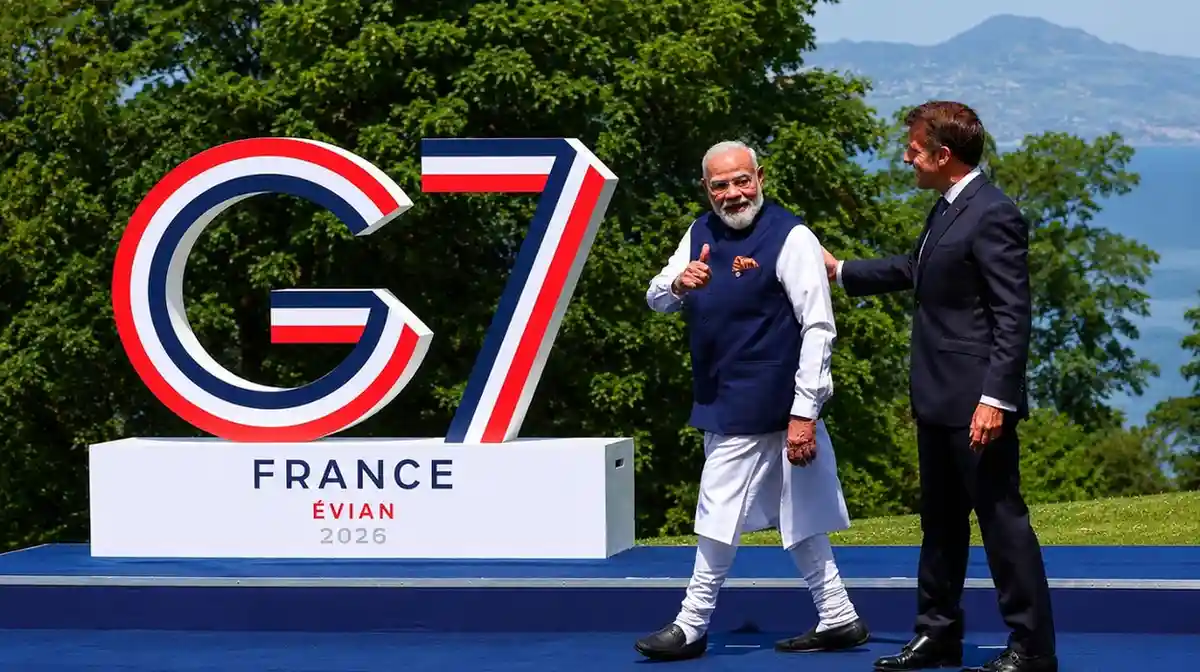
Back to France for the actual headline event — the 52nd G7 Summit, June 15-17, Evian.
Leaders gathered lakeside right after a preliminary US-Iran peace deal, with the next round set for June 19. Trump showed up too—notable, given he walked out early last year. Seventh straight G7 for Modi. Thirteenth for India overall.
Still not a member.
MEA stayed coy on a possible Modi-Trump sit-down. Didn't deny it either. Officially, the focus was renewing partnerships, developmental solidarity, balanced growth, and AI rollout — which is the kind of language that could describe literally any G7 summit going back fifteen years, so take it for what it's worth.
Unofficially, the wider agenda covered the West Asia peace deal, Ukraine, economic disparities, and critical minerals without leaning on China.
That last bit is the quiet thread under almost everything India's been doing in Europe lately. Find partners who aren't Russia. Aren't China either. For tech, minerals, defense, basically everything.
One more stop. June 18, VivaTech—Europe's biggest tech and startup event, tenth-anniversary edition, at Porte de Versailles. India holds the newly created designation of AI Country Partner this year, a recognition of the deepening tech partnership and India's growing voice in global AI governance.
Modi is expected to present India's MANAV framework for AI governance—moral and ethical systems, accountable governance, national sovereignty, that sort of thing—and I'll be honest, the acronym is trying a little too hard, but the substance behind it (balancing innovation with inclusion, rooted in Global South priorities) is a genuinely consistent thing Modi's been pushing across multiple summits this year, not just a one-off line for Paris.
The guest list alone tells you how big the stage is: Nvidia's Jensen Huang, Meta's Yann LeCun, Mistral's Arthur Mensch, OpenAI's Sarah Friar, Anthropic's Mike Krieger, and Hugging Face's Thomas Wolf, all in the same building. Modi himself said
He was glad to attend one of Europe's most important tech gatherings and that he'd meet the Indian community in France the same day.
Four days of summits, one warm and casual meet-and-greet, and India's flag on basically every major European tech stage available that week.
Strip the flags and the castle lighting. France gives India a door into capital and deep-tech research it doesn't have enough of at home, plus a now-official seat at the AI governance table. Slovakia's a smaller bet, but a foothold nobody else was racing for. The G7 gives India a seat at the table even without membership.
None of this guarantees anything. Summit agreements get signed every year and quietly go nowhere—the India-EU FTA has been "advancing" since roughly 2007, for what that's worth.
Five-plus days, four stops, one upgraded partnership, eleven new agreements, a G7 seat, a headline slot in Paris. Whether it adds up to anything beyond a very good week of photographs—ask again in a year.