Moderna's stock does not usually move like this anymore. Wednesday, it did.
Before the opening bell, Merck and Moderna said a personalized mRNA cancer vaccine, given alongside Merck's blockbuster immunotherapy Keytruda, hit both main goals in a Phase 3 trial for high-risk melanoma. First time an mRNA cancer vaccine has ever succeeded in a late-stage study. Not a small trial, either. 1,137 patients, randomized, and the companies are calling the results "clinically meaningful," which in pharma-speak is about as close to celebrating as a press release gets.
Shares jumped 60% in premarket trading. Then kept going. By midday Moderna was up somewhere near 150%, a level the stock hasn't touched in years. Merck, being Merck, rose about 2%. That gap alone tells you who needed this win more.
INTerpath-001 enrolled patients whose melanoma, stage IIB through IV, had already been cut out surgically. Worth sitting with that for a second. This isn't treating a tumor. It's trying to stop one that's already gone from coming back, in people who technically look cancer-free but statistically aren't in the clear.
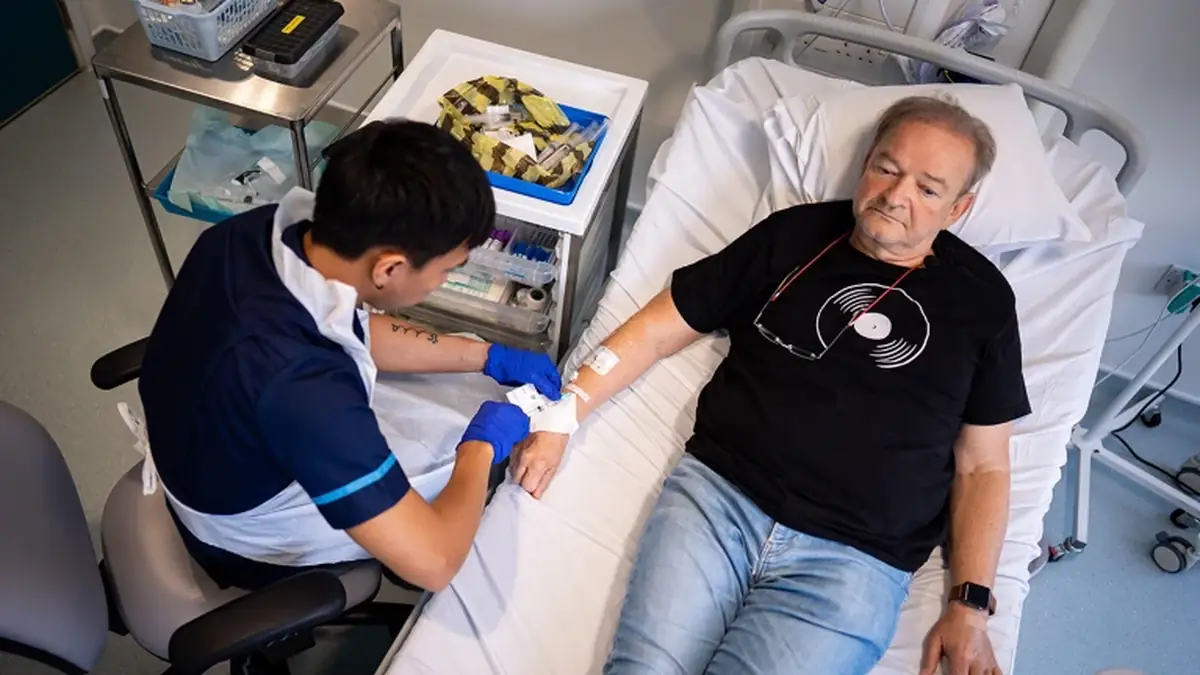
Patients got either Keytruda alone, the existing standard treatment, or Keytruda plus the vaccine, called intismeran autogene. At a planned interim look, the combo beat Keytruda alone on recurrence-free survival (how long before melanoma returns) and distant metastasis-free survival (how long before it spreads somewhere new). Both endpoints hit.
And yet. No actual numbers came out Wednesday. No hazard ratio, no specific percentage, nothing published in a journal. It was a topline press release. The real data, whatever it turns out to be, shows up later at some unnamed medical conference and goes to regulators separately.
Doesn't seem to have dented anyone's enthusiasm much. Catherine Wu, an oncologist at Dana-Farber, told reporters the early report is promising and builds on a decade of smaller studies pointing the same direction. She went a step further too, saying it's genuinely plausible this approach extends past melanoma into other cancers entirely.
Here's the part that still sounds a little like science fiction even though it's been in trials for years now: there is no generic version of this vaccine. Each dose is made for exactly one patient. Researchers sequence that person's tumor, find the specific mutations driving it, and build an mRNA shot that teaches the immune system to recognize the abnormal proteins those mutations produce. One tumor, one formula, one patient.
This isn't coming out of nowhere. Back in 2022, an earlier mid-stage trial of the same combination cut the risk of recurrence or death by 44%. By January of this year, five-year follow-up data pushed that number to a 49% reduction in recurrence risk and 59% for distant metastasis. Wednesday's trial was bigger, later-stage, and basically built to confirm what those smaller numbers had already suggested.
Moderna has spent a few rough years trying to find a second act once the COVID vaccine windfall dried up, and honestly, mRNA as a technology has taken its share of skepticism and political heat since then. A clean Phase 3 win in oncology, nothing to do with infectious disease, is close to the best possible proof that the platform actually works outside a pandemic.
Moderna President Stephen Hoge told reporters thousands of patients who've had melanoma surgically removed could see this treatment as soon as next year, assuming the fuller data holds and regulators move fast. Behind the scenes, Merck and Moderna already have eight or nine other trials running, testing the same personalized-vaccine idea against lung cancer, bladder cancer, renal cell carcinoma. Melanoma was just supposed to be the proof of concept.
The disease itself is still no small thing. Over 330,000 people were diagnosed worldwide in 2022, and the U.S. alone is expecting around 112,000 new cases this year, with more than 8,500 deaths. Surgery helps, but a meaningful chunk of high-risk patients relapse anyway. That's the exact gap this vaccine is aimed at.
Merck and Moderna said Wednesday their personalized mRNA vaccine, intismeran autogene, combined with Keytruda, succeeded in a 1,137-patient Phase 3 trial for surgically removed high-risk melanoma, the first positive late-stage result ever for an mRNA cancer vaccine. Moderna's stock surged as much as 150% during the day while Merck edged up 2%. The companies haven't released specific numbers yet, promising full data later, though earlier mid-stage results showed roughly 49% and 59% reductions in recurrence and metastasis risk. Outside oncologists called it promising, and the same vaccine approach is already being tested in several other cancers.