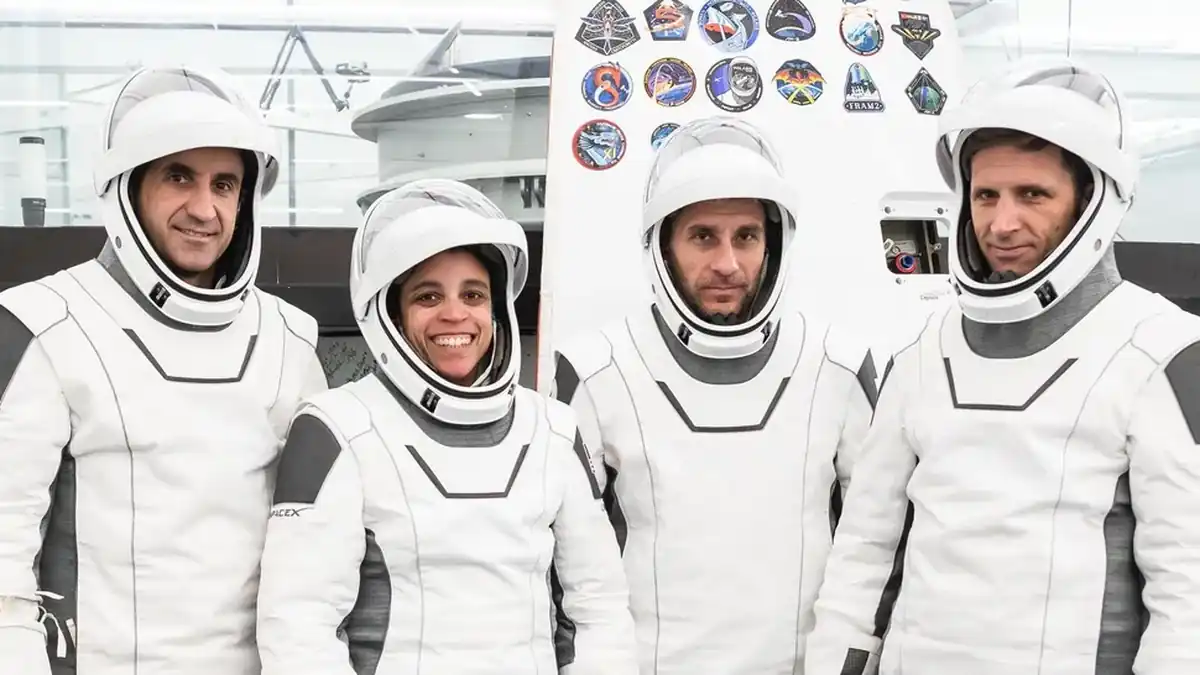
Jessica Watkins, Luke Delaney, Joshua Kutryk and Sergey Teteryatnikov now know when they're leaving Earth. NASA, SpaceX and the Canadian Space Agency confirmed Tuesday that Crew-13 will lift off Thursday, October 1, at 11:10 a.m. EDT from Space Launch Complex 40 at Cape Canaveral. The crew rides up in Dragon capsule Grace, on top of a Falcon 9, headed for the International Space Station.
It's been a long three weeks getting to this point.
Back on August 29, engineers doing routine prelaunch checks on Grace found an oxidizer leak in the capsule's propulsion system. Not the kind of thing you wave off. Oxidizer is what lets the thrusters actually fire, and a Dragon that can't fire its thrusters on command is a Dragon that shouldn't be docking with a space station, or trying to get four people home if something goes sideways up there.
So the flight, originally penciled in for mid-September (September 12 had been floating around in early planning docs), got pulled. NASA and SpaceX didn't announce a replacement date right away. Teams spent the following weeks running tests and digging through data instead, trying to figure out whether the fix was a quick patch or something more involved. By mid-September, spaceflight-tracking accounts like LabPadre were already pointing toward early October, and for a stretch, October 5 was the number getting passed around before NASA landed on the 1st.
Three weeks is nothing compared to some Commercial Crew slips over the years, some of which have run for months. Still, it's three weeks the crew, and the station, didn't plan on losing.
Watkins is commanding. She's a geologist by training, spent years poring over Mars samples with the Curiosity rover team, and flew to the station once before on Crew-4 back in 2022. This trip makes her the first NASA astronaut to fly Dragon twice. Delaney, in the pilot's seat, is new to all of this. Former Navy aviator, research pilot at Langley, first spaceflight.
The other two seats belong to Kutryk (Canadian Space Agency, former fighter and test pilot out of Alberta) and Teteryatnikov (Roscosmos). Four astronauts, four flags on their shoulder patches. It's the kind of international crew makeup that's become almost routine for station rotations now, even with everything else going sideways geopolitically.
Once Dragon docks, the four join Expedition 75 for a stay that's expected to run close to 180 days. Call it six months of experiments, maintenance and the general grind of keeping a space station running, before they head home sometime next spring.
Nobody comes down from the ISS until their replacements show up. That's just how the schedule works. So the delay on the ground turned directly into extra time in orbit for the crew already up there, who'd been counting on Crew-13's arrival to start their own handover process. A three-week slip here means three extra weeks for them, no way around it.
Roughly two weeks out from launch, Watkins, Delaney, Kutryk and Teteryatnikov head into quarantine at Johnson Space Center in Houston, standard practice meant to keep anybody from catching something right before liftoff. From Houston it's on to Kennedy Space Center in Florida for the final stretch: suit checks, training runs, last looks at the hardware.
Between now and the 1st, expect the usual pre-launch rhythm. A flight readiness review. A dry dress rehearsal in the capsule itself. Briefings on what science payload is riding along. Florida weather in early October is its own variable, and a day or two of slip wouldn't shock anybody if a storm parks itself over the Space Coast at the wrong moment.
The leak's fixed, or at least NASA and SpaceX say it is. The date's on the calendar. Now it's just a matter of getting through quarantine.