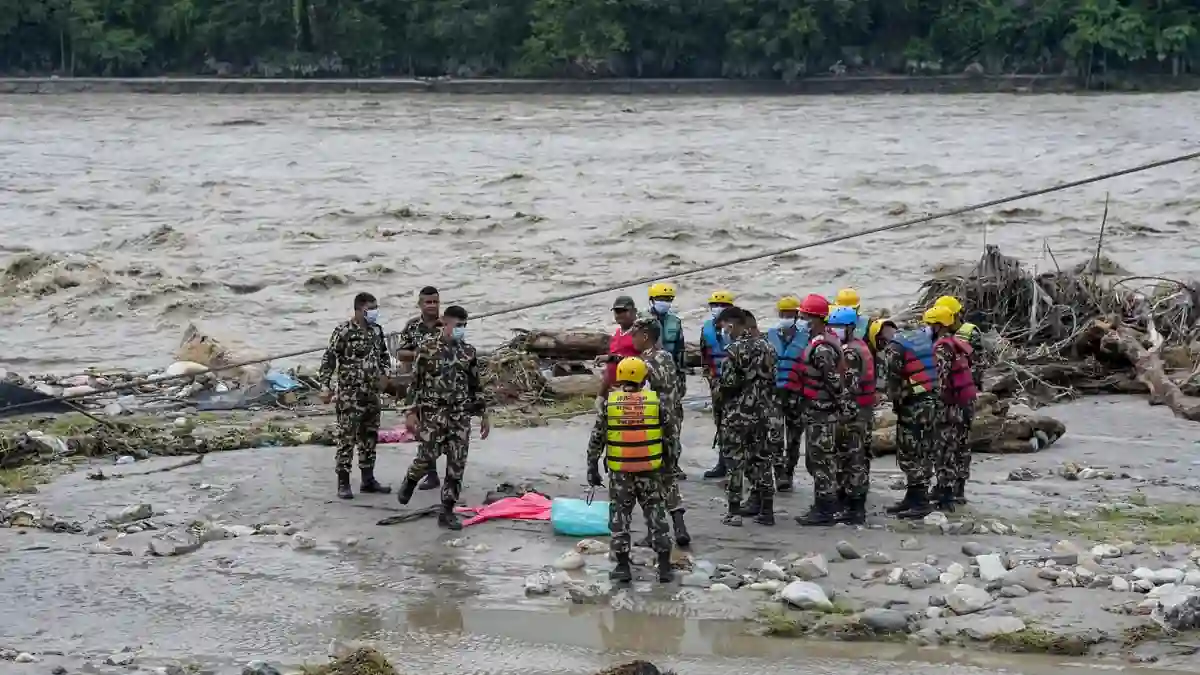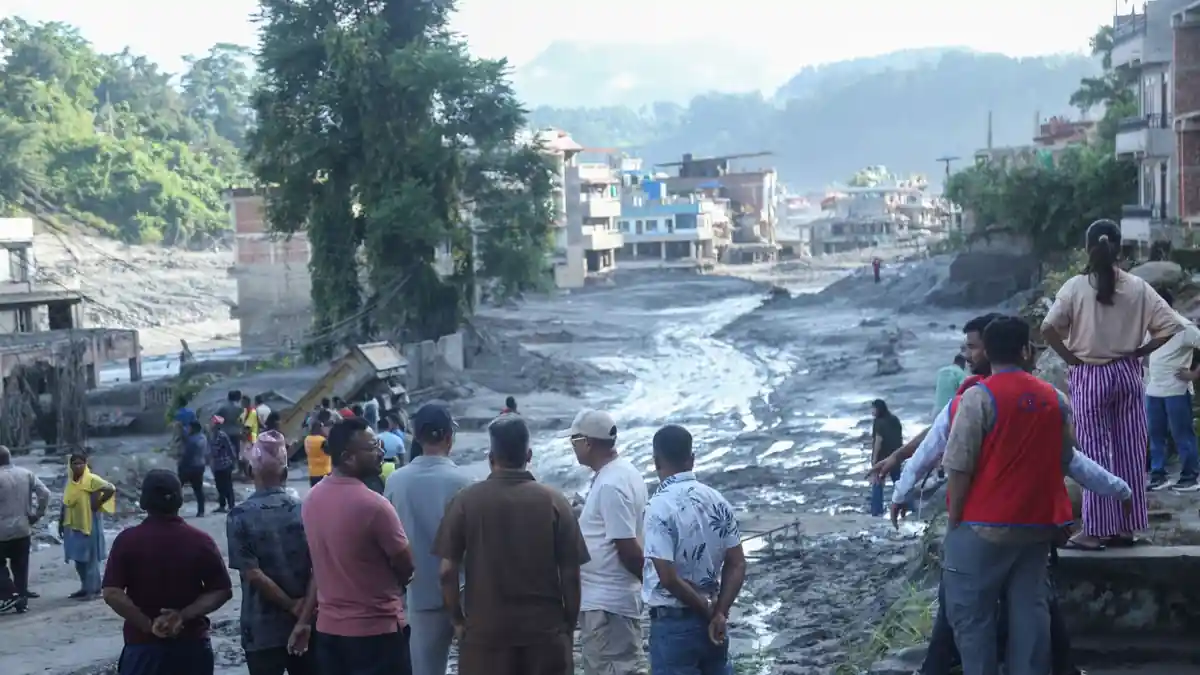
There have been reductions in the levels of the flood water in many areas, but the silt from the flood waters remains in its place.
The major floods caused by a collapse of a section of the glacier along Nepal-Tibet border, which occurred on Wednesday, have resulted in at least 750 deaths and over 3,000 people missing with the Nepalese government stating that over 100 workers are trapped inside several tunnels in hydroelectric projects.
By Sunday, there were additional casualties as rescue teams focused on the Trishuli 3A and 3B sites where some survivors can still be reached.
However, at the Trishuli 3A site, located in the Rasuwa district of Nepal, the search-and-rescue teams are engaged in the difficult task of breaching a way to those who may be trapped there.
At Trishuli 3A on Saturday evening, the army rescue team, by drilling a hole into the upper part of the mud-filled tunnel, was able to pump air and also use a camera to determine the condition inside.
Nevertheless, the operation was not continuous. The rainfall during the night coupled with increased river levels made the area very wet until conditions improved to allow them to proceed.
The recovery operations have had to change with changing circumstances.
"Given that the floodwaters have receded, the team has been able to resume their efforts to find the tunnel opening with the help of drilling machines, excavators, hydraulic cutters, and other types of equipment," stated a spokesperson from the Nepal Army on Sunday.
However, there is a more positive report from the Minister of Energy, Water Resources and Irrigation of Nepal, Biraj Bhakta Shrestha: "We have been successful in the ongoing rescue operations of the Trishuli–3 'A' Hydropower Project tunnel which was covered by mud and sludge due to the flood." The minister revealed that they were able to drill a 6-inch hole into the top part of the tunnel after clearing the mud and sludge with excavators.
This particular rescue mission is of crucial importance due to the sheer number of people who were working in the hydropower projects of Nepal at the time of flooding.
According to the Independent Power Producers' Association of the country, there are around 898 people missing in the hydropower projects of the country. As per their reports, there have been around 361 rescues so far.
As per a different estimation by CNN, there have been approximately 279 hydropower workers rescued in Nepal, or have been able to walk out of the muddy and silt-filled tunnels.
According to Nepali army spokesperson Brig. Gen. Raja Ram Basnet, it was extremely challenging to physically locate the entry and exit points of the tunnel.
"It is difficult to locate the entrance and exit of the tunnel since it is all covered with mud," Basnet said in an interview with the Associated Press. "The priority is to rescue the people trapped inside."
In Nepal at the Upper Trishuli-1 Hydropower Project site, footage revealed that a man was being dragged through the mud-covered tunnel. There were reportedly dozens of others who were trapped in such tunnels in the area.
For Trishuli 3A, the approach has moved from excavating the area to a focused and sustained one while the general rescue operation proceeds.
They have been working throughout the night and into Sunday drilling a hole in order to provide them air and give them food to sustain them until such time that the rescue operation can get to them.
Also among those listed as missing persons working on the hydropower project include those people whose families are only beginning to understand the gravity of the situation.
This includes a man seeking out his brother-in-law, who used to work alongside him in the same team in the tunnels. The man says, “She is my sister and she is pregnant,” and starts weeping immediately.
Some people have come to the place as volunteers and not as government officials. Amar Bista, who is a tour guide and was not working at the tunnels, started helping out immediately after hearing about the accident, since many members of his family and friends were there.
Considering the difficulty of the rescue operation, Nepal’s government decided to seek assistance from international technical experts for this particular stage of the rescue mission, which marks a departure from their previous stand rejecting the idea of foreign rescue teams.
Appeals have been made by the Nepali government for sending experts from India and China to rescue people stuck within the tunnel. Teams from India and China have arrived in Nepal on Saturday.
According to Al Jazeera's Minelle Fernandez who was reporting from Kathmandu, “the government is bringing these experts in to bridge the gap in its efforts,” saying that, “the government is trying to give it its best shot, bringing in these experts to see if there is any way or means of bringing out anyone who is still alive.”
Disaster has spared no side of the border, and there is an additional body count on the Tibetan side.
The casualties in China resulting from the floods on Wednesday have reached 16 deaths and a number of at least 546 missing, reported the state-owned broadcaster CCTV. There are 261 foreigners missing on the Chinese side of the border, including 18 US citizens, as stated by the authorities in a press briefing on Sunday.
The science behind Wednesday’s tragedy has now been explained following satellite imagery analyses.
Scientists believe that the satellite images have indicated the fall of bedrock under the glacier located in the Himalayan region that swept away parts of the glacier along with it. The impact was so great that a 5.2 magnitude earthquake occurred due to it.
The rocks along with water from the melted ice led to the sudden increase in the level of water in the rivers within the valleys, leading to huge floods that wiped out all that came in their way within Tibet and Nepal, and extending up to 100 kilometers downstream.
Anyone who knows what happened during the Chamoli incident in 2021 in Uttarakhand would see this tunnel rescue operation in Rasuwa is highly reminiscent — right down to the technique used for rescue.
In that unfortunate incident too, triggered by a glacial burst, rescue agencies bored holes through the debris of the Tapovan tunnel to save around 30 people stuck within it; finally, when they reached the slush till 140 meters, they had to stop owing to the sludge beyond that distance which took about a week altogether, saving nobody at all from the depths of the tunnel.
This clearly shows not only the rescue technique being used in Nepal but also how bleak the chances are for those still stuck in the tunnel days after the disaster.
Now that drilling, excavating, and cutting machines are being used together at Trishuli 3A and 3B, and tunneling experts from India and China have arrived to help, the next few days will prove crucial in determining whether some of the 900 missing hydropower workers can be found alive.
The fact that so much has changed so fast, with heavy rains having flooded the excavation site shortly after the breakthrough occurred, means that the search efforts continue to be at the mercy of weather conditions and the river flow.