Heat conduction is a phenomenon not quite intuitive at the atomic level. As the atoms vibrate, a special type of energy carriers, called phonons, move heat across a solid object. Typically, in everyday objects, the process works in a simple way — when the phonons move through the substance, they collide with one another constantly, which results in an even distribution of heat in the form of expanding circles of waves, much like when one drops a stone into the water surface.
However, depending on certain parameters, the process of heat transportation may occur otherwise. Namely, the phonons may exhibit their quantum properties in the form of being coherent and move in a specific direction instead of scattering randomly. The phenomenon is called phonon focusing and was previously observed only at cryogenic conditions near absolute zero, roughly -273°C .
Researchers from the UCLA Samueli School of Engineering, led by mechanical and aerospace engineering professor Yongjie Hu, have now discovered otherwise. As described in their paper, published in Nature Physics, the phenomenon of phonon focusing may happen at room temperature – around 300 Kelvin, or 80 degrees Fahrenheit – in the case of boron arsenide, a crystalline semiconductor known for its extremely high thermal conductivity.
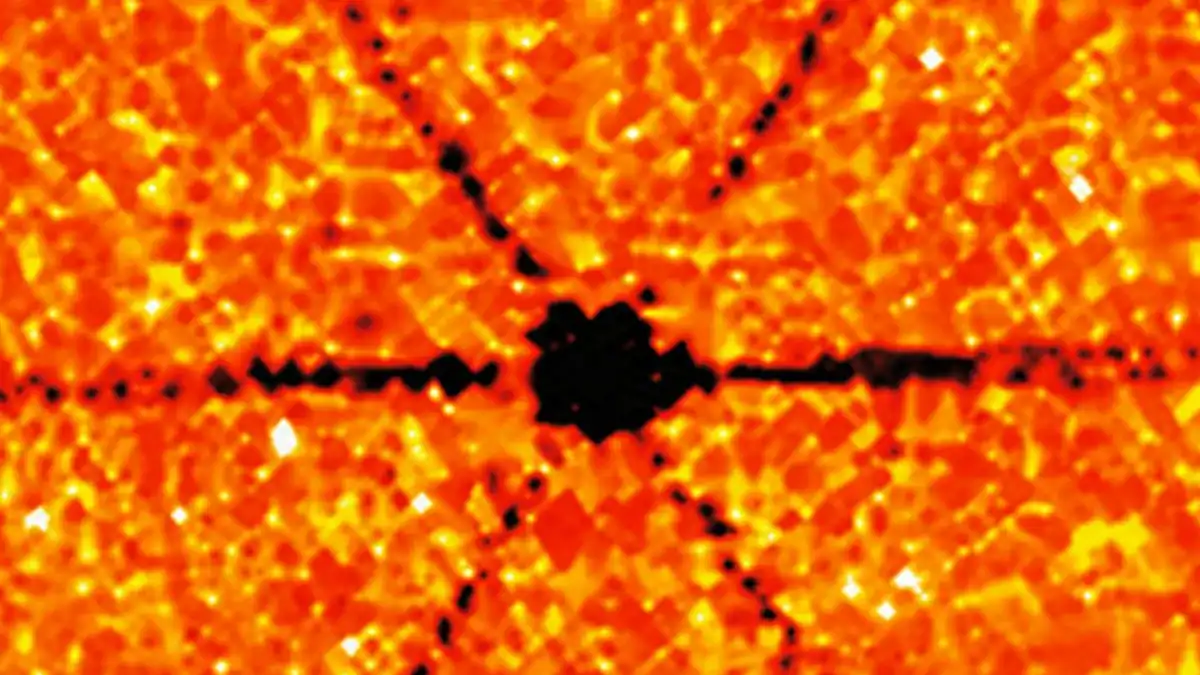
In order to observe the effect, the researchers created a nanoscale thermal mapping technique which allowed imaging how heat was distributed from the source. In case of ordinary materials used for the test, the heat spread in the usual way – forming a circle. In the case of boron arsenide, however, the thermal pictures showed that heat did not spread uniformly from the source; instead, the heat radiation formed sharp rays in specific directions.
The number of the rays depended on the plane of the crystals' lattice being imaged, and varied between four, six, and eight – just as it would be expected from the models describing quantum phonon transport in such a material. This allowed the researchers to conclude that they indeed observed the phenomenon of phonon focusing.
The reason behind this breakthrough is how far the phonons travel in boron arsenide before they scatter. The answer is that phonons travel a very long distance in boron arsenide before scattering takes place, unlike most other materials, where the phonons scatter in very small distances, making the wave like focusing effect impossible in those materials at room temperature.
This effect worked from distances between about one micrometer to tens of micrometers, which is exactly the physical dimensions of components used in today's microelectronic and photonic devices.
This was the reason that made this effect practically significant and not scientifically theoretical, since it works within the dimensions of components used in the devices and not just in laboratory conditions and at cryogenic temperatures.
Effective heat handling has turned into one of the critical barriers in developing future-generation electronics. As chips get smaller and more densely-packed, and as AI hardware and quantum computing technologies increase power density, traditional heat dissipation methods are getting less and less effective in cooling parts.
The vast majority of the current solutions focus on cooling diffused heat by utilizing materials and structures optimized for absorbing it as effectively as possible. The UCLA discovery leads towards a completely new approach to solving the problem as an efficient thermal conductor like boron arsenide would be capable of guiding the heat in the predetermined nanoscale-precise manner right from its generation, kind of in a way that how optical fibers carry the light signal in one direction without letting it diffuse.
According to Hu, his team demonstrated the first step towards room-temperature quantum thermal engineering, meaning the possibility of wave-like, directional heat transport at room temperatures is not just an exotic thing anymore but something that can be implemented.
Possible applications may include better cooling techniques for microelectronics, AI accelerators, and quantum computers hardware.
Apart from Hu, the other authors on this paper are Man Li, Huan Wu, Zihao Qin, Chuanjin Su, and Huu Duy Nguyen, who are all graduate or former graduate students in Hu's H-Lab at UCLA Samueli.
This study was made possible through financial support from the U.S. Department of Energy, the National Science Foundation, the National Institute of General Medical Sciences, and a grant from Parag and Falguni Patel.
Computational facilities were made available through UCLA's Institute for Digital Research and Education Research Technology Group and the Bridges-2 supercomputer at the Pittsburgh Supercomputing Center.