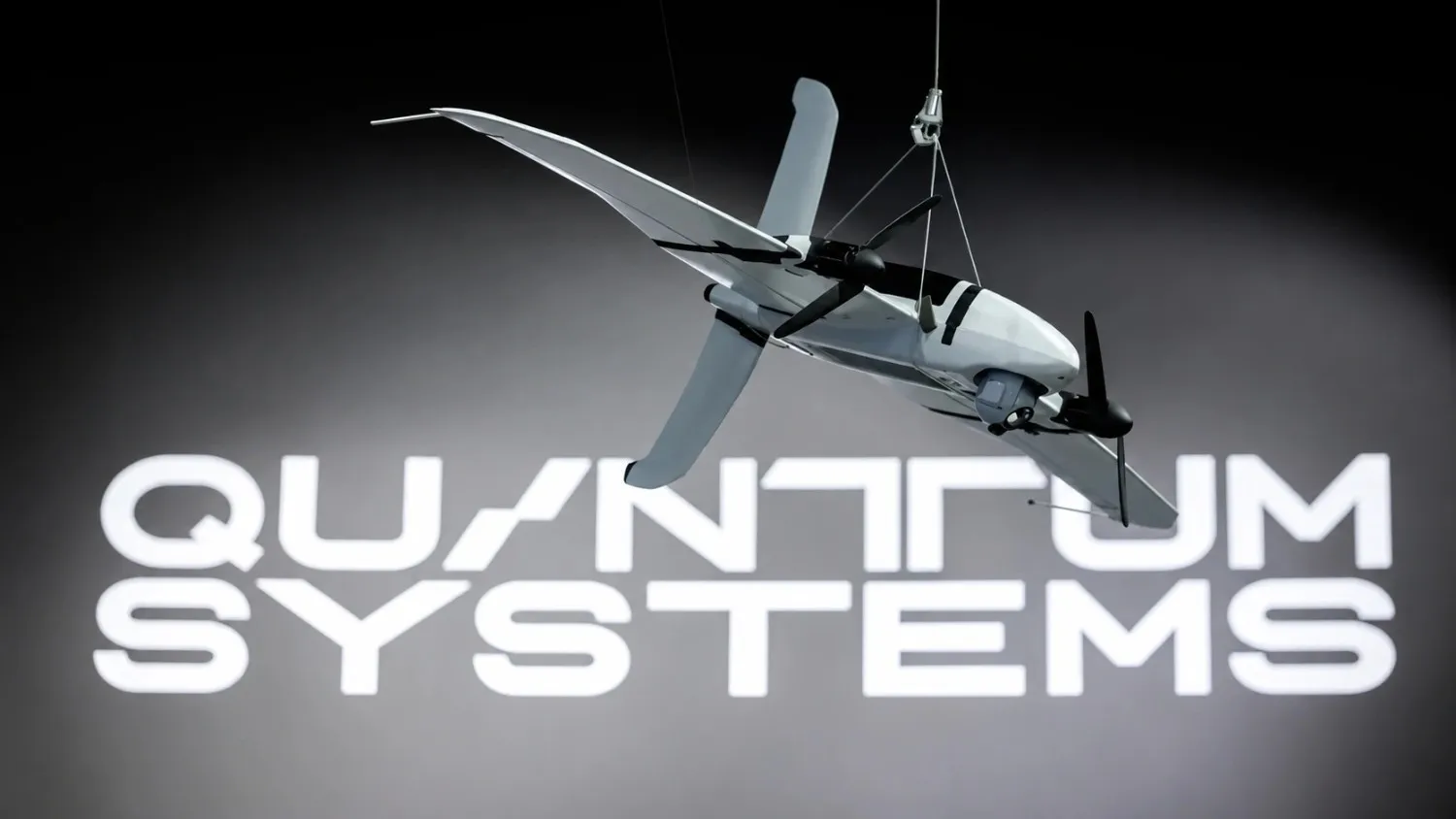
The Munich-based defense startup Quantum Systems, which specializes in the development of autonomous drones for both civil and military purposes, has recently received $1.2 billion in its latest funding round. According to an announcement made on July 2, 2020, the value of the company has increased to $8 billion on a post-money basis, thus doubling the value of the firm from eight months ago.
This is one of the biggest funding rounds secured by any European defense tech company and reflects the increasing interest of the international community in defense tech investments.
This financing round, according to the classification of Quantum Systems, is designated as Series D, which, as a rule, means that it is a late-stage financing of the company that has already proved its business model and aims to develop.
According to Quantum Systems, this financing round has been led by the following four major investors:
- Blackstone – one of the biggest investment companies that specializes mainly in real estate, credit and acquisition
- Noteus—a private equity firm specializing in technologies
- Airbus – a European company specializing in aerospace and defense
- Advent International—a global private equity firm having a successful portfolio in defense sector
Also, there were several more recognizable investors that have joined this financing round, among them Bond, Fidelity, Wellington Management, A.P. Moller Holding, and also the two previously mentioned investors—Balderton Capital and HV Capital.
Quantum Systems reports that this money will be spent on the increase of manufacturing capacity, development of the supply chain, and scaling delivery to allied countries, as well as developing AI and software.
The German Quantum Systems Company was founded back in 2015 in Gilching, Germany, by the ex-Bundeswehr helicopter pilot Florian Seibel, along with two co-founders—Armin Busse and Tobias Kloss. At first, the company offered drones for the peaceful use cases, including agricultural or infrastructure surveys.
However, all the alterations happened due to the Russian invasion of Ukraine in 2022 when the demand for flexible military aircraft capable of performing commercial flights appeared. Thus, Quantum Systems stepped into the defense sector and currently offers battlefield reconnaissance through its vertical take-off drones. As stated by the company, its drones made more than 19,000 missions in Ukraine in 2025 alone.
Currently, the activities of Quantum Systems are not limited to Germany and include Ukraine, the United States, Australia, Romania, the United Kingdom, and Baltic States.
The key element of Quantum Systems' operations is a software platform called MOSAIC UXS. This technology brings the company's drones, sensors, counter-drone technology, and drone docking stations into one interconnected system so that the components function in unity instead of serving as individual instruments.
Importantly, the platform is presented as "ITAR-free," which implies that it is based not on the technology regulated under the export rules of the United States (the ITAR stands for the International Traffic in Arms Regulations). In case of European states, this aspect is of crucial importance because they would be able to use this system without the risk of losing access to it due to any decisions made by the US authorities.
This approach allows building what is known as "defense sovereignty."
Co-CEO of the firm Florian Seibel stated it clearly when he mentioned that the firm is developing a "next generation neo prime that has the potential to disrupt defense as we know it today." In the world of the defense industry, a "prime" typically stands for the traditional major defense contractors like Airbus and Lockheed Martin. The term "neo prime" used by Florian indicates that the company envisions itself becoming a "neo prime," or, in other words, the future defense giant similar to those defense giants but formed like software companies.
Interestingly enough, one of the investors in this disruptive business idea is the traditional defense "prime" Airbus.
The funding round by Quantum Systems is just one among many others, according to statistics provided by Dealroom. Indeed, defense technology startups across the globe have received record funding amounting to $17.4 billion so far this year, which is significantly higher than the $11.2 billion received in all of 2024.
Some of the most notable investments this year include:
- Anduril (USA) – $5 billion in May
- Shield AI (USA) - $2 billion in March
- Saronic Technologies (USA) - $1.8 billion in March
- Helsing (Germany), a rival company to Quantum Systems, is expected to raise $1.2 billion at an even higher valuation of $18 billion
- Stark Defence (Germany) - €500 million in June
Significantly, both Quantum Systems and Helsing are based in Munich, thus making Munich the host to two of Europe's most valuable defense startups. This situation has led to concerns in the industry over whether Europe can afford to sustain multiple multi-billion-dollar defense firms that will all be vying for the same government defense contracts or whether there will be consolidation of these firms into fewer but more valuable ones.
Indeed, the founder of Quantum Systems alluded to such possibilities when he noted ongoing rumors of a possible merger with Stark, another strike-drone company founded by him in 2024. He was quoted as saying, "The two of us are valued north of $10 billion. Maybe one day we will add those two together; maybe not. If it makes sense, we'll do it." However, an official from Stark said that there were no plans for a merger.
Considering the amount of money that has been invested in defense companies recently, some people in the defense sector have begun to ask questions about whether a bubble may be forming. At a technology event in late June, the CEO of Anduril Brian Schimpf was asked point-blank whether a bubble had formed in the defense technology sector. His answer was that "when you have a successful company, you have lots of other companies and investors chasing that, and there can be very risky behavior."
Regarding quantum systems, the company insists that they are not just spending money from their investors. They claim that they are profitable with "double-digit EBITDA." In other words, they are making profits and not only promising profits in the future. They made €300 million in revenue last year and claim to make double this figure this year.
There have been talks regarding the future IPO of Quantum Systems. Earlier this year, there were speculations that the company was planning to get financial consultants for its potential stock exchange debut, with rumors suggesting it could happen as early as 2027.
Seibel has dismissed some of these rumors, as he called the recent speculations "wrong" and a "misunderstanding." However, Seibel confirmed that the company's board had requested its management to carry out an "IPO readiness review" to see if the company is ready to go public. It turns out that there were areas needing improvement, but there was no decision made yet about the company going public.