The weather was clear. The mood was light. Families had gathered at the Nancy-Essey aerodrome on the outskirts of Tomblaine, a quiet commune in northeastern France's Meurthe-et-Moselle region, to watch their loved ones leap from a plane for the first time.
Some of those on board had received the skydiving experience as a gift. First-timers. Beginners. People stepping into the unknown for the rush of it—the kind of reckless joy that makes a good story at dinner tables for years.
They never got that story.
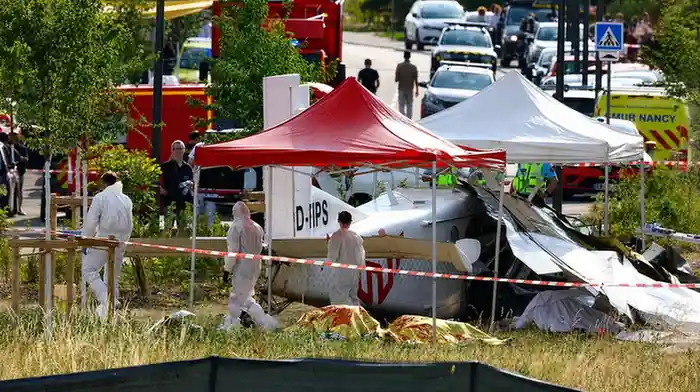
At 11 a.m. local time on Sunday, the aircraft went down in a grassy area near the runway at the Nancy-Essey aerodrome. The Pilatus PC-6/B2-H4 Turbo Porter, registered D-FIPS, was operated for Tandemotion Parachutisme, a skydiving school based at the airport. It had barely left the ground.
All 11 people on board were killed.
The crash killed five instructors, five students, and the pilot, said Yves Seguy, the prefect of the eastern department of Meurthe-et-Moselle.
Local media outlet BFMTV reported that the five students were nurses taking part in what "seems to have been a hazing ritual," citing the Meurthe-et-Moselle Council of Independent Nurses. Some of the students had received the skydiving experience as a gift.
Think about that for a second. Nurses—people who spend their days keeping others alive—had come to jump out of a plane together, probably laughing about it beforehand. The kind of group outing that gets planned in a WhatsApp chat.
The parachutists were to have jumped as tandems—skydiving experiences where two people, often an instructor and a novice jumper, are attached together for the descent, Nancy Mayor Mathieu Klein told public broadcaster France Info.
It was not a reckless adventure. It was a structured, supervised activity. One with instructors, protocols, and checklists.
None of it mattered in the end.
Some of the victims' families watched the aircraft fall with their own eyes. Interior Minister Laurent Nunez described the scene as one of "tremendous emotion and even greater psychological trauma."
A local resident named John Curaku, speaking to BFM TV, said he was in his yard when he heard the sound of a plane engine cut out—immediately followed by a bang.
He rushed to the crash site. "There were no signs of life," he said, with two bodies thrown meters from the wreckage.
According to regional prefect Yves Séguy, the aircraft appeared to suffer a technical problem before plunging almost vertically to the ground in a built-up area close to a shopping center. No distress call was reported. No attempt at an emergency landing was visible to those on the ground.
Initial reports indicate the aircraft drifted slightly to the left after takeoff before entering a left turn and crashing onto a road just outside the airport perimeter, near a commercial area.
It happened fast. Devastatingly fast.
The plane was a 25-year-old Pilatus PC-6 aircraft registered in Germany.
The Pilatus is a type widely used by parachuting operators because of its ability to climb rapidly while carrying multiple jumpers and has earned a reputation for reliability. It is a common fixture at skydiving centers across Europe and North America.
Pierre-Yves Eugène, president of the National Parachutists' Union, told French media that the German-registered Pilatus aircraft undergoes comprehensive inspections every two years.
Officials said the aircraft went down during its third takeoff of the day, which makes the timing even more baffling. Two previous flights had gone smoothly. The third did not.
Here is where things could have been considerably worse.
The aircraft crashed in a grassy area near the runway of the Nancy-Essey aerodrome, close to a residential area and two roads. Meurthe-et-Moselle official Yves Séguy said the crash was close to an urban shopping center. "Give or take a few meters and the accident could have caused collateral casualties," he said.
Mayor Hervé Féron of Tomblaine confirmed that no homes were hit. No one on the ground was injured. The crash also reportedly triggered a power outage in parts of the surrounding area.
Eleven dead is an immeasurable tragedy. It could, in another universe, have been far worse.
The French state moved quickly. Interior Minister Laurent Nunez was en route to the scene shortly after the crash. A technical investigation was opened, with the Nancy deputy public prosecutor, Amaury Lacôte, confirming that gendarmerie units specializing in air transport had begun examining the wreckage.
The Paris prosecutor's office is leading the crash probe, Nunez confirmed. Medical and psychological support teams were deployed to care for relatives of the victims present at the airfield, as well as other witnesses.
Transport Minister Philippe Tabarot called it France's biggest aviation accident involving skydiving in about 30 years.
Thirty years.
As of Sunday evening, investigators had yet to indicate whether mechanical failure, pilot error, weather conditions, or another factor may have contributed to the disaster. Officials stressed it would be premature to speculate on the cause.
Nunez refused to speculate on what caused the crash but confirmed the plane dropped out of the sky suddenly—no prolonged distress, no warning. Just gone.
Police urged people to strictly avoid the area around the airport to allow emergency responders and law enforcement unrestricted access to the crash site.
The black box equivalent from the aircraft and witness testimonies will form the backbone of the investigation in the coming days.
A skydiving trip is supposed to be about one thing: the feeling of falling and surviving it. The adrenaline. The story you tell.
Eleven people boarded that plane in Tomblaine on a clear June morning. Families were waiting. Some had cameras ready.
None of them came back down the way they were supposed to.
France mourns today—not just for lives lost, but for the specific cruelty of it. The gift certificates. The nurses are out on a day trip. The families who watched. What began as a day intended to provide excitement, adventure, and perhaps a memorable first jump ended in a disaster that stunned a region and cast a somber shadow over the French aviation community.
The investigation is ongoing. The cause is unknown. The grief, however, is immediate and total