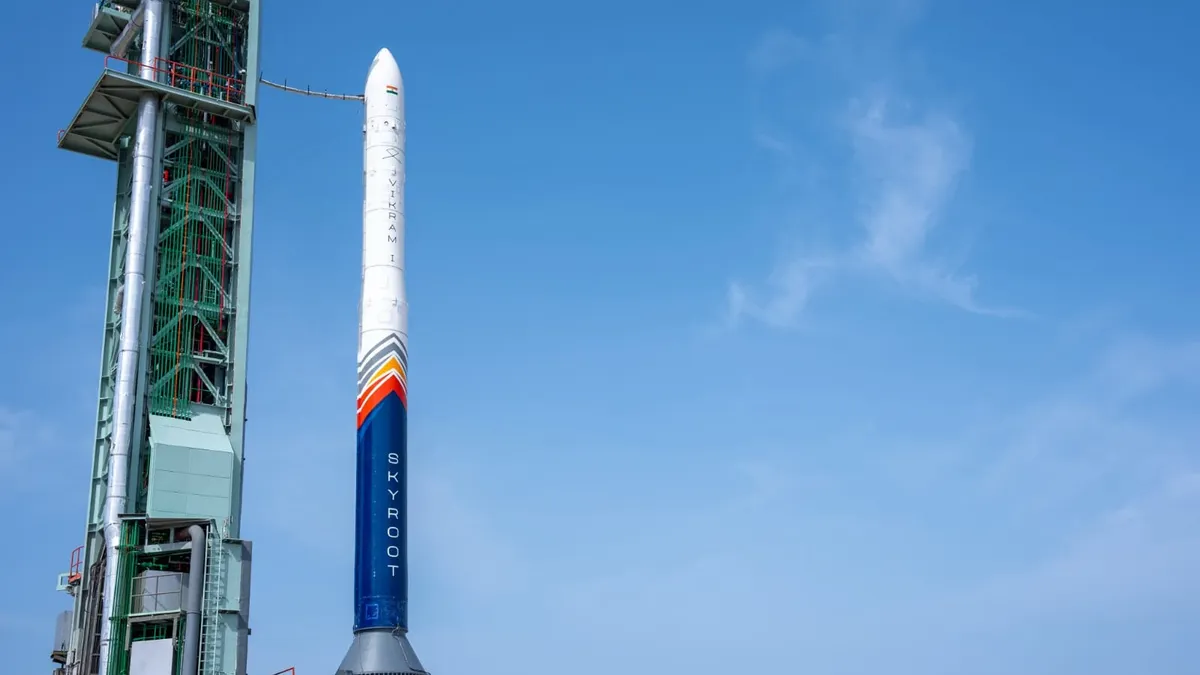
Fifteen minutes. That's roughly how long it took Skyroot Aerospace's Vikram-1 to go from a launch pad in Sriharikota to a 450-kilometre orbit, and with it, to make India only the third country on Earth after the United States and China where a private company, not a government space agency, has put something into orbit on a rocket it built itself.
Not bad for a company that was assembling its first solid-fuel motor in a rented shed less than eight years ago.
The countdown wasn't pretty, for what it's worth. A technical glitch popped up at the five-minute mark, and the launch, originally set for 6 am GMT, slid back about 35 minutes.
Nobody at Skyroot seemed to care much once the rocket actually flew. "Mission Aagaman is a grand success," the company said after the third stage separated and the liquid-fuel kick stage fired its final burn and then, almost as an afterthought, reminded everyone this was still a test flight. A couple more are apparently planned before anything resembling regular commercial service begins.
Three solid-fuel stages, then a liquid-propellant kick stage called the Orbital Adjustment Module that can start, stop and restart in space powered by a 3D-printed engine flying on an Indian rocket for the first time.
The whole airframe is carbon composite, not aluminum, which has been Skyroot's bet since day one. Loaded up, Vikram-1 can haul 350 kilograms to low Earth orbit. A beefed-up version with strap-on boosters, Vikram-1U, is meant to push that to 550 kilograms, though that's a later problem.
None of this happened by accident, and none of it happened fast, either.
Back in November 2022, Skyroot flew a much smaller rocket called Vikram-S on a suborbital hop five minutes up, a splash in the Bay of Bengal, done. That mission, Prarambh (Sanskrit for "the beginning"), made Skyroot the first Indian private company to touch space at all. It also made for a nice photo, but orbit is a different animal entirely.
Getting there means surviving four separate stage separations without anything going sideways, and doing it on the first real attempt is the part that actually impressed people in the industry.
Both rockets are named after Vikram Sarabhai, generally called the father of India's space programme, which let's be honest is about as subtle as naming your startup Apollo.
Buried among the working payloads Skyroot's own SCOPE satellite, a solar-power demo from Grahaa Space, a debris-grabbing robotic aSpace, andled Embrace from Cosmoserve, a test payload from German startup DCUBED was a pile of stuff that served no engineering purpose whatsoever.
Micro-sculptures of C.V. Raman, Sarabhai, and A.P.J. Abdul Kalam, each smaller than a grain of rice.
A diamond-studded lotus artwork worth around ₹10 lakh.
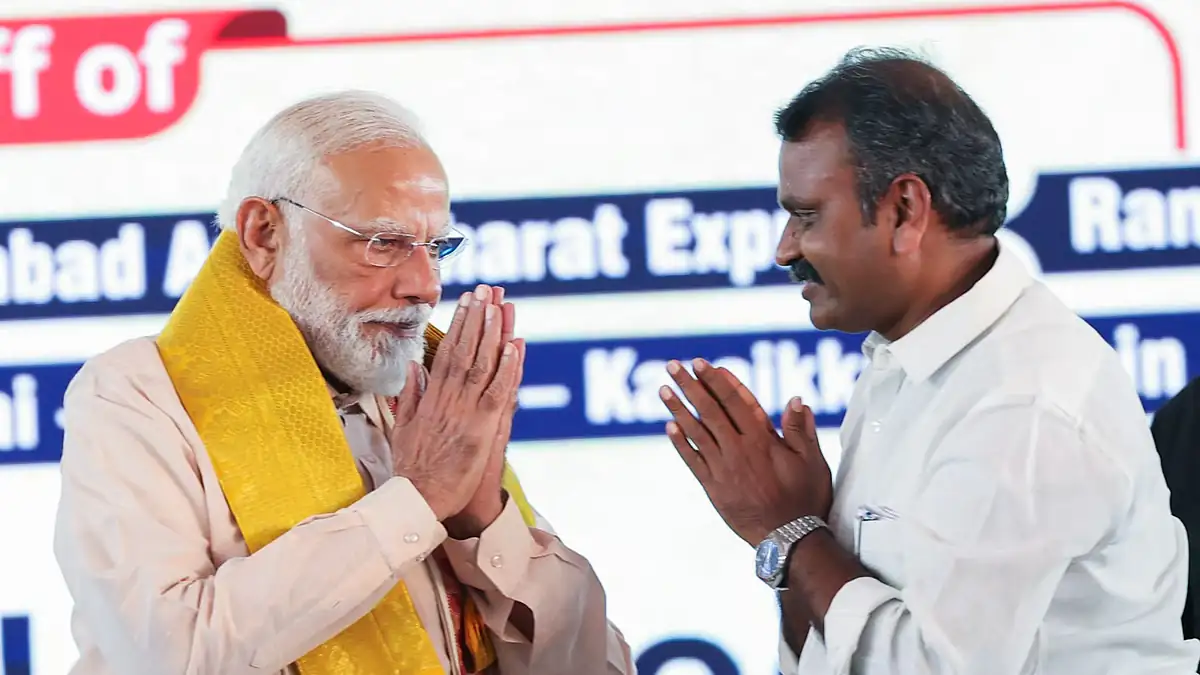
A handwritten postcard from Prime Minister Narendra Modi reading "Vande Mataram," tucked in with notes from engineers and investors. Somebody at Skyroot clearly wanted this flight to feel like a moment, not just a data point, and honestly, it worked.
Skyroot didn't get here on good vibes. Founded in 2018 by ex-ISRO engineers Pawan Kumar Chandana and Naga Bharath Daka, it became India's first space-tech unicorn earlier this year after raising $60 million at a valuation past $1.1 billion more than double where it stood in 2023.
GIC led that round; Ram Shriram, who sits on Alphabet's board, joined Skyroot's as well. That's serious money chasing an industry that barely existed in India five years ago. Next up on the drawing board is Vikram-2, a one-ton-class rocket with a cryogenic upper stage, aimed at satellites too heavy for Vikram-1 to bother with.
India opened its space sector to private companies in 2020. Since then roughly 400 space-tech startups have shown up, all chasing a government target that sounds almost aggressive on paper: growing the country's space economy from about $8.4 billion today to $44 billion by 2033.
Meanwhile the small-satellite launch market Skyroot is trying to break into keeps getting more crowded SpaceX still runs the table, Rocket Lab and Firefly Aerospace are scrapping for whatever's left, and governments across Europe and Asia are throwing money at their own launch startups for the same reason India is bothering with any of this.
Depending on someone else's rocket to reach orbit is a strategic weakness nobody wants anymore, not in this decade.
One clean flight doesn't make a launch business. Skyroot knows that better than anyone watching from outside which is probably why the company was so outside,o call this a test, not a victory lap, even while it was still celebrating.