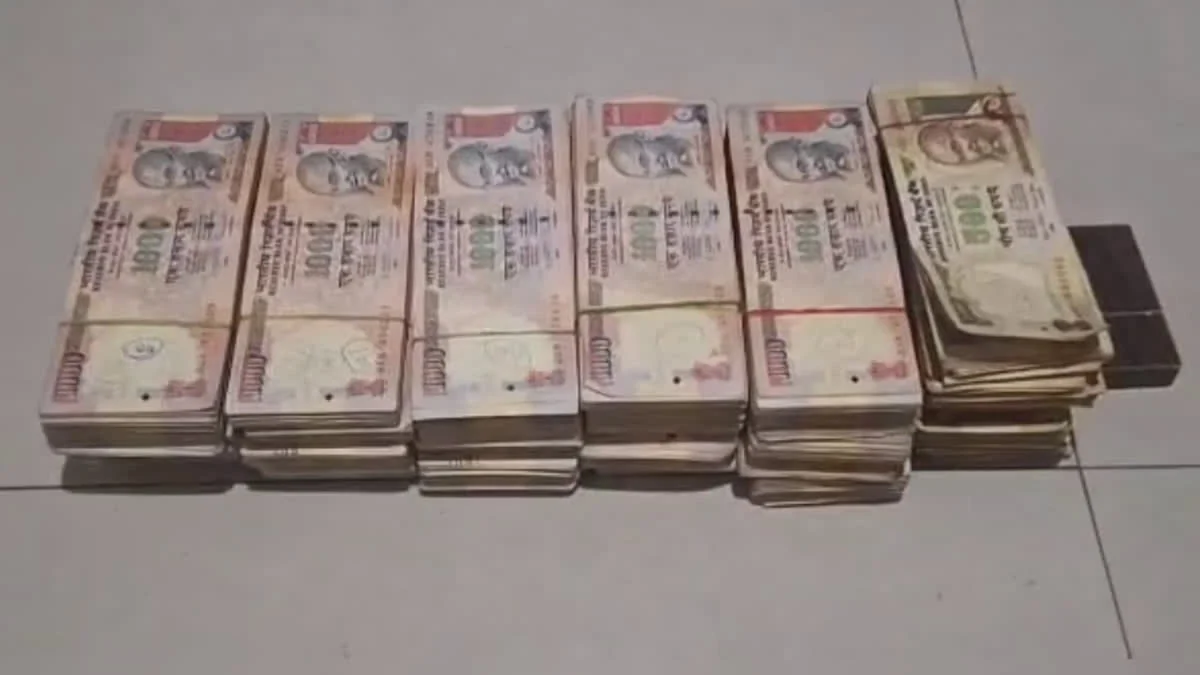
The Prime Minister of India came out on television at 8 pm on 8th November 2016 to declare that ₹500 and ₹1,000 notes will cease to be legal tender from midnight. After 10 years, the data available from the government paints a clearer picture of what changes and did not change with this policy.
The old notes constituted close to 86 percent of the cash in circulation. The government stated that this measure would help in reducing black money, tax evasion, and fund terrorism through counterfeit currency.
The expectation that all cash stashed away will be destroyed proved to be a false one. The final accounts of the RBI for the month of August 2018 revealed that 99.3 percent of the money taken out had made its way back into the banking system.
The shock to cash was temporary. Cash in circulation declined to ₹13.10 lakh crore in March 2017 and surpassed pre-demonetisation levels in March 2018, based on the findings of ETV Bharat of RBI data.
The trend has persisted. As per Business Standard, the cash amount was ₹43.16 lakh crore on October 23, 2026, which is 13.7 percent higher from the previous year. In its report released in March 2026 regarding 2025-26, RBI mentioned that the cash amount was ₹41.24 lakh crore in March 2026 against ₹36.87 lakh crore last year.
Independent estimates show that the current figure is around 2.4 times the ₹17.74 lakh crore on the eve of demonetisation. Tribune has quoted experts calling cash "more than doubling" in the last decade. Business Standard also reported that cash/GDP ratio is at its pre-ban levels again.
Similarly, the importance of notes which are used the most has remained constant. The ₹500 note constituted 85.5 percent of the total value of currency in circulation, and 41.2 percent by quantity, according to the annual report of the Reserve Bank of India dated March 31, 2026. It was stated that in 2016, the Prime Minister himself mentioned that high denomination notes constitute 80 to 90 percent of cash.
UPI marks the most significant transformation in payment systems in India. According to the Tribune, the monthly number of transactions through UPI exceeds 25 billion, valued at over ₹31 trillion. UPI was introduced in August 2016, even before demonetization, although the lack of money made Indians adopt UPI.
Analysis by Business Standard shows that India has taken major strides towards digital payments but is not yet a cashless economy.
Counterfeiting currency was also among the reasons cited. The data on counterfeit currency issued by the RBI shows a gradual fall followed by an uptick.
The figure of the number of fake currencies discovered in the banking system stood at 2,96,695 in 2019-20 and 2,30,971 in 2021-22, according to the data provided by the RBI, reported by Business Standard. It then fell to 2,17,396 in 2024-25.
However, the counterfeits are back. As per the data in the annual report, there was a 5.7 percent rise in detections to 2,29,746. The counterfeit currency of ₹500 denomination, which is the most counterfeited currency, saw an increase of 20.5 percent to 1,41,907 from 1,17,722 in the previous year, and 85,711 in 2023-24.
There were some denominations of currencies that saw different trends. The counterfeit currencies of ₹200, ₹100, ₹50 and ₹2,000 notes saw a decrease. However, counterfeit ₹20 notes went up by 47.4 percent, although on a low base of 373 notes.
All the other banks except the RBI accounted for 97.6 percent of the fake currency detections.
Counting the number of notes discovered rather than in circulation by the RBI, an increase could mean increased counterfeiting, better detection or increase in cash flows. The circulation of ₹500 notes increased as well, which gives the counterfeiters more material to work with.
The only thing that is certain about this situation is the fact that the number of counterfeit ₹500 notes has been rising for two years now, and detections are considerably lower compared to 2019-20 figures.
The hardship faced then was immediate. Millions lined up to change or save their money, and there were losses of income to small businesses and daily wage earners. There was also an indication of the cost borne by banks and the economy because of handling currency.
The reports reviewed do not have a statement from the government on the occasion. The advantages claimed by those supporting the policy are that it broadened the tax net and forced more people into banking systems.