The Women’s Reservation Bill could not be passed in the Lok Sabha because it required a two-thirds majority, as it was a constitutional amendment.
The government needed 352 votes to pass the bill in the House of 528 MPs, but the bill received only 298 votes in favor, while 230 MPs voted against it. Because of this shortfall of 54 votes, the bill failed to pass in the Lok Sabha.
After the voting, Om Birla, the Speaker of the Lok Sabha, informed the House about the result.
The Constitution (131st Amendment) Bill proposed increasing the number of seats in the Lok Sabha to 850, including 815 seats for the states and 35 seats for the Union Territories.
During the voting on the Constitution (131st Amendment) Bill in the Lok Sabha, a total of 489 MPs voted. Out of these, 298 voted in support of the bill, while 230 voted against it. However, 352 votes were required for the bill to pass. Since it did not receive the required number of votes, the bill could not be passed in the Lok Sabha.
To pass the Women’s Reservation Bill, the government had called a three-day special session in the Lok Sabha.
A total of 21 hours of discussion took place on the bill, in which 130 MPs participated, including 56 women MPs.
Apart from this, the government had also passed two other bills related to women’s reservation, but since the 131st Constitutional Amendment Bill was not passed, the government decided to withdraw both of those bills.
The government had also introduced two more bills: the Delimitation Amendment Bill, 2026, and the Union Territories Laws Amendment Bill, 2026.
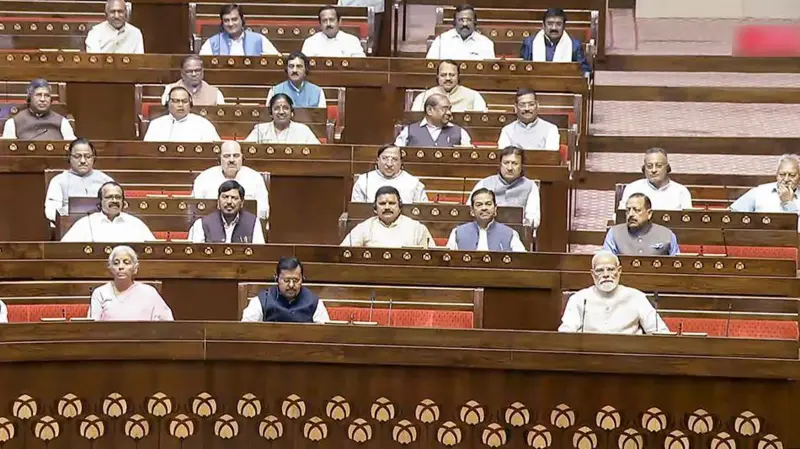
Photo: @ ANI
Changes were proposed in the definition of population for delimitation. The main objective was to reorganize electoral constituencies according to the new census so that each constituency would have an equal ratio of representation.
This bill proposed changes to the laws of Puducherry, Delhi, and Jammu and Kashmir so that delimitation and the Women’s Reservation Bill could be implemented.