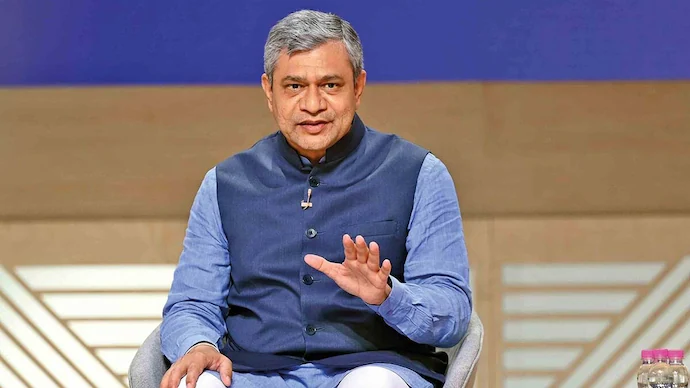
Bullet trains and semiconductor chips are major agendas for India, according to Union Minister Ashwini Vaishnaw.
The mention comes on the back of the push for modern infrastructure, advanced manufacturing, and a rise in self-sufficiency in technology, in general, to take the nation forward in the coming years, the Union Minister of Railways, Communications, and Electronics & Information Technology said.
The government’s thrust through high-speed rail projects and for semiconductor chips comes in light of India’s aim to emerge as an industrially developed nation and one built on technology, with Vaishnaw deeply invested in both.
The high-speed rail program in India isn’t the only game in town beyond the first Mumbai-Ahmedabad corridor, though—India's now eyeing the expansion of such connectivity between other large cities.
Vaishnaw has previously stated that high-speed train designs could be in the range of 350 mph for the next round of bullet trains in India, a crucial development phase for more advanced and rapid rail infrastructure in the nation.
The lessons learned from that inaugural route could lead to India generating expertise not only in construction, but operations and maintenance for high-speed railway networks.
Back at the drawing board – The Mumbai-Ahmedabad High-Speed Rail Corridor (MAHSR), which is on track to be the launchpad of India's bullet train dreams and hopes to serve as an 'example' of how high-speed railway technologies can be deployed in India’s transport architecture, had also been delayed in March over 'site selection and feasibility checks'.
This project—that has included tunnels, viaducts, stations, and the construction of India's largest railway tunnel for the line—is planned to cut the travel time between India's financial capital, Mumbai, and Prime Minister Narendra Modi's home state of Gujarat, Ahmedabad, to a little over two hours.
There is a lot to be gleaned from this process to implement it on the other high-speed rail corridors that are in the pipeline.
India is not just considering the high-speed rail corridors in western India but in many areas. Multiple other corridors are being proposed and talked about to connect several important economic as well as metropolitan hubs.
Union Railway Minister Vaishnaw had also cited that Hyderabad is envisioned to be developed into a high-speed railway hub with connections to several other big cities like Bengaluru, Pune, and Chennai. These corridors could help connect prominent economic cities and might create possibilities for economic development along the same.
Apart from infrastructure, semiconductors have emerged as India’s top technology priority. These chips are used in smartphones, vehicles, computers, telecommunications gear, defense equipment, and smart railway technology, among other products.
With a mission to scale up the domestic semiconductor ecosystem, the government has introduced the India Semiconductor Mission. The initiative covers all aspects of semiconductor technologies like designing, packaging, assembling, testing, and manufacturing.
Developing these skills, it is felt, would lessen India’s dependency on imported chips and boost the country's position in the global technology supply chain.
Semiconductor ambitions in India aren’t limited to building just factories (fabrication plants). A mature semiconductor sector is incomplete without skilled engineers, expensive tools, robust infrastructure, research facilities, and a string of ancillary industries.
So, the government has had its priorities set on the twin aims of talent building and creating inducements for Indian and foreign companies to set up chip manufacturing and ancillary infrastructure in the country.
The eventual idea is to ensure that India can not only design but also fabricate, assemble, and test chips locally.
But, there is a closer linkage to the semiconductor chips sector than one might think of. Semiconductors are crucial for all electronic components used in signaling, communication, navigation, safety, and power management of modern trains.
High-speed trains necessitate advanced sensors and sophisticated signaling, navigation, and control mechanisms—many of which heavily rely on semiconductor chips.
Vaishnaw has spoken about several semiconductor chips in modern Indian trains at various forums, indicating a higher interdependence.
The drive in semiconductors also fits into India's broader scheme for boosting electronics manufacturing. The growth in cell phone manufacturing in India in the last few years is notable, and the country's electronics exports have boomed recently.
India hopes to venture in higher-value products such as servers, memory modules, computing hardware and other complicated electronic goods.
Building up domestic capabilities for producing semiconductors would allow manufacturers to gain access to these important parts, thereby facilitating further electronics development.
India’s developmental thrust, expressed in a push for Bullet Train and chip (semiconductor) manufacturing, stands on two connected foundations.
Whereas the former epitomizes futuristic physical infrastructure, the latter symbolizes technologically enhanced infrastructure.
Both necessitate and encourage long-term investments, professional competencies and expertise, and sophisticated engineering skills and could enable India’s ascension up the global value chain.
Furthermore, other emerging areas, such as artificial intelligence, electronics manufacturing, and deep technology, rely on advanced computing power and the capabilities for manufacturing semiconductors.