Surendra Singh Chaudhary has been passing by this polluted river for years before going to the temple, and each time it made him feel very disturbed.
Bittu Tabahi, the name by which he is popularly known, is only 20 years old but he shows how one individual can do something to improve a situation. He does not wait for a clean-up drive organized by an authority body and decides to take matters into his own hands.
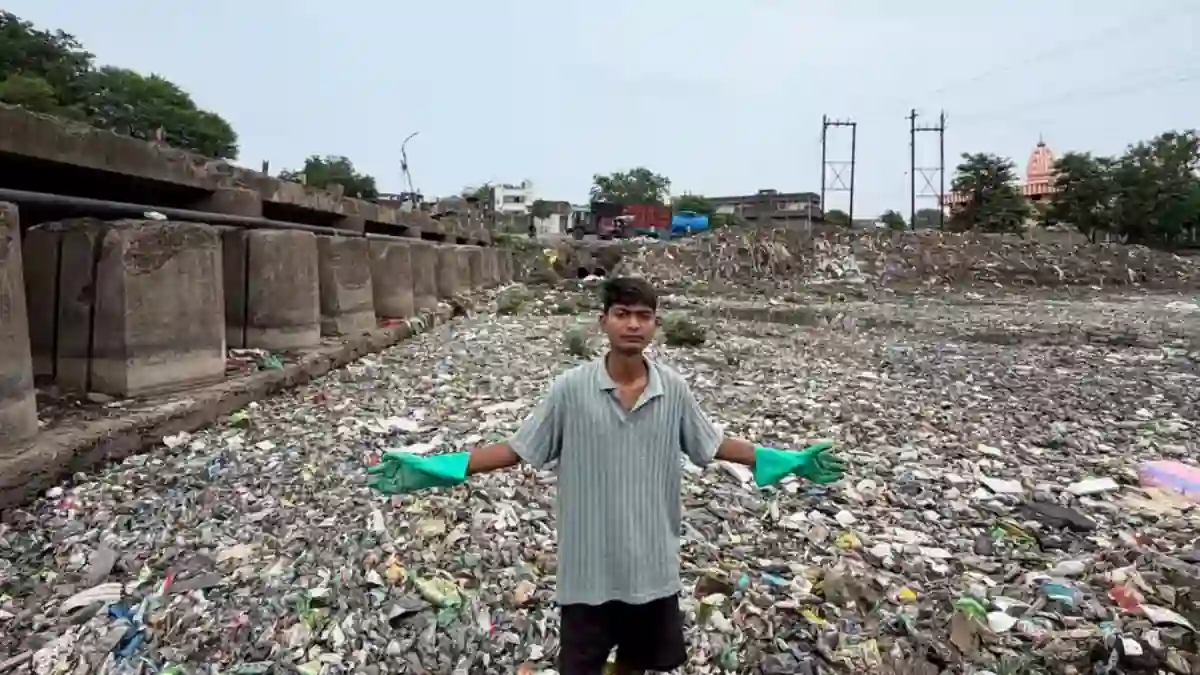
The polluted Ajnar River in Biaora, Rajgarh is choking due to waste, garbage, algae and debris.
It was not something that happened on the spot but rather something which had been going on for many years and reached boiling point on an important day.
"I have always noticed pollution in the river or in the temple."
This concept had been in my mind for a long time, but I kept delaying myself," Bittu informed the Times of India.
That delay came to an end on the day of 26th January – Republic Day. "I began working from 26th January and have been doing it ever since," he added.
What is noteworthy about Bittu's work is precisely that he had started from a completely average situation without any NGO intervention or any government project.
Bittu is a second-year student studying BSc from Biaora of Rajgarh district. The Ajnar River, which carries historical importance for the region, had turned out to be very polluted with plastic, garbage, and all kinds of wastes over time – just like an environmental disaster that was now an integral part of the local scene until Bittu intervened.
Bittu wasn’t always working on his own right at the start, but the joint effort didn’t continue for long.
At the beginning, he managed to get the assistance of some of his friends, but soon enough that began to fall off and Bittu found himself having to do most of the work alone.
Before the accolades came through, Bittu had been subjected to ridicule by those who either believed that his endeavor was futile or even deranged.
He had been ridiculed by others and even been labeled as “crazy.” In light of the enormity of the challenge, which was basically the attempt by one college student to clean up a whole polluted river on foot, it was not surprising at all.
In addition to the social humiliation that comes with it, Bittu has indeed suffered physically from being exposed to the polluted water.
Going into the polluted water has also impacted his well-being, as he experienced infections and skin conditions. He says himself that he did not even have appropriate safety gear when he began going into the water to clean up the pollution.
This initiative did not have any grants, any crowdfunding campaigns, or any sponsors but only a student who spent his own money.
The clean-up drive has been mainly supported by the money of Bittu and his friends. As per the reports, he and his friends have spent around ₹30,000 for the cleaning material and dustbins.
Bittu himself installed several dustbins along the river and claimed that he got no funding from anywhere for them – which means the very infrastructure used to reduce littering also came out of his own pocket.
Most importantly, one of the most interesting things about the story of Bittu is that his own family did not know how big a thing it was until it got viral on the internet.
Initially, the family of Bittu was not aware of his efforts to clean the river. It came to their knowledge only when industrialist Anand Mahindra posted Bittu’s story on X.
They became worried about the health and safety of Bittu when they got to know what Bittu was doing. Bittu said that they told him that going in the polluted water again and again may affect his health.
But things took a dramatic turn when one prominent figure made this news go viral within minutes.
The hard work, which was mainly done using his personal funds and minimal resources, is now making headlines in social media and motivating thousands of people around the globe.
Mahindra, who posted about the story, not only shared the news but also called him his "Monday Motivation."
The compliments were not just restricted to India but the efforts of Bittu also managed to grab the eye of a sports personality who was known across the world.
His endeavor managed to go viral and gain praise not only from Anand Mahindra but also from Kevin Pietersen, the former England cricketer – which is quite an extraordinary cross section for an article written about a small town that hardly anyone outside Madhya Pradesh would know about.
In Bittu’s case, there lies a common and unresolved concern in India – a disparity between the general knowledge about river pollution and the lack of visible and individual responsibility to solve the problem.
There have been several attempts by Indian citizens to clean up rivers in the past, ranging from mass participation in cleaning up the Yamuna and Gomti Rivers to community participation in the Kapila River in Karnataka. Bittu’s case stands out because of the amount of time and isolation that he has put into his task.
Even the staunchest admirers of Bittu are aware that there are only so many things an individual without funding can accomplish when faced with a big problem of pollution.
The question of whether one man can revive a polluted river goes beyond anything one person could do by himself. While Bittu has been able to transform certain parts of the Ajnar river, the problem of pollution caused by plastic waste and debris is still a major issue in India’s rivers as a whole.
From the coverage of the story, Bittu is now receiving the attention from institutions that had so far been lacking during the eight months he spent working alone, as the reports indicate that his work has now elicited some form of response from the government, which had not offered him any assistance for what he was doing.
But Bittu's story is not one of just river cleansing; it is about being responsible for our surroundings in a time when many young people are struggling to figure out their life ahead.
But this story of Bittu's shows that social media, which is often blamed for creating outrage or diversion, can actually be used to capture the real and un-glamorous work that needs to be done and how the frustration of a college-going youth has been converted into a discussion about the pollution of rivers in the entire country.