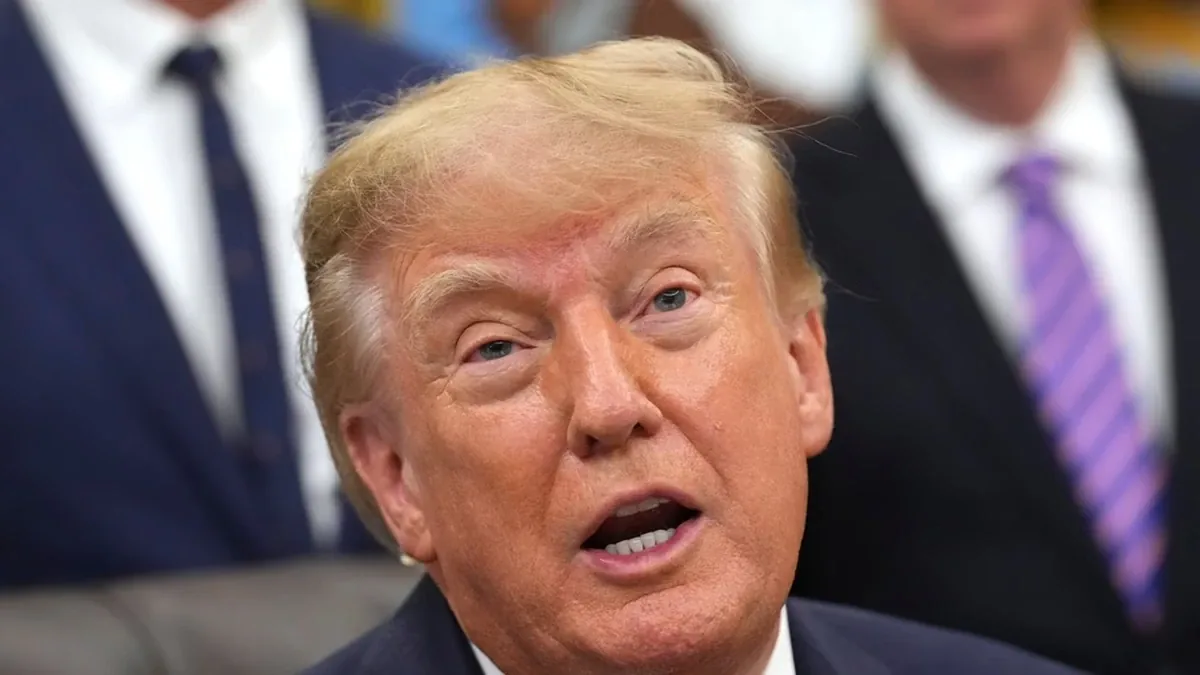
President of the United States, Donald Trump, made an announcement on Friday stating that the agreement has been signed between Washington and Denmark and Greenland, giving the US "permanent control over security and all other needs" on the Arctic island, thus ending the crisis that began with threats to annex the land by force.
This ends an 18-month period where Trump kept insisting that there would be a military seizure of Greenland based on the national security interests in the face of China's and Russia's presence in the Arctic region.
The rhetoric led to the biggest protests ever in the history of Greenland in January 2026, where one-fourth of the population of Nuuk demonstrated with "Greenland is not for sale" signs.
In his Truth Social post, Trump claimed that his government has worked with the countries in question "to ensure that the US will FOREVER have the full ability to do whatever is necessary in Greenland."
He called the result a dream come true for the US of America and announced the immediate start of plans to increase the presence of the US military on the island.
As per an unnamed official in the State Department quoted in numerous media sources, the agreement prevents any military base from non-NATO countries from being stationed in Greenland, imposes limitations on investment from hostile nations, and explicitly ensures that neither China nor Russia can create a military presence there.
Additionally, the United States will be granted increased rights to construct bases throughout the country besides the one that it already has in Pituffik, located in the northwestern part of the island, which hosts America's northernmost military base.
It is worth mentioning that the deal does not contain any provisions related to rare earth minerals, which were frequently mentioned by Trump in his justification of buying the country during the crisis.
Most importantly, the treaty does not go as far as Trump had wanted with regard to his call for annexation of Greenland. According to Denmark's Prime Minister Mette Frederiksen, the treaty "recognizes the sovereignty and territorial integrity of the Kingdom of Denmark" and "confirms the Greenlandic people's right to self-determination." Jens-Frederik Nielsen, the Greenland Prime Minister, described the treaty as one that "enhances" the security of Greenland and "is good for all three governments."
U.S. Secretary of State Marco Rubio described it as a "historic deal that permanently and completely resolves all U.S. security concerns and makes sure that Greenland 'will forever be a strategic defence area of North America.'"
In a joint announcement made by the two nations, the deal is expected to be officially signed next week at the UN General Assembly meeting in New York City. But the deal must still go through the approval process in both the Denmark and Greenland legislatures.
Danish Foreign Minister Lars Lokke Rasmussen posted on social media that the new agreement "will replace a long period of uncertainty with a situation that 'strengthens security in the Arctic and North Atlantic, and thereby also our common security in NATO and Europe.'
NATO expressed its support in a statement, noting that the agreement will "contribute to advancing security, stability, and cooperation in the region."
Experts in foreign policy considered the new agreement as Trump's acceptance of a lesser outcome than what he first desired. Richard Weitz, who is a senior fellow at the NATO Defense College, observed that Trump had mentioned the annexation of Canada, the Panama Canal, Venezuela, and Greenland but later toned down those ambitious plans because of local resistance.
"Here, he got almost everything that he wanted without the formal annexation," said Weitz. He added that the solution to the conflict with Greenland will allow NATO member states to concentrate on the Russian aggression in Ukraine.
According to Mikkel Olesen, who is a senior researcher at the Danish Institute for International Studies, the part about keeping Russian and Chinese bases out of the region would be the easiest part of the deal to agree upon for the two countries, as neither of them has any desire for the establishment of such bases in the area. However,