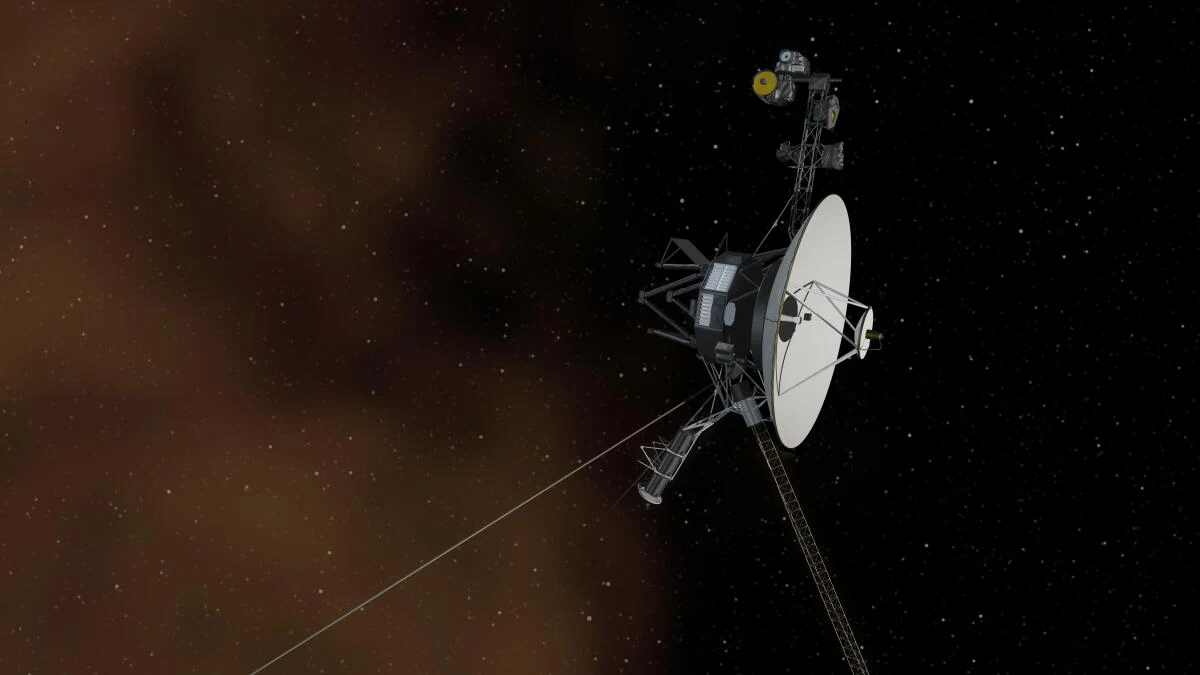
For most missions, a missed check-in is a Tuesday. For Voyager 1, it is a small crisis.
NASA's Deep Space Network, the set of giant antennas at three sites around the world, tried to pick up the probe's radio signal on Oct. 18 and again a day later. Both attempts came back empty. Voyager 1 is about 16 billion miles (24 billion km) away, so there is no quick way to ask if it is okay. Engineers could only wait for the next scheduled window.
On Oct. 20, the signal reappeared. Nobody had commanded it to. The team had not yet sent a single troubleshooting instruction, according to NASA, and contact has held ever since.
Not as much as it would like.
Engineers have worked out that one group of thrusters on the spacecraft went offline and its backups took over. That swap is built to happen automatically when the onboard computers sense something wrong with the active thrusters. The same mechanism, known as fault protection, tells the spacecraft to settle into a safe, stable configuration and pause normal operations while people on the ground figure out the problem.
What it does not explain is why the signal vanished. That part is still being investigated.
Kareem Badaruddin, the Voyager mission manager at NASA's Jet Propulsion Laboratory, said this was the first time the team had seen the spacecraft behave this way. He added that, this late in the mission, expecting the unexpected is part of the job.
The timing matters because Voyager 1 had just been through major surgery of a sort.
Both Voyager probes run on radioisotope thermoelectric generators, which turn heat from decaying plutonium into electricity. The output drops by roughly 4 watts a year. After almost half a century, the margins are thin, and the team has been switching off nonessential hardware to keep the probes alive.
Two of Voyager 1's science instruments have already been shut down for this reason. The spacecraft launched in 1977 with 10 dedicated science instruments, and some were retired after the planetary flybys. A few were kept running to study the edge of the heliosphere, the bubble of particles and magnetic fields the Sun blows around itself. Both Voyagers now sit outside that bubble in interstellar space, and they remain the only spacecraft to have studied that region directly.
In early September, engineers pulled off a manoeuvre they call the "Big Bang." They turned off three devices on Voyager 1 and replaced them with three lower-power alternatives. All six devices help keep the spacecraft warm in the cold of deep space, which is why the swap had to happen at the same moment. Doing it piece by piece would have thrown off the way heat is spread around the probe.
The team had run the same swap on Voyager 2 about six weeks earlier. Without it, NASA says, Voyager 1 would have needed to lose another science instrument as early as summer 2027.
On Nov. 18, Voyager 1 is expected to be 16.09 billion miles from Earth. Light covers that distance in exactly one day.
The probe is travelling at about 38,000 mph (61,155 kph). A radio message to it takes 24 hours to arrive, and the reply takes another 24 to come back.
Suzanne Dodd, the Voyager project manager at JPL, put the practical side of it this way: you send your message, go home, and wait two days for an answer.
NASA is upfront that nothing will happen on the spacecraft when it crosses the line. No instrument will register a change and nothing onboard will shift. The number is a marker, a way of making the scale of the thing easier to grasp. For comparison, the Moon is about 1.3 light-seconds away.
For now, the work is detective work. The team is going through the data from the October blackout to find out why the signal dropped, and whether it could happen again.
Meanwhile, the clock on the power budget keeps running. The Big Bang bought time, not a permanent fix. Another instrument could still face shutdown after 2027, and every year the probe has about 4 fewer watts to work with.
The next date to watch is Nov. 18. Expect NASA to mark it, probably with a post on its Voyager blog, and expect the first reply to any "hello" sent that day to arrive two days later.