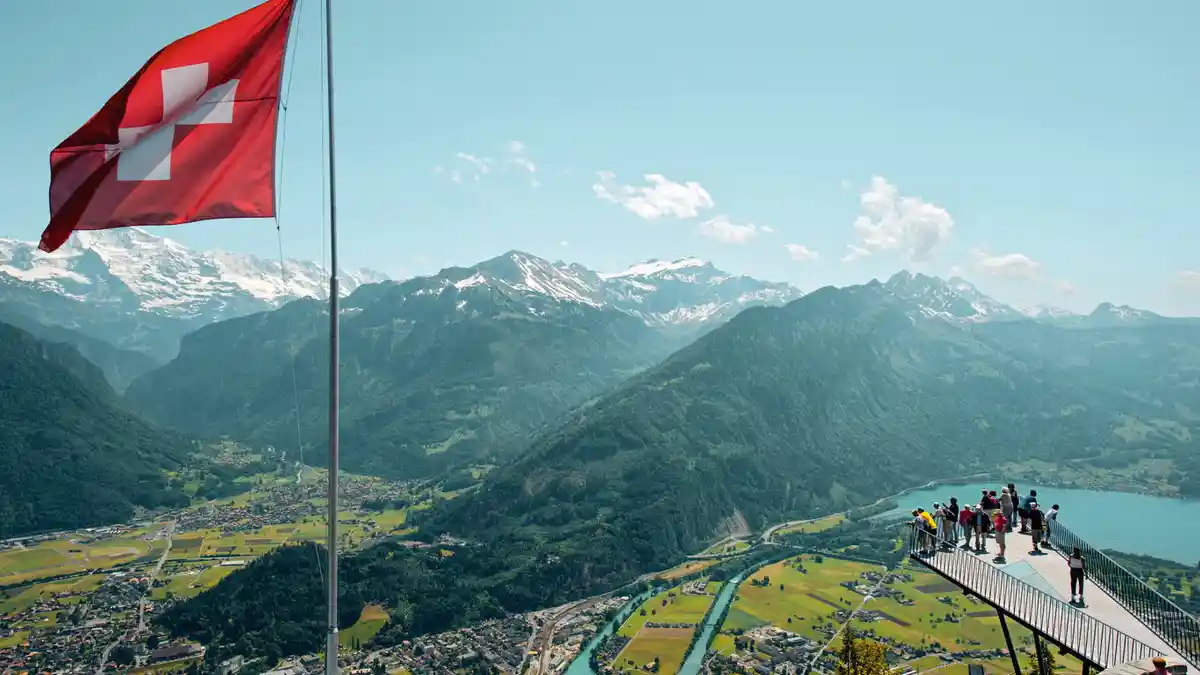
For decades, Switzerland has sold India a rather simple fantasy—snowy mountain peaks, filming sites, and checklists of photo-friendly spots.
This pitch is changing.
Swiss Tourism intends to take up a new strategy that would please the affluent tourists from other nations who like privacy, personalized service, and the concept of “Swiss Silent Luxury."
This strategy is different from the common way of exhibiting luxury and concentrates on discretion, comfort, scenic surroundings, and hospitality.
The approach takes a departure from the conventional show of opulence and concentrates on discretion, comfort, natural splendor, and hospitality.
The concept was launched at ILTM Asia Pacific, an important luxury travel exhibition, where Switzerland positioned itself in contrast to the standard practice in the industry of over-branded, extravagant offerings.
According to Pascal Prinz, director of the global luxury market at Switzerland Tourism, Swiss luxury “has nothing to do with bling bling or bla bla.” It offers “peace of mind” and everlasting perfection.
There are three concrete pillars of the strategy: nature of the Alps, discretion and privacy, excellence in service and craftsmanship.
Prinz explained the reasons why the particular approach appeals to the travelers from the Asia-Pacific region, including Indians: “And that is exactly what the most discerning travelers in Asia-Pacific are looking for.”
This is not merely a smart marketing strategy, but the numbers give a clear indication of why Switzerland is investing so much in the development of this market niche.
Luxury travelers spend approximately 630 Swiss francs per capita per day in the premium segment of the Swiss travel market—truly a substantial sum of money.
The extent of such spending is evident from statistics of hotel incomes as well. Hotels of five stars comprise about 8% of the total number of guests but provide 25-30% of the total revenue of Swiss hotels. Thus, a fairly modest number of people brings in disproportionately large sums of money.
Looking at it from the broader perspective, the reason becomes even clearer since sales of the global luxury travel segment are forecasted to increase by nearly two times until 2032.
India is certainly not a minor player in the said approach – it is fast turning into one of the hottest growth markets.
In one particular year, India accounted for 660,640 overnight stays in Switzerland, reflecting year-on-year growth of 10.6%, indicating the increasing interest that Indians have in the country regardless of the season, and not only in the summertime.
Specifically, the Indians are already practicing the “silent luxury” concept in their booking behavior. Bookings by Indians for Switzerland grew 41% on a yearly basis, while smaller and more vibe-driven towns have seen a 63% increase in bookings for December to February stays in particular.
And the change in trend has faces and locations attached to it. Travelers coming from Tier-1 and Tier-2 Indian cities are moving away from Interlaken and Lucerne and preferring to stay in destinations such as Grindelwald (78%), Gstaad (71%), Pontresina (66%), Meiringen–Hasliberg (58%), and Andermatt (55%).
The demographic that has fueled this change is significant.
Indian honeymooners account for 63% of the rise in small-town bookings, couples who prefer a less crowded vacation in an offbeat destination rather than a holiday itinerary crammed with landmarks in India’s smaller towns.
Abhishek Daga, the co-founder of Thrillophilia, put it bluntly when he highlighted how this change speaks volumes about the changing psyche of Indian travelers and how it reflects the fact that the palate of the modern traveler is different from what it was a decade ago.
Bookings themselves are also changing, along with the destinations. The median booking period has gone up to 54 days from 49 days in the previous year.
It is not a shift in geography but a shift in the preferences of the traveller.
According to the travel industry analysis, the Swiss winter tale today is not about ticking off landmarks but about mornings at leisure, bakeries in the village, train journeys, and small luxury stays without any noise.
It is a significant deviation from the traditional approach of Switzerland marketing its destinations in India. The country was mostly known for its connection with Bollywood movies shot in Switzerland, especially the Bernese Oberland, which became popular with the help of the director Yash Chopra. One lake located in Bern is unofficially named “Yash Chopra Lake” due to repeated appearances in Yash Chopra’s films.
Silent luxury is the deliberate turn away from the tradition.
It is not just marketing language because the Swiss hospitality industry has turned the idea into a product.
For example, the Hotel des Horlogers in Le Brassus offers guests the unique experience of silence that cannot be reproduced in any urban hotel, as well as the design of buildings so that every room is like an independent pavilion.
The phenomenon is not limited to hotels alone. Programs of silent retreats were available previously only in meditation centers in rural India or the Swiss Alps. Nowadays, luxury hotels offer their guests the ability to spend 24-72 hours in silent zones of their properties after checking in and giving up their phones.
In other words, this change was noted by observers in the following way: silence is becoming "the sonic equivalent of a pillow menu" — a small detail but crucial one for returning guests.
It should be noted that the country is not developing this trend spontaneously but rather taking a leading position in a wider movement related to luxury travel throughout the world.
In this regard, the business has even introduced a special concept, which stands for "calmcations," namely holidays specifically organized for stressed travelers in order to relax from the "fire hose of daily life" rather than add additional sightseeing.
What makes the Swiss case different from other countries is the complete focus on the theme within the country's entire tourism strategy, not just another service. Discretion and privacy become the main principles, the alpine landscape is turned into an entire country's product, and the railroad system connects the quiet and small towns of Switzerland without imposing any sacrifices on comfort.
To the Indian traveller, however, this is more than just a change in trends; it represents an important development in the nature of what the upper echelons of India desire in their travels.
While older generations of luxury travel in India was associated with obvious indications of prestige – five-star monuments, identifiable settings, and itinerary plans meant to be photographed – the increasing popularity of unobtrusive, small-town Switzerland implies that the current generation of wealthy Indian traveller is looking for the opposite – an experience that cannot be easily duplicated, is difficult to boast about, and is valuable in its very exclusivity.