Interstellar comet 3I/ATLAS, one of three objects proven to be interstellar so far, has left the solar system and is moving away from the Sun, but the studies based on observations continue.
Among the recently published findings is the paper by the Southwest Research Institute (SwRI) that linked the comet's ice composition to those of trans-Neptunian bodies thanks to the analysis conducted using the NASA's James Webb Space Telescope. According to scientists, the comet poses no threat to Earth and is not expected to visit our neighborhood again.
The NASA-supported ATLAS survey telescope located in Rio Hurtado, Chile, spotted the comet on July 1, 2025. The object also got the name C/2025 N1 (ATLAS).
Its origin lies in the constellation of Sagittarius. The new discovery follows the previous interstellar objects – 1I/'Oumuamua, which was spotted in 2017, and 2I/Borisov, spotted in 2019.
The comet had its perihelion in late October 2025 and was hiding behind the Sun for some time. It appeared again in early December 2025, having reached its closest distance to Earth on December 19, 2025, at 1.8 astronomical units, or 270 million kilometers, away from it. NASA underlined the fact that the comet posed
3I/ATLAS was observed through numerous instruments, both in the solar system and outside of it. Key observations included:
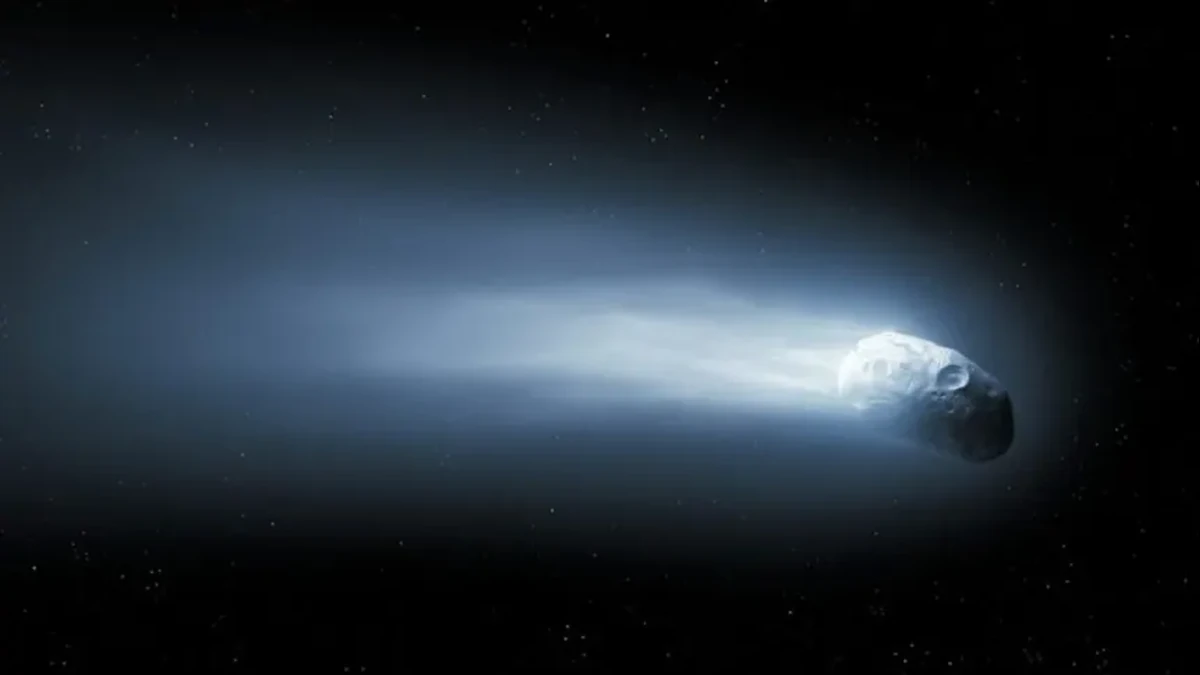
- Hubble Space Telescope: Photographed the comet on July 21, 2025, at 277 million miles from Earth, showing the comet's ice core surrounded by teardrop-shaped cloud of dust.
- James Webb Space Telescope:Observed 3I/ATLAS on August 6, 2025, and made its last observations on April 1, 2026.
- Mars orbiter: ESA's Mars Express and ExoMars Trace Gas Orbiter observed the comet as it flew past relatively close to the Red Planet in October 2025.
- Solar missions: NASA's Parker Solar Probe, SOHO, STEREO, and PUNCH observed the comet in the vicinity of the Sun.
- X-ray observations:ESA's XMM-Newton observed the comet in X-ray glow in December 2025.
One of the most interesting things about 3I/ATLAS is its unique chemistry. Using the Hobby-Eberly Telescope in Texas, astronomers observed very strong emission lines of neutral iron and nickel,
suggesting that those were emitted directly from the comet's nucleus in a metallic form. According to researchers, this makes a significant difference between 3I/ATLAS and other interstellar comets.
- Methane: Webb telescope was able to make the first direct detection of methane on an interstellar comet as per NASA's announcement dated June 4, 2026.
- Heavy water: According to a study led by the University of Michigan, the water in the comet contains unusually heavy deuterium, far exceeding the amount observed in the solar system.
- Methanol:Another study indicated extremely high amounts of methanol, implying that the comet originated from very different conditions than those prevailing in the solar system.
- Nitrogen: The WEAVE telescope indicated more nitrogen than usual in the comet, while the formation zone of the comet is estimated at below minus 240 degrees Celsius based on the temperature of the coldest known regions, far outside its own system.
In the early stages, unusual characteristics of the comet were also observed. According to research published in December 2025, jet structures in the sun-facing "anti-tail" of the comet were observed to wobble every 7 hours and 45 minutes.
This is the first observation of this sort of outgassing in an interstellar comet. Recent studies indicate that the gas flows from the comet much slower than expected.
The most recent result, produced this week by the team at SwRI, utilized the Webb telescope to look at the ice contained in the comet's coma.
They found that it consisted of dust-rich water-ice grains that had rocky components mixed into the ice; they claimed that the signatures resembled those of icy bodies beyond Neptune in our own solar system. The models pointed to 3I/ATLAS as having a dust-rich signature compared to the range.
This work provided a unique comparison between planet-forming material in other solar systems and our own. As the authors noted, future observations of interstellar visitors would help to decide whether 3I/ATLAS was an outlier or more common.
Interstellar comets are pieces of alien planetary systems, which makes them carriers of chemical signatures unavailable through any other channel.
Scientists have stated that the study of 3I/ATLAS may show conditions in the home solar system or on its journey through the cosmos. High levels of nickel, iron, and carbon compounds in 3I/ATLAS make it unique compared to 'Oumuamua and Borisov.
3I/ATLAS is already faint enough that it cannot be observed any further and will exit the solar system forever. NASA announced that all the data from its observation would continue being freely available to researchers and even more papers should come in the future as they go through the massive dataset.
Additionally, new observatories, including the upcoming Vera C. Rubin Observatory, are expected to discover additional interstellar objects in the coming years.
A year after 3I/ATLAS was discovered by astronomers, there is still a lot of information about this strange comet that contributes to the knowledge of worlds beyond our solar system.
The unique composition and dirty ice of 3I/ATLAS have generated many questions concerning the origin of such comets in other star systems.