- Jaishankar called out an unnamed "serial practitioner of terrorism" for misrepresenting facts at the UN, saying attempts to "normalise terrorism and claim immunity" from consequences "will not stand"
- He tied any future India-Pakistan goodwill to Pakistan ending its support for terrorism, saying "it is for the perpetrator of terrorism to mend its ways"
- India confirmed the Indus Waters Treaty stays frozen until Pakistan credibly and irreversibly stops cross-border terrorism
- Sharif's Friday speech had thanked Trump for "timely intervention" in last year's India-Pakistan clash, raised Kashmir, and called any diversion of the Indus rivers "an act of war"
- Separately, Jaishankar had a sharp, viral exchange with a Pakistani journalist on the sidelines
- India also exercised its Right of Reply after Sharif's address, as it has in past sessions
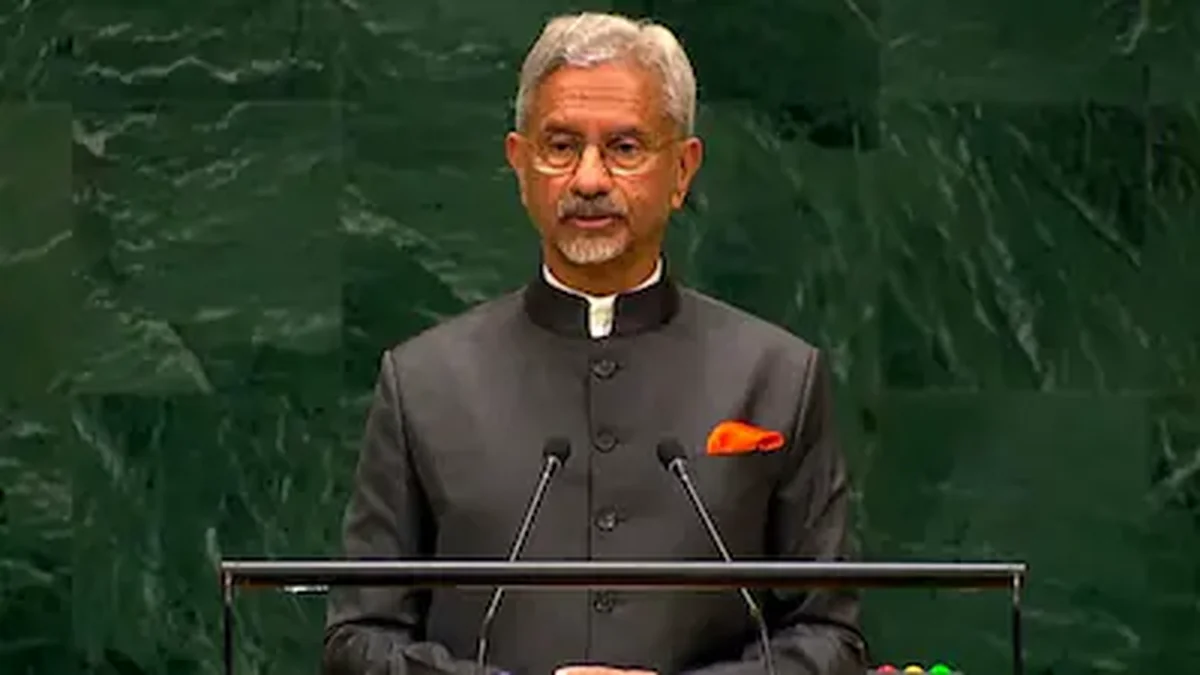
External Affairs Minister S. Jaishankar walked up to the UN General Assembly podium in New York on Saturday and, without once naming Pakistan, made it obvious who he was talking to.
"Yesterday, a serial practitioner of terrorism misrepresented facts before this Assembly," he said, delivering India's national statement at the General Debate of the 81st session. "Arguments were invoked to normalise terrorism and claim immunity from its consequences. That will not stand."
The line landed exactly a day after Pakistan Prime Minister Shehbaz Sharif used his own UNGA address to raise Kashmir, credit US President Donald Trump with defusing last year's India-Pakistan military clash, and accuse New Delhi of illegally holding the Indus Waters Treaty in abeyance.
Jaishankar didn't stop at pushback. He tied the entire future of India-Pakistan relations to one condition.
"Friendship and goodwill cannot coexist with terrorism," he said, adding that any understanding built on ignoring that reality "will naturally be called into question." The responsibility for change, he said, sits with the country doing the exporting: "It is for the perpetrator of terrorism to mend its ways."
He described terrorism as a threat that fuses bigotry, intolerance and violence, and said its state-backed, cross-border form amounts to a direct affront to the global order. India's own right to defend its citizens, he told the Assembly, isn't up for negotiation.
A few things stood out in how India framed its position this year:
- The Indus Waters Treaty stays in abeyance until Pakistan credibly and irrevocably ends support for cross-border terrorism, not as a bargaining chip but as a precondition
- Jaishankar avoided naming Pakistan directly throughout his speech, a rhetorical choice that let the "serial practitioner" line do the work instead
- He connected the terrorism argument to a broader push for reformed multilateralism, describing a world moving toward multiple centres of power rather than one
- He closed by invoking Mahatma Gandhi's words inscribed outside the UN building, that there is no way to peace, peace itself is the way
Sharif's Friday address leaned heavily on the events of May 2025, when a four-day military confrontation between the two nuclear-armed neighbours ended in a ceasefire. He thanked Trump for what he called timely intervention and repeated Islamabad's long-standing demand that the Indus Waters Treaty be treated as fully binding, calling any diversion of the rivers an act that Pakistan would treat as war.
He also raised Kashmir, a subject India considers entirely internal and non-negotiable at any international forum. New Delhi's foreign ministry has previously dismissed similar claims from Islamabad as political theatre designed to distract from its record on sponsoring militant groups, and this year's response followed the same script, just delivered with sharper language.
Away from the main hall, Jaishankar also found himself in a testier, unscripted exchange. Pressed on terrorism by a Pakistani journalist on the sidelines of the session, he shot back with a line that quickly went viral across Indian television, effectively asking why a country accused of harbouring terrorists was the one posing the question. Indian commentators and former diplomats spent the following day dissecting the moment, treating it as almost as telling as the formal speech itself.
India also used its Right of Reply after Sharif's address, a procedural tool the country has leaned on in each of the last several UNGA sessions to rebut Pakistani statements point by point on the record.
Nothing announced this week changes the practical reality on the ground. The Indus Waters Treaty remains frozen, diplomatic channels between the two countries stay minimal, and both sides used the world's biggest diplomatic stage mainly to restate positions their publics already expect from them.
What's different this year is the bluntness. Jaishankar's "will not stand" language and his explicit refusal to let any future thaw happen without a change in Pakistan's approach to militancy set a tone that leaves very little room for the kind of ambiguity past statements sometimes carried.