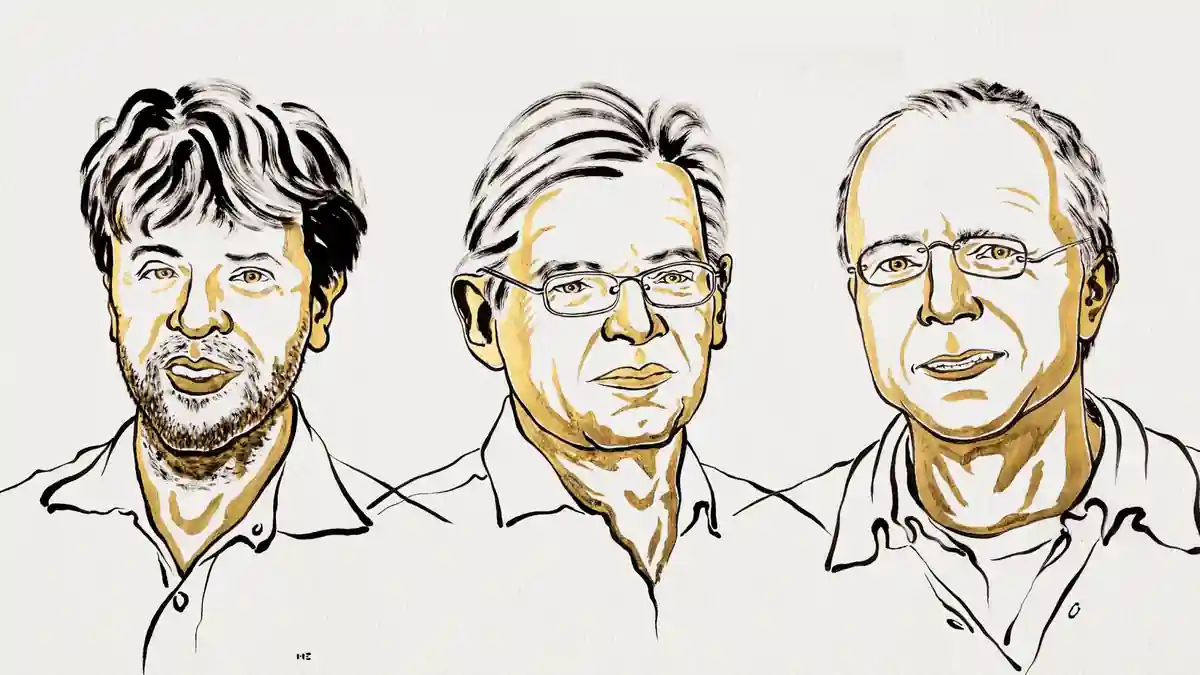
The 2026 Nobel Prize in Physiology or Medicine goes to Karl Deisseroth, Peter Hegemann and Georg Nagel for optogenetics, the Karolinska Institutet announced in Stockholm on Monday. The citation credits "discoveries concerning light-gated ion channels and optogenetics." Prize money is 12 million Swedish kronor, around $1.2 million, shared three ways.
Deisseroth is a psychiatrist at Stanford University and an investigator at the Howard Hughes Medical Institute. Hegemann teaches neuroscience at Humboldt University in Berlin. Nagel, 73, is a biophysicist at the University of Würzburg.
Take a gene for a light-sensitive protein, get it into a neuron, shine light on the neuron. It fires. Depending on the protein, you can also make it go quiet. Only the cells carrying the gene respond, which means a researcher can target one cell type inside a living brain and leave everything next to it alone. Timing is down at the millisecond level.
The Nobel Assembly called the work a "molecular switch for nerve cells," according to AFP. Per Svenningsson, who chairs the medicine committee, said it has given scientists a way to map the brain that they could once only have dreamed of.
Deisseroth heard first. It was past midnight in California and he had just lain down after working late on a paper. Thomas Perlmann, the committee's secretary, made the calls and said Deisseroth was clearly asleep when he answered. Deisseroth told STAT the call was unexpected and, of course, delightful.
Nagel's surprise was obvious, the Nobel Prize website says.
The committee reached all three, which doesn't always happen. Perlmann said that when each man heard who he was sharing the prize with, the reaction was close to identical. They called the other two friends. By the time Deisseroth spoke to STAT he hadn't yet talked to either of them, but he described years of co-written papers, family introductions and beers at meetings.
Everything traces back to a green alga. Chlamydomonas is a single cell, and it swims toward light. Hegemann wanted to know how. STAT dates that work to the early 1990s at the Max Planck Institute, though the key results came later.
Nagel joined him, and between them they found a protein in the cell membrane called channelrhodopsin. Blue light opens a channel in it. Charged ions flow into the cell and produce an electrical impulse. Then they put the protein into other cells, and it kept working. Whatever cell they chose turned light sensitive. Hegemann, Nagel and Ernst Bamberg showed this in frog egg cells around 2002 and 2003.
Deisseroth took it from there. He put the gene for channelrhodopsin into nerve cells from rats, shone blue light on them, and got nerve signals on demand. He published that in 2005. Two years later the same trick was running inside the brains of living mice.
Why that counted for so much: until then, neuroscience mostly watched. You could record which cells were active while an animal did something, and you could guess at cause. You couldn't easily prove it. With the light switch, a lab can turn on a specific cell population, see what the animal does, turn it off, see again.
Deisseroth made the same point to STAT. Light has been a tool for collecting information, he said, and in this case it is used to make things happen.
Hundreds of labs use it. Researchers have used optogenetics to trace circuits behind memory, fear, addiction and movement, and the Nobel Assembly said it has exposed circuits tied to feelings and behaviors that matter in neurological and psychiatric disease.
Clinical use is early. Teams are trying it to bring back some vision in people who have lost the rods and cones in their retinas but still have other healthy retinal cells. Make those cells light sensitive, the thinking goes, and they can send a signal up the optic nerve. Svenningsson also pointed to cochlear implants, where light could stimulate the auditory nerve more precisely than electricity does now. Parkinson's disease and epilepsy are down as maybe, someday.
No treatment yet. That's the honest summary.
Nobel statutes allow three laureates per prize, and the field has had more than three architects. Bamberg worked on the early channelrhodopsin experiments with Hegemann and Nagel. Ed Boyden and Gero Miesenböck have shared earlier honors with the winners, among them the 2019 Warren Alpert Foundation Prize. Deisseroth and Hegemann took the Lasker Award together in 2021, which many treat as a Nobel signal.
Deisseroth pointed to the wider group himself. A lot of problems had to be solved, he said, and students and collaborators in many labs did much of the solving.
Physics is announced Tuesday, chemistry Wednesday, literature Thursday. The peace prize follows on Friday in Oslo and economics closes things out on October 12. Winners collect their medals in Stockholm on December 10. The medicine prize has now gone to 235 people since 1901, 14 of them women.