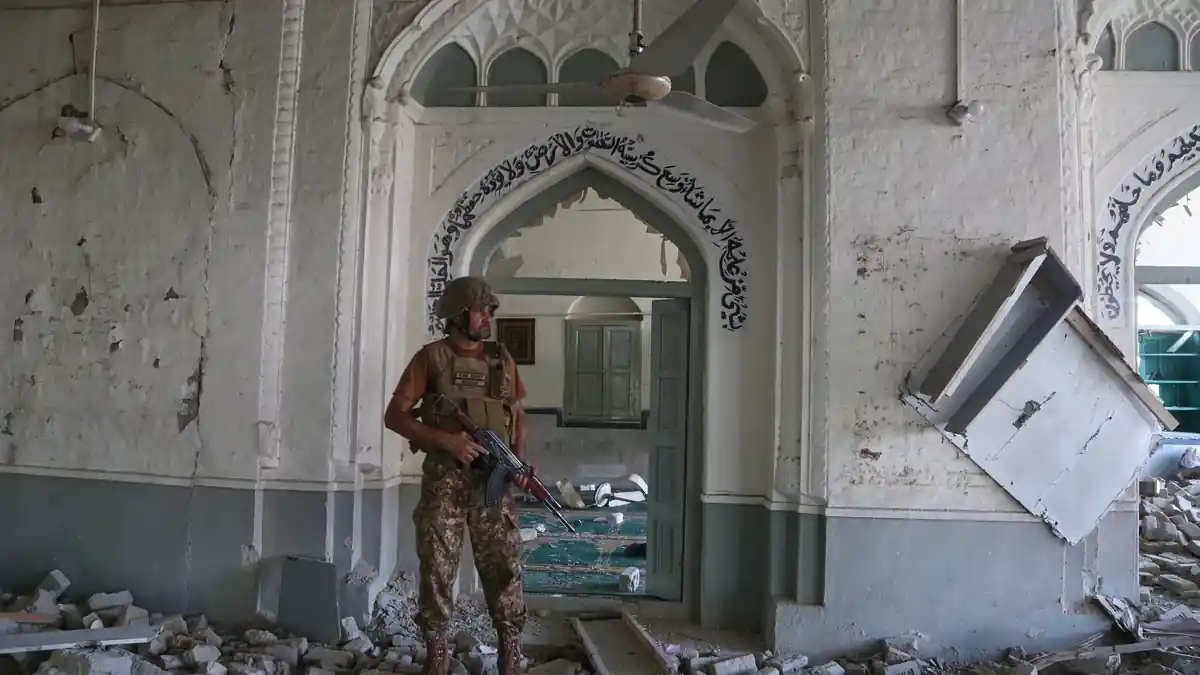
The wall came down first. Then the crater. Then, according to police, seven armed men tried to push through the smoke into the compound, making for the Counter Terrorism Department building and the Special Branch office.
A gun battle followed. It ran long enough for six of the attackers, the original bomber included, plus a sniper who'd taken position somewhere in the chaos, to end up dead by the time officers regained control.
The numbers still won't sit still.
Pakistani police say 16 confirmed dead, five of them officers, more than 50 wounded. Rescue 1122 in Khyber Pakhtunkhwa says 15.
Reuters is reporting 16 dead and 57 wounded. AP has it at 21 dead, 80 wounded, sourced differently again. By the time Al Jazeera filed hours later, the count had climbed to at least 27, fifteen police officers and six civilians among them. None of this is strange, actually. First-day numbers after an attack like this rarely hold. Give it a day, maybe two, before anyone treats a figure as final.
Usually one group claims an attack like this within hours and that's that. This time two did, and their stories don't fully line up.
Al Jazeera reported a Tehrik-e-Taliban Pakistan faction took credit. Separately, a group calling itself Ittehad-ul-Mujahideen, roughly "alliance of holy warriors," claimed the same operation, saying it was run by commanders loyal to Hafiz Gul Bahadur, a Taliban-aligned figure with a long record along the Afghan border. Reuters, meanwhile, reported that as of its own filing, nobody had claimed it yet.
Worth knowing why that split doesn't matter as much as it sounds. Ittehad-ul-Mujahideen only came together last year, and most analysts treat it less as its own organization and more as an umbrella that several TTP factions operate under when it's convenient. Whichever name ends up in the history books, it probably doesn't change who built the bomb.
Kohat sits close enough to Afghanistan that attacks here rarely stand alone. This one landed a day after a roadside bomb killed six Pakistani soldiers in a convoy in nearby Hangu. Analysts who watch this stretch of border don't read that as coincidence.
Michael Semple, who's negotiated with the Afghan Taliban before and now teaches at Queen's University Belfast, told Al Jazeera that an operation with this much planning and logistics doesn't come together inside Pakistan alone. His view, which lines up with what Pakistani officials have argued for years, is that the Afghan Taliban keeps giving both al-Qaeda-linked networks and various TTP factions room to prepare attacks like this one.
Islamabad has said some version of that for years. Kabul has denied it just as consistently, for just as long.
The two governments have traded cross-border strikes on and off as things have soured between them, and nothing about Friday's bombing looks likely to slow that down.
Zulfiqar Hameed, the Inspector General of Police for Khyber Pakhtunkhwa, went to Kohat himself to run the response alongside the Additional IG of Counter-Terrorism. More than 40 rescue workers and 14 ambulances got sent in.
The wounded went to Kohat's District Headquarters Hospital, which declared an emergency once the casualties kept coming.
Hameed didn't hold back afterward.
He called the Khyber Pakhtunkhwa police a "wall of steel" against terrorism, said morale wouldn't crack, and promised that the blood of those killed wouldn't go to waste. Anyone who helped plan or carry it out, he said, would face consequences.
Condemnations rolled in fast after that. Khyber Pakhtunkhwa Chief Minister Sohail Afridi asked police for a full report. Punjab Chief Minister Maryam Nawaz Sharif put out her own statement.
Saudi Arabia and Jordan both condemned it too, which is close to automatic whenever an attack hits a mosque specifically.
Here's what's solid right now. A suicide car bomb hit a mosque inside a police compound. A gun battle followed. Somewhere between 15 and 27 people are dead depending on which agency you believe.
Two militant groups both want credit for it.
What isn't solid yet is the final death toll, or whether Islamabad does anything beyond issuing the same statements it's issued after nearly identical attacks on this same border, more than once already, in recent memory.