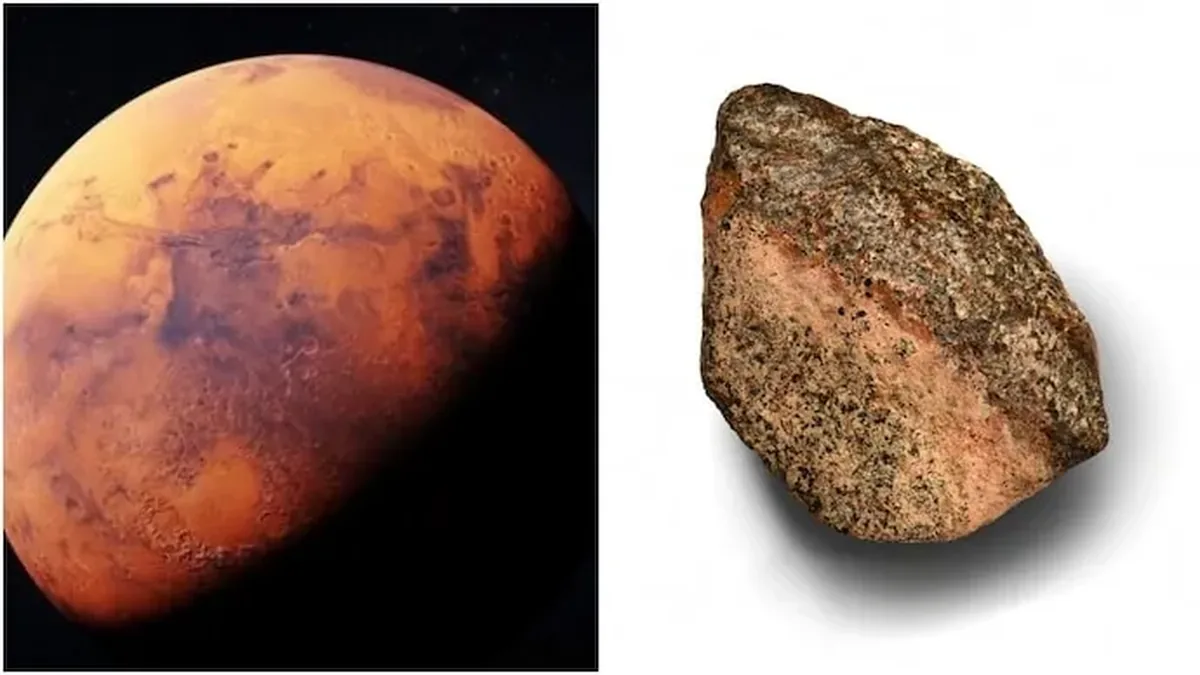
Some of the best science of the year was sitting in the sand of the Sahara. Nomadic meteorite hunters picked up a strange stone in 2022, and early checks showed it came from Mars. Then came years of slicing tiny pieces off it to work out what it actually was.
The headline number is the age. The team dated zircon crystals in the rock with uranium-lead methods and got about 4.11 billion years. A separate rubidium-strontium test came out older, about 4.24 billion years, though less precisely. Either way, the rock formed no later than around 4.1 billion years ago, in the earliest chapter of Martian geology.
That’s remarkable because of the kind of meteorite it is. Teghaza 001 is a shergottite, the most common class of Martian meteorite, and most shergottites are just a few hundred million years old. On first look, nobody thought it was anything special.
The second discovery is the one that gets planetary scientists talking. Yang Liu and her colleagues found the rock had been altered by Martian water around 4.1 billion years ago, which suggests it formed even earlier. Oxygen isotopes, texture and chemistry all point toward a more dynamic water cycle on early Mars than many models assume.
Other analysis adds a twist. Hydrogen trapped inside the rock suggests that even when it formed, Mars was already losing much of its atmosphere and sliding toward its cold, dry state. So this wasn’t a stable wet world. It was a wet world on its way out.
The team can’t pin it to a single spot. NASA says its volcanic minerals and zircon crystals match terrain in several locations in Mars’s southern highlands. The researchers narrowed it to 13 candidate sites. They also don’t know when the rock reached Earth.
It’s a useful reminder that meteorites are a lopsided sample. Two older specimens exist: ALH 84001, found in Antarctica, and a group of fragment-filled rocks that includes Northwest Africa 7034. Teghaza 001 is different from both. It’s a single clean rock type, not a jumble of pieces, which makes it easier to interpret.
Nothing here proves Mars ever had life. But a rock that old, with water in its history, is exactly what scientists wanted for pushing the timeline back. One reviewer of the paper called it a Rosetta Stone for Mars. Earlier ancient meteorites gave narrow views, and this one shows how the crust cooled from magma and was later changed by water.
For the next step, samples from Mars itself would settle a lot of arguments. Until those come back, rocks that fell from the sky into a Saharan salt flat are doing the job.