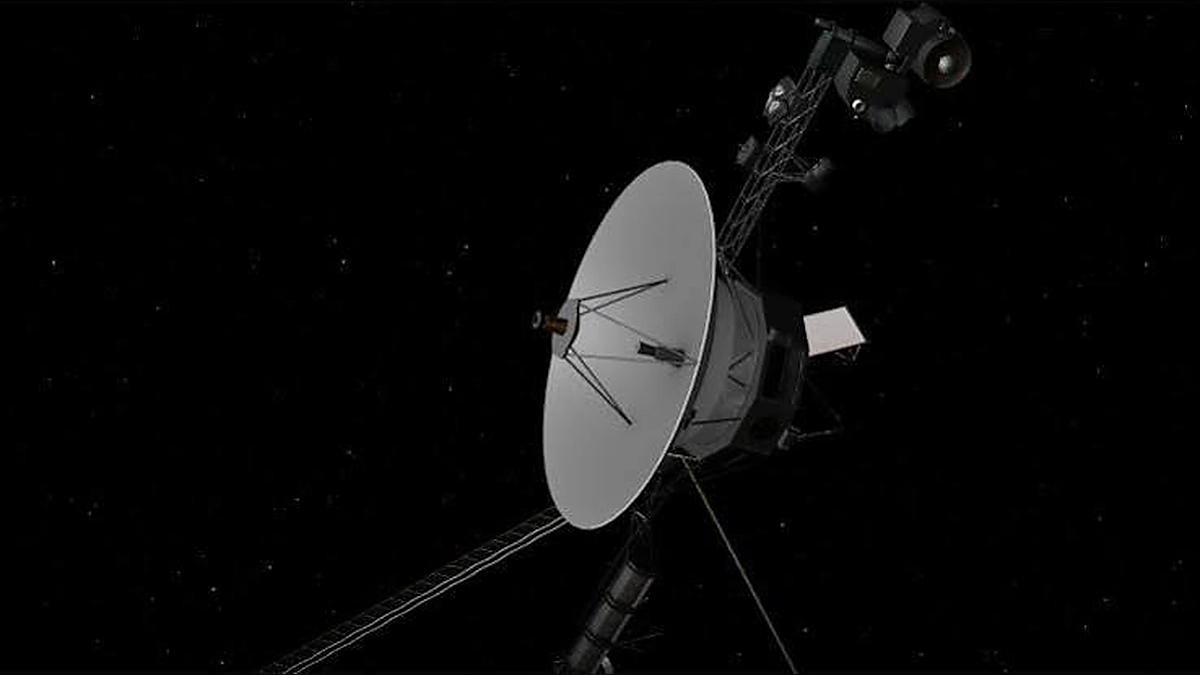
NASA's Voyager 1 spacecraft reached one light-day from Earth on November 18, 2026, becoming the first human-made object to travel this far from our planet. The milestone came after more than 49 years of continuous travel through space.
According to NASA, Voyager 1 was about 16.1 billion miles (25.9 billion kilometres) away from us at the point it passed this mark. Radio messages now need about 24 hours to reach us from this spacecraft.
This marks an extraordinary accomplishment in space exploration because it shows just how far man-made technology can reach into the far-off expanses beyond our local area of space.
A light-day is a measure of distance rather than time. It is the distance that light travels through a vacuum in 24 hours, about 16.1 billion miles.
Light travels at a speed of about 299,792 kilometres per second. While this is an extremely fast speed, Voyager 1 is so far away now that it takes a whole day for a message traveling at the speed of light to reach it.
This means that there is a considerable time lag in communications too. If any commands are issued to Voyager 1, there will be a wait of about 24 hours before they are received. There will be a further wait of 24 hours for their answer to be received.
The launch of Voyager 1 took place on September 5, 1977, within the framework of NASA's Voyager program together with its sister craft, Voyager 2.
The initial mission involved the study of the outer planets of our Solar System. The spacecraft carried out significant flybys of Jupiter and Saturn, acquiring crucial pictures and data about those planets and their moons.
Having finished its study of the planets, Voyager 1 continued traveling towards outer space. It passed the heliopause – the border between the protection of the solar wind and magnetic fields provided by the Sun and interstellar space – on August 25, 2012.
It became the first man-made object to enter that area of space. Voyager 2 made it in 2018.
In spite of all the success mentioned above, the spacecraft faces technical problems connected with its aging equipment.
As reported by NASA, the spacecraft stopped sending science and engineering data on November 14, 2026. But it continued to send carrier signals which proved that communication with the spacecraft wasn't lost completely.
Engineers managed to use the carrier signals along with trajectory calculations to prove that Voyager 1 has reached the one-light-day mark.
Scientists have already started looking into the problem and trying to establish the transfer of scientific data again. The large distance makes troubleshooting hard as each command and answer takes about a day to reach the Voyager.
Voyager 1 also contains one more thing other than scientific equipment: the Golden Record.
The gold-plated copper record contains sounds, music, images and greetings, symbolising human civilisation and life on the Earth. It was created as a message for any advanced extraterrestrial civilisation that could discover the spacecraft someday.
It contains natural sounds, greetings in different languages and samples that should describe mankind and our planet somehow.
Though there is still uncertainty whether another civilisation will ever find it or not, Golden Record is one of the boldest attempts made by mankind to say something to others.
Voyager 1 will keep traveling even further into the interstellar space while its scientific instruments will work using ever diminishing power sources.
The spacecraft uses a radioisotope power system which converts heat resulting from the decay of plutonium into electrical energy. The power source diminishes slowly but still the engineers have to turn off some devices and find ways of conserving energy to prolong the mission.
NASA's work on preserving the spacecraft is evidence of how crucial the long-term engineering and ageing technology management are.
At the same time Voyager 2 is traveling in interstellar space. It is forecasted to get to the one-light-day away from the Earth point in November 2035.
It is not just a record of distance. It shows the immense size of the universe and limits of the human space flight.
In less than five decades, the spacecraft has covered a distance of approximately 25.9 billion kilometers, but it still hasn't reached any other star system. NASA has projected that it will take about 18,000 years for the spacecraft to travel a single light year in its current velocity.
The journey of Voyager 1 is an illustration of scientific curiosity, technological advancements, and determination of scientists from several generations, which managed to keep the spacecraft operational after achieving the initial mission goals.