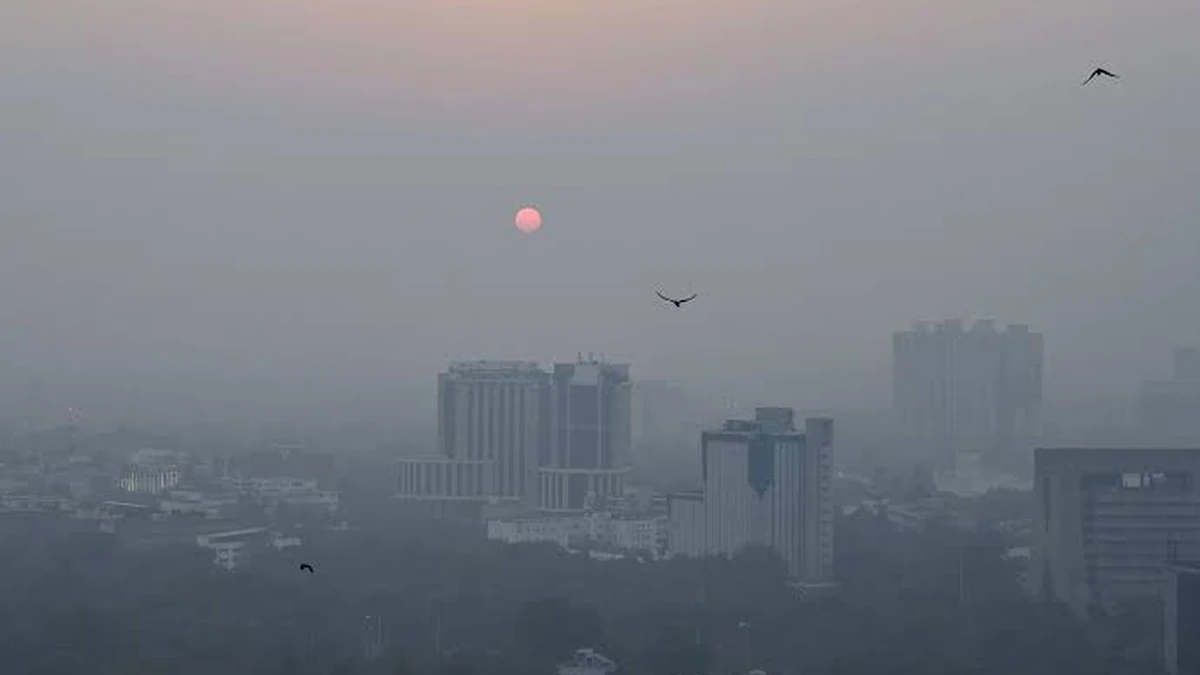
The AQI for the city dropped to "severe" level on Diwali morning on Sunday, November 8, 2026, when the AQI stood at 483 at 8:10 a.m., as per CPCB. The rise was very sharp, as the AQI on Saturday morning at 8 a.m. was recorded as 364 in the "very poor" category. It should be noted that Stage III of GRAP was already in effect in the city.
CPCB defines AQI between 0-50 as good, 51-100 as satisfactory, 101-200 as moderate, 201-300 as poor, 301-400 as very poor and 401-500 as severe. An overall AQI reading of 483 is close to the upper limit of the scale.
Commission for Air Quality Management (CAQM) declared stage III of GRAP applicable on Friday, November 6, two days ahead of Diwali, for Delhi and neighboring areas of Haryana, Uttar Pradesh and Rajasthan.
It was an anticipatory action based on the forecast by the India Meteorological Department and the Indian Institute of Tropical Meteorology to impose restrictions before the city reached the severe category of AQI.
As per ANI, Stage III entails more stringent vehicle restrictions, ban on construction work and hybrid model for primary schools.
Stage IV is imposed when the air quality falls under "severe plus" category over 450 and brings about more restrictive actions. As Delhi's overall AQI was over 450 on Sunday morning, there is possibility of declaring Stage IV, which I could not locate in any report.
The Supreme Court order dated October 29, 2026, stipulated that only green firecrackers could be used on November 7 and 8, and that these must only burst between 6 am and 7 am and 8 pm and 10 pm, says MaargX UPSC Current Affairs.
While green firecrackers release about 30% less pollutants compared to the regular type, the same regulations failed to stop a haze-filled morning after Diwali in 2025, during which 36 out of 38 stations fell in the red category, as per Gulf News.
Please note that this Sunday morning reading was recorded before the evening firecracker slot; thus, emissions due to the Diwali celebrations of the previous night had yet to arrive. The sources I could find do not explain the reasons for this spike other than the fact that the season is winter and that the dispersion level is low.
The Diwali air quality in Delhi is usually very poor. Some of the past 24-hour average levels measured on the Diwali Day include 218 in 2023, which was the best in eight years, and 339 at 9 a.m. in 2025.
The reading of 483 that has been registered this Sunday morning is much higher than these two levels although the two sets are not directly comparable because the former is a 24-hour average level while the latter is measured during the early morning.
The period between mid-October and mid-November is usually the most challenging for Delhi-NCR due to stubble burning, motor vehicle emissions, colder temperatures, and festival fireworks.
Some general health guidelines usually recommended during such periods are as follows:
- Minimize outdoor activities: Avoid outdoor physical exercise, particularly during the early morning hours and evenings when pollution is high.
- Take care of susceptible persons: Children, senior citizens, and individuals suffering from respiratory and heart conditions should be careful.
- Wear masks: Using masks like N95 or FFP2 is helpful in reducing exposure to small particles while outside.
- Close windows:Use air cleaners indoors if available.
The authorities will monitor the evening air quality post firecrackers and further deterioration on Monday.
CAQM may go up to stage IV if there is any worsening of the situation, and the Early Warning System would be issuing alerts accordingly. The weather condition, especially wind speed, will decide the dispersion rate of pollutants after the festivities.