
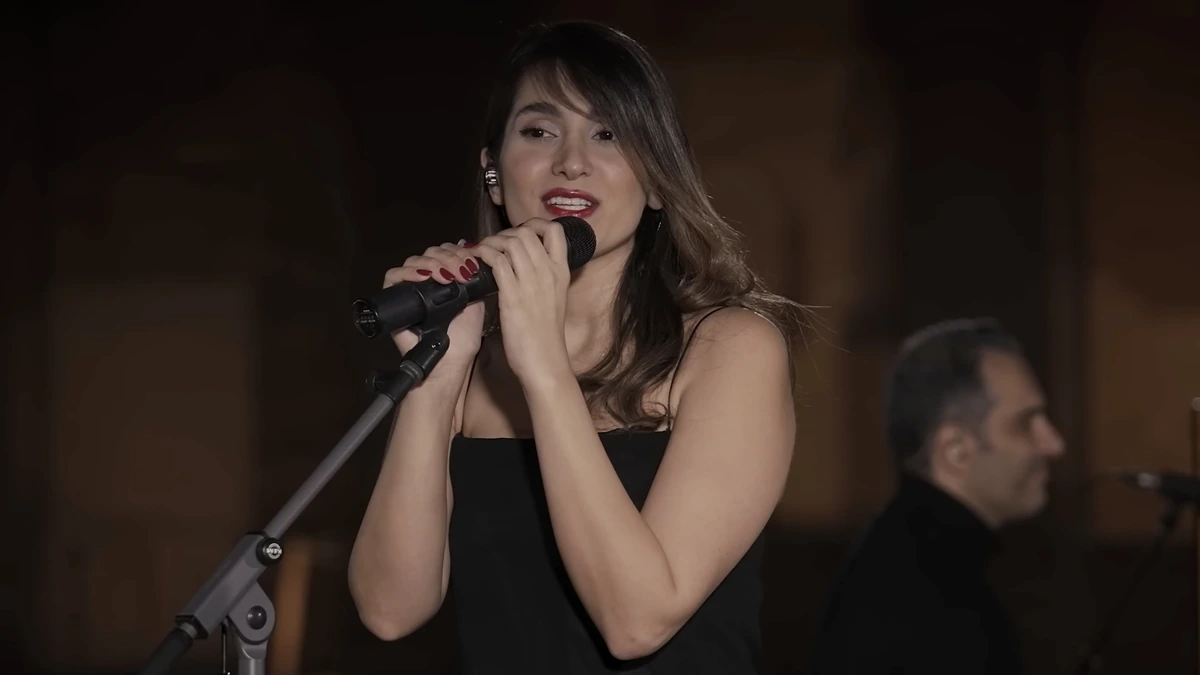
One of the defense lawyers told the BBC that Ahmadi, three musicians, and a producer had been flogged at the third branch of the Criminal Sentence Enforcement Office in the central city of Qom. The five also received two-year bans on leaving Iran and on artistic and musical activity, in addition to the lashes.
The reports depend a lot on the defense team. Mostafa Nili, a lawyer, reported the flogging in the pro-reformist outlet Emtedad.
This performance is dated December 2024. In the video, which was not performed live, Ahmadi sings in a long black sleeveless dress, with her hair uncovered, alongside male musicians.
Radio Free Europe/Radio Liberty said the video has been viewed 2.9 million times in two years.
The Iranian state was quick to respond.
The judiciary-affiliated Mizan News Agency said a case had been opened shortly after the video appeared over what it called a “illegal concert” that did not comply with the country’s legal and religious standards. Ahmadi and eight others were found guilty by a Qom criminal court in June of offending public decency by publishing obscene and indecent material, charges the defendants denied.
The two rules are at the heart of the case. Iran bans women from performing solo, and the law requires women to wear the hijab in public. Al-Monitor has reported that compliance with the head-covering laws is declining, but officials have said they want to ramp up enforcement during the war.
Rights groups condemned the sentence. Amnesty International, which last year accused Iranian authorities of increasingly using flogging against singers, journalists, and women’s rights activists, calls flogging cruel, inhuman, and degrading.
It urged Iran in October to drop the planned sentences.
Dadban, a group of volunteer lawyers outside Iran, said flogging is a torture that cannot be justified. Bahar Ghandehari of the Center for Human Rights in Iran said it was a violent attempt to suppress women’s freedoms.
It was also a political answer. Iran's exiled Crown Prince Reza Pahlavi's office condemned the flogging, saying the Islamic Republic was afraid of women's voices. Mahmood Amiry-Moghaddam, of Iran Human Rights, slammed the government for its punishment of women while turning a blind eye to the economic and infrastructure crises.
Iranian authorities have not immediately commented on the reported execution of the sentences.
That leaves the state’s public position based on its earlier statements in which the performance was an unlicensed concert that violated legal and religious norms.
Some details differ between outlets.
How many flayed, how many sentenced? Ahmadi and eight of her production team members were sentenced to 74 lashes, National Reports. Five others were caned on Monday. The status of the other four defendants is not reported.
Live stream or video. A concert that was live streamed by the BBC and Amnesty A video was posted on YouTube, Al Jazeera said. Some Indian outlets are calling it a "YouTube concert." Pahlavi’s office calls it a “virtual concert." The descriptions overlap but are not identical.
The charge. The wording changes in translation: “offending public decency,” “hurting public decency," and “outraging public decency.” It says it is “producing and publishing obscene and immoral content online. It seems they are talking about the same conviction.
who was whipped along with her. Al-Monitor refers to them as bandmates and associates. BBC names three musicians and one producer.
For rights groups, the case is an example of a state cracking down after a long period of looser enforcement. For Iranian officials it’s the application of existing law, as the Mizan statement implies.
The coverage reflects both readings, and the facts underlying both, the conviction and the lashes, are the same.








Comments 0